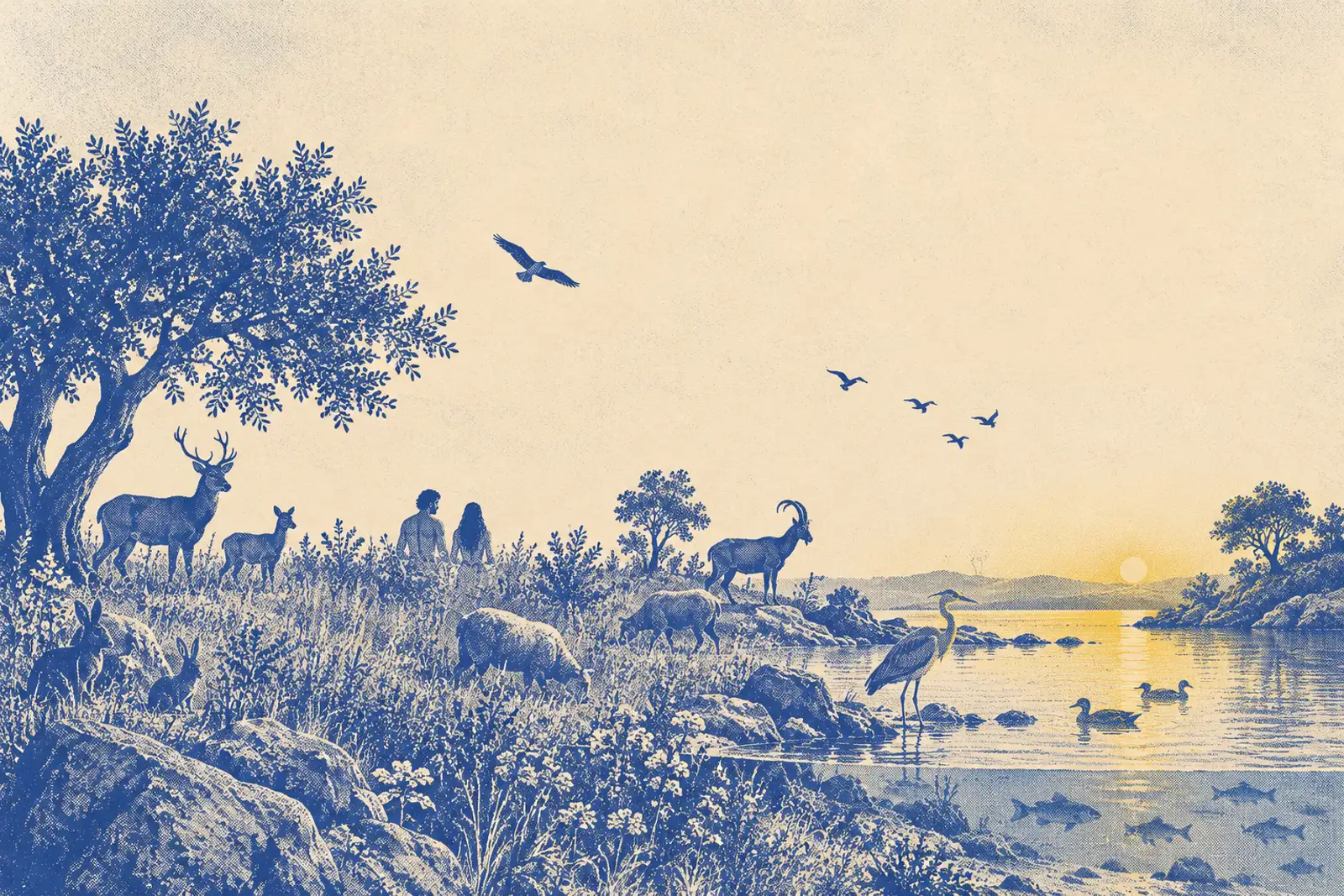
And God looked upon all that He had made, and indeed, it was very good. And there was evening, and there was morning—the sixth day.
Genesis 1:31 (BSB)
EU•AN•GE•LION (YOO-AN-GEL-EE-ON) · εὐαγγέλιον — Good News
EUANGELION is a product of WokeGod LLC. Copyright © 2026 WokeGod LLC. All rights reserved.v0.8.39TermsPrivacyCookie PolicyCommunity GuidelinesContent Disclaimer
EU•AN•GE•LION (YOO-AN-GEL-EE-ON) · εὐαγγέλιον — Good News
Return to the first word, the difficult sky, the unnamed lights, the life in the waters, and the image shared by humanity. The questions stay open where the evidence stays open; the story’s Creator remains clear.
Genesis 1:1-31; Revelation 21:1-5; John 1:1-5; Colossians 1:15-20
Opening
And God looked upon all that He had made, and indeed, it was very good. And there was evening, and there was morning—the sixth day.
Genesis 1:31 (BSB)
At the close of the sixth day, God looks upon all that has been made and calls it very good. We have spent five readings looking closely at the words and images that bring us here: the beginning and the creating verb; the raqia and the waters; the lights and their work; the creatures that teem; and the humans made in God's image. This verse gathers the whole scene into one affirmation. (Scripture: Genesis 1:1–31, BSB.)
The phrase bara brought us to a grammatical question, not a shortcut. The sky word kept a scholarly debate open. The lights were named by their functions. The phrase nephesh chayyah crossed the line between animal and human scenes. The image claim included male and female and led into a bounded vocation. Today, we bring these observations together without adding a new theory.
REFLECT
Which word or image from the five readings stayed with you most clearly?
A Short Prayer
Creator God, thank you for a world made and called good. Keep us curious where questions remain and faithful to what your words say. Let our reading lead us toward Jesus, through whom all things were made. Amen.
IN YOUR OWN WORDS
Five Things to Carry Forward
1. The opening word invites careful reading. Genesis begins with bereshit, often translated “in the beginning.” Its syntax has drawn more than one analysis. We learned to separate the question about the first phrase from what the whole sentence clearly says: God creates the heavens and the earth. Benjamin Kantor's accessible article record supports the traditional reading as grammatically viable; the full article remains under embargo, so we did not rely on its inaccessible text. (S1, S19.)
2. The sky word leaves a real question. Genesis says God makes the raqia, separates the waters, and calls it sky. Seely argues for a solid firmament; Davidson and Younker challenge that view. Our reading did not turn either translation choice into a settled dictionary proof. It let the text's action remain clear while naming the scholarly disagreement. (S18, S22, S31.)
3. The lights are given work. Genesis calls them greater and lesser lights, gives them the role of marking time, and does not use the usual Hebrew words for sun and moon in these verses. The Met tablet belongs to Enuma Anu Enlil, and ORACC identifies that work as an omen series. The map is a modern regional orientation marked 1400 BCE. Neither object dates Genesis or proves direct dependence. (S7, S16, S20, S23, S30, S32.)
4. The waters teem with living creatures. The Hebrew phrase nephesh chayyah appears in the creature scene and again when the human becomes a living being. The phrase is not exclusive to animals, and the shared wording does not erase the different scenes or the human image-bearing vocation. John uses Greek ζωή (zōē) for life; that word is not a translation of the Hebrew phrase. Christians connect the passages through the canon, not by pretending their vocabularies are identical. (S24–S25, S33–S35.)
5. The image and the commission belong together. Genesis includes male and female in the image statement, then speaks of rule and subduing within blessing and provision. We named scholarly interpretations as interpretations. We read Christ as the image of the invisible God through Colossians, a Christian connection that informs our understanding without replacing Genesis's own Hebrew terms. (S5, S8–S9, S26, S36–S37.)
Across the chapter, God speaks, separates, names, blesses, gives, and sees goodness. The six-day pattern of ordering and filling is useful as a lens, but it is not a hidden chart we have to impose on every line. It helps us notice how the account moves from spaces to their contents. (S6; Scripture: Genesis 1:1–31, BSB.)
The main questions remain available for further study. How should the first clause be parsed? What sky picture does raqia evoke? How did Genesis relate to other ancient texts? What does the image of God mean in full? Our sources allowed us to say what they support and stop where they do not. Curiosity does not demand that we pretend uncertainty has disappeared.
If you want to keep reading, take one question at a time. Begin with the passage itself in two or three translations from the checked-in corpus. Mark what stays the same and what changes. For the first word, compare the Hebrew morphology with Kantor’s accessible article record, keeping in mind that its full text is embargoed. For the sky word, read the exact lines from Seely beside the published counterargument by Davidson and Younker. Write down where each author makes a claim and what evidence that author uses. The goal is not to pick a side after one paragraph. It is to understand what is being argued. (S1, S18, S19, S22, S31.)
For the ancient context, look first at the museum record, then at the tablet image, then at ORACC’s classification of Enuma Anu Enlil. Ask what the object record establishes and what it cannot tell you about Genesis. Keep the map beside it only as regional orientation. Its label says 1400 BCE; that date belongs to the modern map’s subject, not to Genesis. Compare Genesis with other ancient texts only after you can describe both their similarities and differences. That method keeps comparison specific. (S16, S20, S23, S30, S32.)
For the Hebrew phrases, place Genesis 1:20 next to Genesis 2:7. Read the morphology before you decide how to explain nephesh chayyah. Then read John 1:1–5 and Colossians 1:15–20 in the checked-in Greek and English corpus. Keep the Hebrew and Greek words in their own columns. The Christian link is in the canonical reading: the New Testament places Christ in relation to creation, life, and the image of God. It is not a claim that the words are interchangeable. (S24–S25, S33–S35.)
Finally, go back to Genesis 1:26–30. Read the command to rule beside the blessing, the image statement, and the food provision. Then consult the two named scholarly readings in the source list. Record which sentences are the text, which are an interpretation, and which are your application. You can keep an open question without losing the passage’s clear claims. That is how study can remain both rigorous and full of wonder. (S5, S8, S26, S36–S37.)
The story also has a long horizon. Genesis begins with creation. John says that all things came into being through the Word and names life and light in him. Colossians calls Christ the image of the invisible God. Revelation ends with a vision of a new heaven and earth and God dwelling with people. Christians read this as a creation story moving through Christ toward renewal. That is the Bible's canonical arc, not a claim that every detail of Genesis predicts a later verse. (Scripture: John 1:1–5; Colossians 1:15–20; Revelation 21:1–5, BSB; S9, S34–S35, S38.)
Tomorrow's reading is short. It will stay with the seventh day: God ceases from the work of creation, blesses the day, and makes it holy. For now, carry this: the world in Genesis is not self-made. It is spoken into being, filled with life, and called good by its Maker.
TAKEAWAY
I will keep one question open and one clear claim from Genesis 1 close.
REFLECT
What is the one creation claim you now hear with more wonder and care?
Finished reading? Mark this day read.
BEFORE YOU GO
Anything you want to keep from today?
EUANGELION is a product of WokeGod LLC. Copyright © 2026 WokeGod LLC. All rights reserved.v0.8.39TermsPrivacyCookie PolicyCommunity GuidelinesContent Disclaimer