HOW TO READ · 2026-08-22
The day's guides
Practice
The Psalms, Out Loud
The Psalms were noise before they were text, and they still work best at the speed of breath.
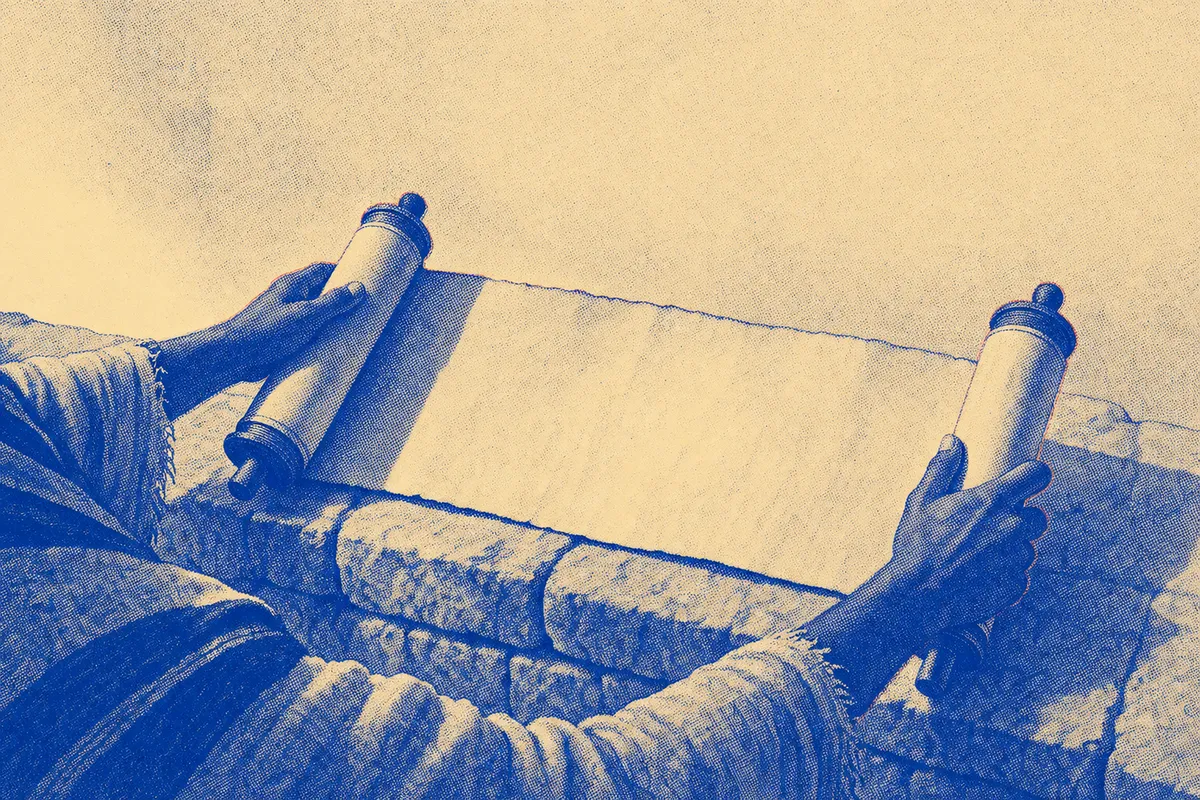
For most of their history, the Psalms were noise. They were sung in the temple, chanted in monasteries, muttered by shepherds, shouted by the drowning. The silent, private reading we default to is the historical oddity. A psalm on a page is sheet music; you can study it that way, but you haven't heard the piece.
Reading aloud changes the pace first. Your eyes can take in a psalm in forty seconds and leave nothing behind. Your mouth cannot. Speech is held to the speed of breath, and breath is roughly the speed at which a person can actually mean something. Lines you have skimmed a hundred times will stop you mid-sentence, simply because you had to say them.
You will also start to hear the architecture. Hebrew poetry rhymes thoughts rather than sounds: the second line of a couplet answers, sharpens, or overturns the first. 'He makes me lie down in green pastures; he leads me beside still waters.' On the page that looks like repetition. In the ear it is a rhythm, one idea breathing in and out. The form was built for the voice, and it only fully works there.
Yes, it feels strange at first. Close a door. A whisper counts; so does reading to the steering wheel. The awkwardness fades in about three days, which is roughly how long it takes for the psalm to stop sounding like a text you are studying and start sounding like something you are saying.
Stay with one psalm for a week before moving on. By Thursday you will notice its phrases turning up unbidden — in traffic, at the sink. That is the whole aim. The psalm has stopped being content and become vocabulary: words that were waiting in your mouth before you knew you needed them.
- Pick one psalm — 23, 42, or 103 are good doors in.
- Read it aloud at a speaking pace, door closed if that helps.
- Don't perform it; say it the way you'd say something true.
- Stay with the same psalm every morning for a week.
- Move on only when its phrases start surfacing on their own.
3 MIN
Tools
Buy a Bible You Can Ruin
A Bible too beautiful to write in is a Bible that keeps you at arm's length.

Many households own a Bible that no one would dare write in. Leather, gilt edges, pages like tissue, a name inside the cover in someone else's handwriting. Keep it. Treasure it. But notice what it teaches: deference. A book you handle carefully is a book you are handling, not reading.
So buy a second Bible, the cheapest sturdy paperback you can find, and read it with a pencil. This is not a downgrade. It changes the transaction entirely. An underline is a small act of commitment: this mattered, and I said so. A reading you can't respond to slides past like scenery.
The most useful mark is not the underline but the question mark. Put one in the margin at every verse you don't understand, every claim you can't square, every place the text seems to contradict itself or you. This is not irreverence; it is honesty, and it leaves a trail. Some of those question marks will get answered within a year — by a later chapter, a sermon, a friend. Some won't. Both kinds are worth keeping.
Date your notes. This is the quiet payoff. Five years on, you will open to Psalm 88 and find your own handwriting from a hard winter, and the page will hold two testimonies instead of one. A margin with dates in it becomes a journal you never had to decide to keep.
If writing in scripture still feels like vandalism, take comfort from the tradition: readers have crowded the margins for as long as Bibles have had margins — scribes, monks, grandmothers with fountain pens. The pristine copy is the modern invention. When your paperback is full, set it on the shelf beside the heirloom and buy another. A worn-out Bible is not a ruined one. It is a read one.
- Buy the cheapest sturdy paperback edition you can find.
- Read with a pencil in hand, every time.
- Underline what strikes you; put a question mark wherever you're lost.
- Date your notes in the margin.
- When it's full, shelve it and buy another.
3 MIN
Method
By Heart, the Slow Way
You already know how to memorize; you have just been calling it listening to music.

You already hold hundreds of texts word-perfect in memory: song lyrics, mostly, plus a few poems, some film lines, the odd jingle from decades ago. No one drilled you. Nothing tracked your streak. You met them often, in a form you liked, and one day they were simply yours. That is the entire method.
Most scripture-memory systems fight this. They treat the text as material for an exam: first-letter prompts, acronym schemes, review algorithms, daily quizzes. They do produce recall, the way cramming produces grades. But they train you to retrieve the words rather than to hear them, and the passage arrives in your memory pre-chopped into testable pieces.
The slow way is almost insultingly simple. Choose one short, whole thing — Psalm 121, the Beatitudes, the opening of John. Read it aloud, from the page, once a day. That's all. Don't try to memorize. Don't cover the text and check yourself. For two weeks you are just a person reading the same page every morning.
Somewhere in the third week the passage will begin finishing its own sentences. You'll look up from the page mid-line and find the rest already in your mouth. Let that happen at its own speed. Memory built this way is not a performance you rehearsed. It is residue — the sediment a river leaves by running the same course daily.
Two cautions. Memorize whole units, never isolated verses; a verse alone will bend to whatever you want it to say, while a whole psalm carries its own context and corrects you as you go. And keep the daily reading after you 'have it.' The recital was never the point. The point was the thirty mornings, and the thirty after that, in which the words got to say themselves to you again.
- Choose one short, whole thing: a psalm, the Beatitudes, a single paragraph.
- Read it aloud from the page once a day.
- Don't test yourself for the first two weeks.
- When lines start finishing themselves, let them.
- Keep the daily reading even after you have it.
3 MIN
Back to today's paper →