HOW TO READ · 2026-08-23
The day's guides
Practice
Six Verses, Four Times
The oldest method in Christian reading assumes you will cover no ground at all.
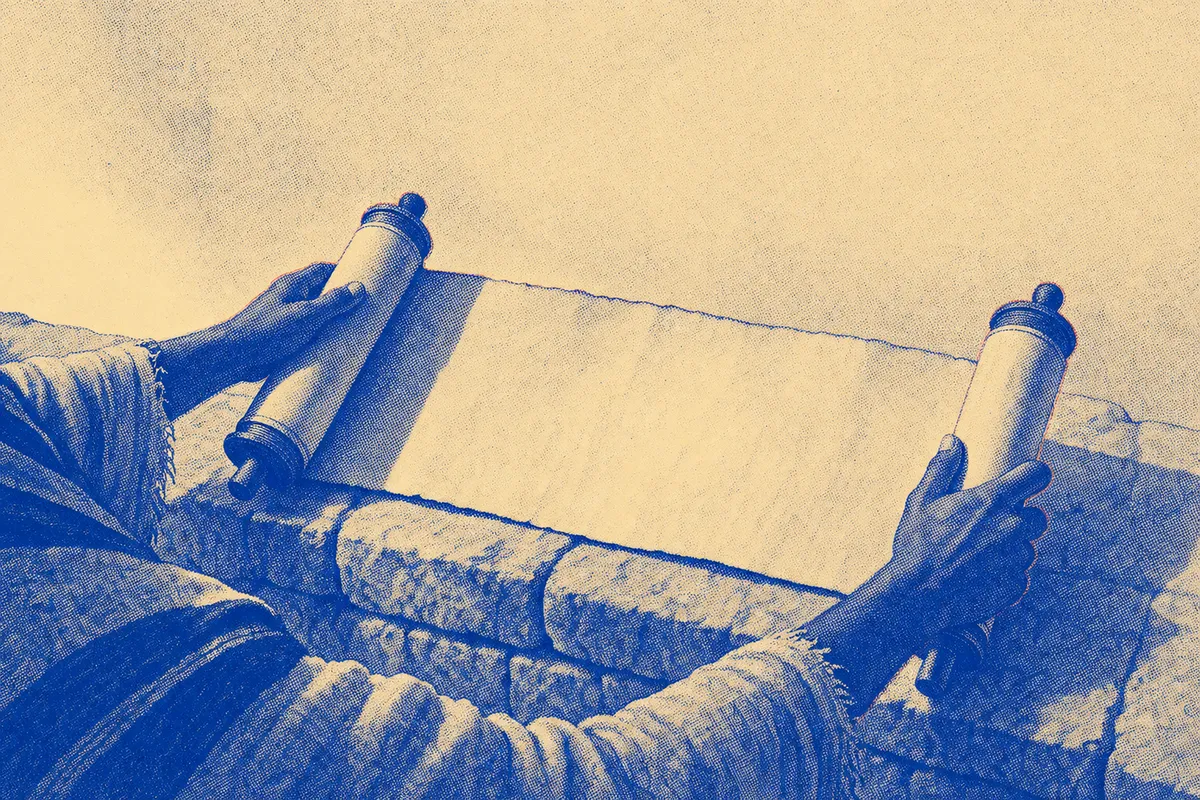
Benedict told his monks to read this way in the sixth century, and the method carries a Latin name, lectio divina, that makes it sound more specialized than it is. Four passes over a short passage. That is the whole technique. What makes it strange to a modern reader is not the difficulty but the scale: you are going to spend twenty minutes on six verses and finish exactly where you started.
Pick the passage the night before so you are not shopping at the top of the hour. Something with a scene in it works better than an argument. Jesus asleep in the stern. Hagar in the desert. The first eleven verses of Psalm 139. Read it once, straight through, aloud if you can manage that without feeling foolish. This first pass is only to get the sound of it into the room. You are not looking for anything yet.
Read it a second time and stop where you snag. There is usually one word. In Psalm 23 it is often makes, as in he makes me lie down, because you had not remembered any compulsion being in that verse. Stay there. Turn the word over. Ask what it would mean if it were true in the plainest sense. This is closer to chewing than to thinking, and it is the part that cannot be rushed.
The third pass is where you answer. Not a summary of the passage and not a general prayer, but a response to that one word: the complaint it produced, the thanks, the request it made obvious. Say it out loud in ordinary language. If the word made you defensive, say that instead.
Then stop reading. Three minutes, timed, with the Bible shut. This is the part everyone skips, and it will feel like nothing is happening, and mostly nothing will be. Boredom is not a failure of the exercise. It is the first thirty seconds of it. You are learning to sit in front of the text without working on it.
The obvious objection is that at six verses a sitting you will never get through the book. True. This is not meant to be your only reading. Keep whatever chapter-a-day or whole-book plan you already have and run this alongside it once or twice a week. Coverage and depth are two different jobs, and asking one to do the work of the other is how people end up doing neither.
- Choose six to eight verses the night before.
- Read it once, out loud, just to hear it.
- Read again and stop at the word that snags.
- Read a third time and answer it in plain language.
- Close the book and sit for three timed minutes.
20 MIN
Tools
The Smallest Type on the Page
The narrow column of tiny letters is a century of other people's reading, handed to you for nothing.
Open your Bible to almost any page and look for the smallest type on it. Depending on the edition it runs as a narrow column down the middle of the page or as a block of footnotes keyed to superscript letters in the text. Most people look past this for years. It is a map of the Bible's internal traffic, assembled by editors who spent careers noticing where one passage picks up another.
It helps to know what it is not. These links are editorial, not inspired. Many English Bibles inherit theirs from an 1830s compilation called the Treasury of Scripture Knowledge, revised and pruned ever since. Editors disagree with one another, and you are allowed to disagree with them. Some links are load-bearing, marking a direct quotation. Others are one shared word doing no work at all.
The way in is a single hop. Take Matthew 2:15, where Matthew says the flight into Egypt happened to fulfill what the Lord had spoken through the prophet: out of Egypt I called my son. Follow that reference to Hosea 11:1, read the paragraph around it, and you find Hosea is not predicting anything. He is talking about Israel coming out of slavery, and he is angry about what came after. Matthew is doing something considerably more interesting than proof-texting, and the cross-reference is what lets you see it.
That example contains the rule. Read the whole paragraph where you land, then come back and read your original verse again. A single line pulled out of its neighborhood will confirm whatever you already thought before you went looking.
Stop after three hops. The links branch endlessly and it is easy to surface forty minutes later somewhere in Chronicles with no memory of the question you began with. Follow one thread, come home, and write down what changed.
In the Gospels these references do a particular favor: they tell you where the parallel version of a scene lives. Read Mark's account of a healing and then Luke's, back to back, and the differences stop being trivia. One writer keeps a detail the other drops. One puts the scene early where the other puts it late. Noticing that is most of what serious comparison amounts to, and the tiny type is already holding the door open.
- Find the center column or the footnote letters.
- Take one verse that puzzles you and follow a single link.
Getting started
Reading It With a Child
Children are not a lesser audience; they are the audience that will not let you fake it.

The first thing to give up is the moral at the end. The instinct, reading to a child, is to land the plane: and that is why we should be brave like David. Children hear the pivot coming and file the whole evening under school. The story of David and Goliath has survived three thousand years without your closing sentence. Read it and let it sit there unexplained.
Read narrative. Genesis past the first eleven chapters is one long, difficult family drama. Then Exodus, Ruth, 1 Samuel, Jonah, Daniel, any of the Gospels, Acts. Save Romans. Save Leviticus. Nothing requires you to go in order, and nothing is lost by treating the first year as a tour of the stories.
Use a real translation rather than a rewritten storybook, or use both and be clear about which is which. Storybooks have their place at bedtime, but they have already made every decision for you: what to include, what a character was feeling, what the whole thing meant. A plain modern translation read aloud is well within a six-year-old's reach, and the gaps in it are the good part.
The gaps produce questions, and the questions are the actual event. Why did God like Abel's offering better? The honest answer is that the text does not say. Saying that out loud, and meaning it, teaches something no lesson can: that this is a book you are permitted to interrogate, and that adults are not sitting on a secret answer key. Answer the question the child asked, not the one you had prepared on the way in.
Hard stories will come up. You choose the diet, so you can wait on some of them, but do not sand down the ones you read. If a child is troubled by the flood, or by Abraham walking up the mountain, the useful thing to say is that it troubles you too and that people have argued about it for a very long time. Anything smoother than that is a debt that comes due at fifteen.
Ten minutes, and stop while they still want more. Expect them to demand the same story a dozen times; that is the correct instinct and the one adults lose somewhere along the way. And there is a benefit running in the other direction: reading aloud to a child pins you to about a hundred and fifty words a minute, which happens to be roughly the speed at which a grown reader starts noticing what is on the page.
- Read narrative first — Genesis, Exodus, Ruth, the Gospels.
Back to today's paper →