HOW TO READ · 2026-08-28
The day's guides
Method
Know What Kind of Book You're In
A psalm and a law code were never meant to be read at the same speed, and most of the confusion starts right there.
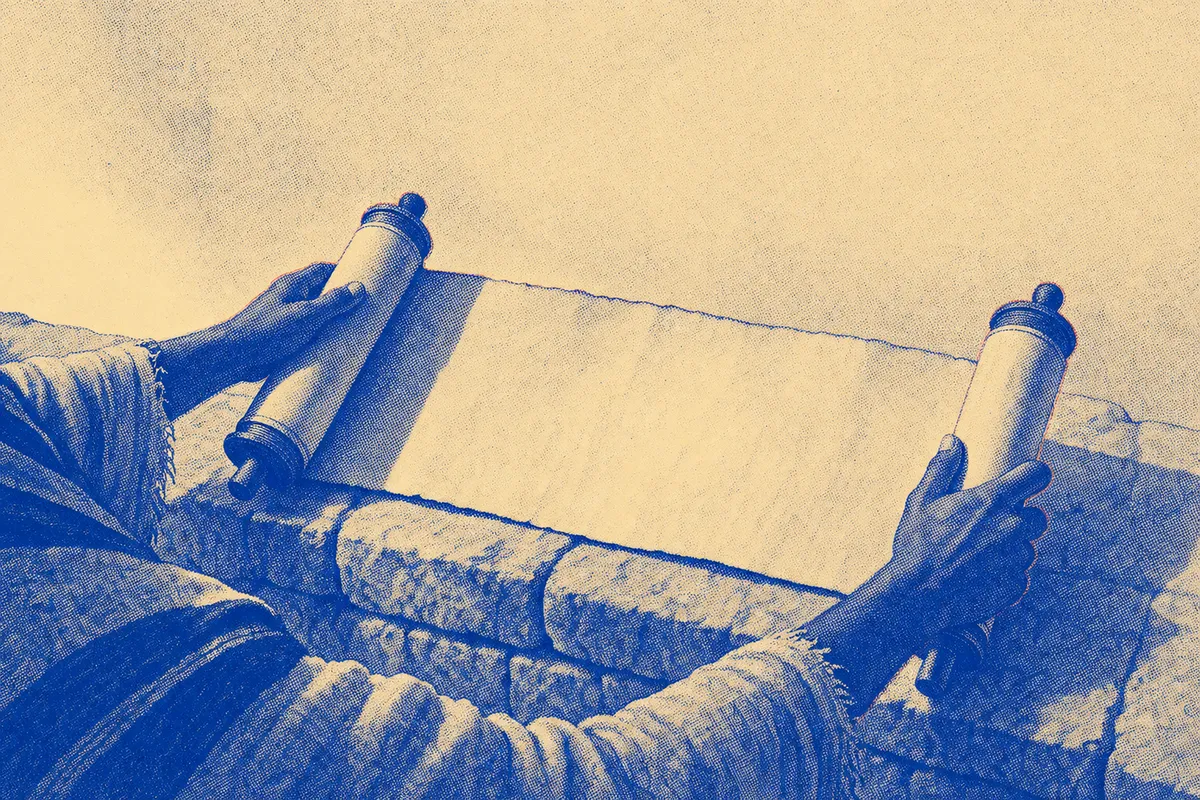
Open Leviticus expecting a story and you'll stall out by chapter three. Open Proverbs expecting an argument and you'll miss the point of every couplet. Most of the frustration people report with the Bible isn't the content — it's a genre mismatch. They're reading case law like they'd read a novel, or poetry like they'd read a memo, and the text won't cooperate because it was never built for that.
The Bible is not one kind of writing. It's a library: narrative history in Genesis and Kings, legal code in Exodus and Leviticus, courtroom poetry in Job, love poetry in Song of Songs, sermon-in-verse in the Prophets, biography in the Gospels, correspondence in the Epistles, and something closer to vision-report in Revelation and parts of Daniel and Ezekiel. Each of these has its own grammar. Law lists cases and consequences — it isn't trying to move you emotionally, it's trying to be applicable. Poetry works by parallelism and image, saying a thing twice in different words to let the second line deepen the first, not to repeat itself. Prophecy is almost always local before it's future — a specific king, a specific famine, a specific betrayal — even when it echoes forward. A letter assumes you already know the situation on the other end and are reading someone else's mail.
None of this requires a seminary course. It requires one question, asked before you start reading: what kind of writing is this trying to be? A one-line answer — 'this is a letter,' 'this is a law code,' 'this is a vision' — resets your expectations enough to keep you from grading the text on the wrong scale.
A useful habit: read the first chapter and the last chapter of a book before reading it start to finish. It sounds like cheating. It isn't — it's the same thing you'd do with an unfamiliar building, walking the perimeter before going room to room. The first chapter usually tells you what kind of book you're in; the last chapter tells you where it's headed. Judges opens with conquest and closes with civil war and moral collapse — knowing that going in changes how you read the middle. Ecclesiastes opens with 'meaningless' and doesn't resolve that word until the final verses; reading it without that frame turns a carefully built argument into random despair.
Speed matters too. Poetry rewards slowness — you're not extracting information, you're sitting with an image until it opens. Narrative can be read at a normal clip; it's built to carry you forward. Law and genealogy are reference material more than devotional reading — nobody is meant to feel moved by a list of clean and unclean animals, and treating it that way is asking the text to be something it isn't.
If it helps, keep a scrap of paper in the front of your Bible with eight words on it — law, narrative, poetry, wisdom, prophecy, gospel, letter, apocalypse — and the book you're currently in circled. It's a small thing. But naming the genre before you start reading solves more confusion than any commentary will.
- Before you start a book, name its genre: law, narrative, poetry, wisdom, prophecy, gospel, letter, or apocalypse.
- Skim the first and last chapter to catch the book's shape before reading it straight through.
- Match your reading speed to the genre — slow for poetry and law, steady for narrative and letters.
- Ask what the genre is built to do, not just what it says.
4 MIN
Practice
One Proverb, Every Day, Same Number as the Date
Proverbs has thirty-one chapters for a reason nobody had to explain to you.
This is one of the oldest reading habits in the church, mostly because it's one of the few that doesn't require willpower. Proverbs has thirty-one chapters. Most months have close to thirty-one days. Read the chapter that matches the date, and by the end of a month you've read the whole book — and by the end of a year, twelve times.
The reason it works isn't the math. It's that Proverbs is written for exactly this kind of reading. Unlike a letter or a narrative, it doesn't build an argument across chapters that you'd lose by reading out of order. Each chapter is a loose collection of short, self-contained sayings — you can drop into chapter 22 on the 22nd with zero setup and get the full effect. It's the one book in the Bible actually designed to be read a piece at a time, indefinitely, without a plan.
What the habit gives you is repetition with variation. You'll read chapter 3 twelve times this year, and it will land differently each time — the line about leaning on your own understanding hits different in a year you made a big decision than in a year you didn't. That's not a coincidence; it's the whole design of wisdom literature, which assumes you'll bring a different life to the same words and get something new out of them because you're not the same reader.
Don't try to retain the chapter. Retain the line. Proverbs isn't built for chapter-level summary the way narrative is — you're not tracking a plot. You're panning for one image, one warning, one description of a fool or a friend that's sharper than the way you'd have put it yourself. Circle it, copy it onto an index card or the notes app, and let the rest of the chapter go. You'll meet it again next month anyway.
This is also a good entry point if daily Bible reading has never stuck. It has no ramp-up, no context to track, no story arc to fall behind on. Missing three days doesn't break anything — you just read the 18th on the 21st and move on, or you skip ahead to today's date and let the gap close itself next month. There's no plan to have failed.
- Open Proverbs to the chapter matching today's date — the 14th, read chapter 14.
- Read the whole chapter once, straight through, without stopping.
- Read it again slower, and circle the line that catches on something in your actual week.
Tools
Color Is a Filing System, Not a Mood Board
A highlighted Bible that looks beautiful and finds nothing has solved the wrong problem.

A lot of highlighted Bibles are gorgeous and useless in the same way a color-coded planner can be gorgeous and useless — the coloring became the task instead of a tool for a task. If you can't say, six months later, why a verse is orange, the color didn't file anything. It just decorated the page.
The fix is to decide what the colors mean before you pick them up, and to keep the list short enough to actually remember. A workable starter set: one color for promises (statements about what God will do), one for commands (statements about what you're told to do), one for God's character (statements about who God is), and one for warnings (statements about consequences). Four categories, four colors, done. Resist the urge to add a fifth for 'interesting' or 'important' — those aren't categories, they're everything, and a category that includes everything files nothing.
Write the key on the inside cover in pen. This matters more than it sounds like it should — the whole point of a system is that it doesn't rely on you remembering what you meant three years ago. A future version of you, or someone who picks up your Bible after you, should be able to read the key and immediately know why a verse is green.
Mark the phrase, not the sentence. The instinct is to underline the whole verse because the whole verse feels important, but that just recreates the mood-board problem one level down — everything ends up highlighted, and a page that's entirely one color carries no more information than a page with none. If Isaiah 41:10 has a promise ('I will strengthen you') sitting next to a description of God's character ('I am your God'), mark each phrase in its own color rather than painting the verse a single shade.
The real payoff shows up later, when you flip back through a book you finished months ago. A page that's mostly one color tells you something about that chapter before you reread a word of it — Deuteronomy runs heavy on commands, the Psalms run heavy on promises and character, and seeing that pattern in your own margins teaches you something a fresh read wouldn't. Blank space is part of the system too. Not every verse fits a category, and leaving it uncolored is more honest than forcing a fit just to keep the page busy.
- Pick four colors, no more, before you open the Bible — not while you're reading.
Back to today's paper →