EU•AN•GE•LION (YOO-AN-GEL-EE-ON) · εὐαγγέλιον — Good News
The Daily Bread
From the archive · unnumbered14th Week after Pentecost
Genesis 32:24-28
I Will Not Let You Go
Jacob had spent his life taking what he wanted. The night before he met his brother, he held on to God instead, and he walked away blessed and limping. The next morning Esau ran to him.
So Jacob was left all alone, and there a man wrestled with him until daybreak. When the man saw that he could not overpower Jacob, he struck the socket of Jacob’s hip and dislocated it as they wrestled. Then the man said, “Let me go, for it is daybreak.” But Jacob replied, “I will not let you go unless you bless me.” “What is your name?” the man asked. “Jacob,” he replied. Then the man said, “Your name will no longer be Jacob, but Israel, because you have struggled with God and with men, and you have prevailed.”
Genesis 32:24-28 (BSB)
The practice
Fast from one ordinary thing until sundown.
Hunger of any kind is a reliable reminder that you are not self-sustaining.
Until dusk
Greek today
καλέω
kaléō
to call; summon; to call to one's house; invite; name; call by name
Come with Me privately to a solitary place, and let us rest for a while.
Mark 6:31 (BSB)
The funnies
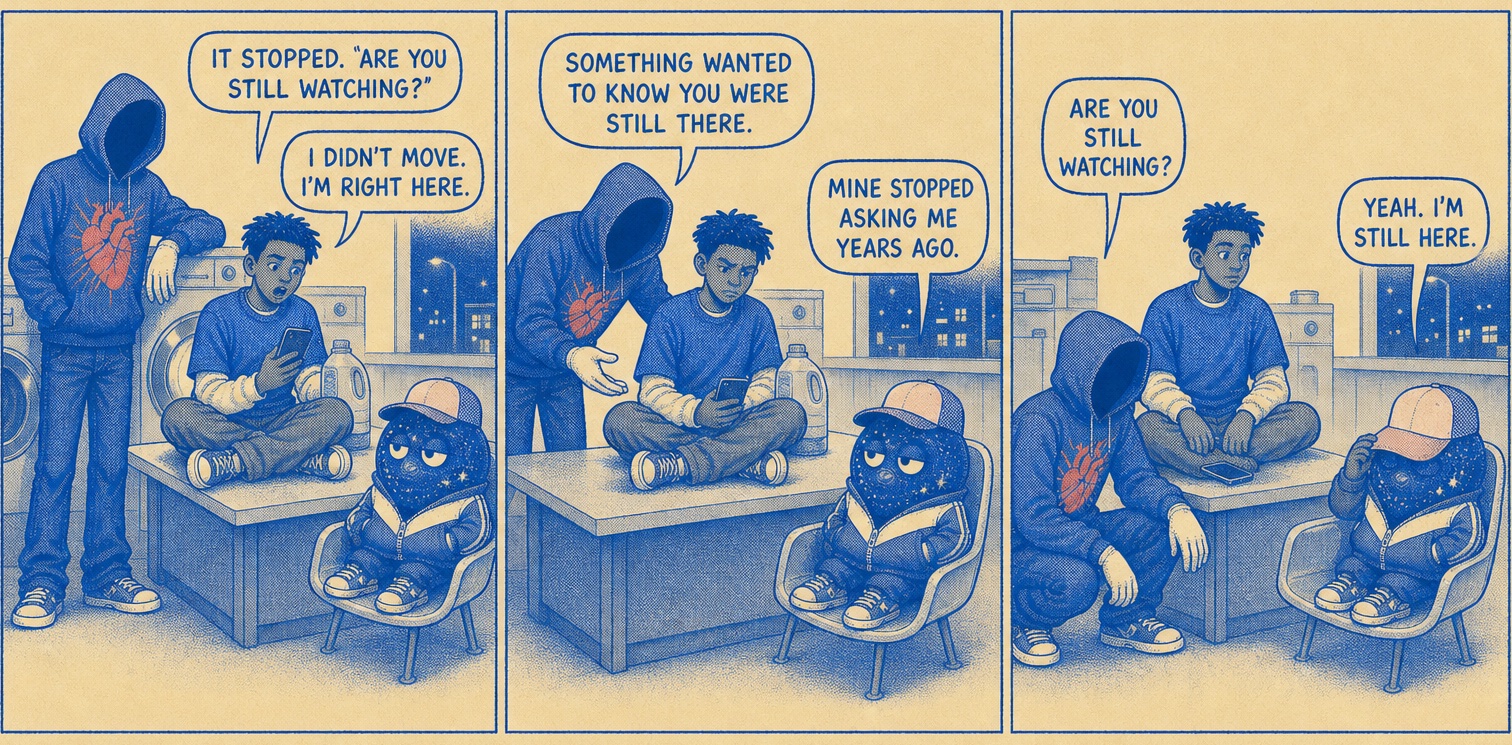
A wordless strip
Echo & Dust — No. 5: Are You Still Watching?
The season
Ordinary Time — the long green season after Pentecost
From the day after Pentecost until Advent begins in late November — roughly half the year, all summer and autumn.
"Ordinary" here does not mean unremarkable. It comes from the same root as "ordinal" — these are the counted weeks, numbered one after another from Pentecost all the way to Advent. It is the longest season of the church year, roughly half of it, covering the whole green stretch of summer and autumn, and it has no headline feast to organize it. That is deliberate. The festival half of the year announces what God has done — birth, death, resurrection, Spirit. Ordinary Time is where the church practises living as if all of that were true, in weeks that look exactly like the ones before them. It opens with Trinity Sunday, naming the whole mystery at once, and it ends with the last Sundays turning toward judgment and hope, just before Advent starts the year again in the dark. Most of the Christian life is lived here. The season simply admits it.
The 14th week after Pentecost counts the church’s long walk of ordinary faithfulness between the Spirit’s arrival and the year’s end.
Green — the color of things that grow, worn for the long season of ordinary growth.
The crossword
Answers from scripture · no timer, no streak
Tap a square to begin.
Across
His, not as the world gives (John 14:27)
The father called for the best one (Luke 15:22)
Short tax collector up a sycamore tree (Luke 19:4)
The word that seals a prayer
She swept the house until she found it (Luke 15:8)
Cast on the right side, it could not be hauled in (John 21:6)
Wise men who came from the east (Matt. 2:1)
Down
In heart, they will see God (Matt. 5:8)
He is my shepherd (Ps. 23:1)
A great one swallowed the runaway prophet (Jonah 1:17)
It returned with a fresh olive leaf (Gen. 8:11)
What the prodigal longed to fill himself with (Luke 15:16)
He was asleep on a cushion in its stern (Mark 4:38)
Firstborn of Adam, a tiller of the ground (Gen. 4:2)
King who married Jezebel (1 Kgs. 16:31)
Scribe who read the Law from daybreak (Neh. 8:3)
"Let this one pass from Me" (Matt. 26:39)
There was no room for them in it (Luke 2:7)
Aging priest at Shiloh (1 Sam. 1:9)
The catechism corner
Heidelberg, Q127
What does the sixth petition mean?
“And do not lead us into temptation, but deliver us from the evil one” means: By ourselves we are too weak to hold our own even for a moment. And our sworn enemies—the devil, the world, and our own flesh—never stop attacking us. And so, Lord, uphold us and make us strong with the strength of your Holy Spirit, so that we may not go down to defeat in this spiritual struggle, but may firmly resist our enemies until we finally win the complete victory.
Heidelberg Catechism (1563), Q127 · Psalm 103:14 · 1 Peter 5:8 · Matthew 26:41
The gallery
7plates · tap any to look closer
Swans and the Abandoned Pipesafter LippiA close view at the water's edge: three white swans move across dark rippled water, one dipping its bill, while a set of panpipes bound with a strap and a small recorder lie abandoned on a mossy rock ledge above. At the right, the bare feet and hems of two robed figures — one in blue, one in rose — stand on the grassy bank; a pale wing-tip and a green frond enter from the edge. The light is even and cool, and the eye circles from the swans up to the set-down instruments.
Where two careful translations disagree, a translator was standing at a fork, and that fork is worth your attention.
Pick one translation that leans literal and one that leans toward natural English.
Read the same fifteen or twenty verses in both.
Underline every place the meaning moves, not just the wording.
Ask what problem the translator was solving there.
Resist picking a favorite; hold both readings at once.
The word search
Words of Prayer
Words of Prayer
Drag across the letters — or tap one end, then the other.
0 of 8 found
KNEEL
FASTING
PETITION
INTERCEDE
THANKS
AMEN
LISTEN
QUIET
Where is this from?
3 questions
A verse from Scripture — tap the reference you think it comes from.
“I waited patiently for the LORD; He inclined to me and heard my cry.”
“Come to Me, all you who are weary and burdened, and I will give you rest.”
“And my God will supply all your needs according to His glorious riches in Christ Jesus.”
The hymnal
Fanny J. Crosby, 1890
I am thine, O Lord, I have heard thy voice
I am thine, O Lord, I have heard thy voice,
And it told thy love to me;
But I long to rise in the arms of faith,
And be closer drawn to thee.
Ref.--Draw me nearer, nearer, blessed Lord,
To the cross where thou hast died;
Draw me nearer, nearer, nearer, blessed Lord,
To thy precious, bleeding side.
Consecrate me now to thy service, Lord,
By the pow'r of grace divine;
Let my soul look up with a steadfast hope,
And my will be lost in thine.
The proverb
He who walks in integrity walks securely, but he who perverts his ways will be found out.
Proverbs 10:9 (BSB)
The memory verse
This week · same verse all seven days
Your word is a lamp to my feet and a light to my path.
Psalm 119:105 (BSB)
The question
To carry, not to close
What do you keep calling a season that has become a settlement?
So Jacob’s gifts went on before him, while he spent the night in the camp. During the night Jacob got up and took his two wives, his two maidservants, and his eleven sons, and crossed the ford of the Jabbok. He took them and sent them across the stream, along with all his possessions.
What comes just before Genesis 32:24-28, which sets the scene for today's passage.
Genesis 32:29-31
And Jacob requested, “Please tell me your name.” But he replied, “Why do you ask my name?” Then he blessed Jacob there. So Jacob named the place Peniel, saying, “Indeed, I have seen God face to face, and yet my life was spared.” The sun rose above him as he passed by Penuel, and he was limping because of his hip.
What follows Genesis 32:24-28, where the passage keeps going.
Voices
From the church’s shelf
A thing wonderful, and worthy of faith, and surpassing all the understanding of man, that Thou, O Lord my God, very God and very man, givest Thyself altogether to us in a little bread and wine, and art so our inexhaustible food.
Thomas à Kempis · The Imitation of Christ
The daily prayer
Abraham · Genesis 18:23-32
23Abraham stepped forward and said, “Will You really sweep away the righteous with the wicked? 24What if there are fifty righteous ones in the city? Will You really sweep it away and not spare the place for the sake of the fifty righteous ones who are there? 25Far be it from You to do such a thing—to kill the righteous with the wicked, so that the righteous and the wicked are treated alike. Far be it from You! Will not the Judge of all the earth do what is right?” 26So the LORD replied, “If I find fifty righteous ones within the city of Sodom, on their account I will spare the whole place.” 27Then Abraham answered, “Now that I have ventured to speak to the Lord—though I am but dust and ashes— 28suppose the fifty righteous ones lack five. Will You destroy the whole city for the lack of five?” He replied, “If I find forty-five there, I will not destroy it.” 29Once again Abraham spoke to the LORD, “Suppose forty are found there?” He answered, “On account of the forty, I will not do it.” 30Then Abraham said, “May the Lord not be angry, but let me speak further. Suppose thirty are found there?” He replied, “If I find thirty there, I will not do it.” 31And Abraham said, “Now that I have ventured to speak to the Lord, suppose twenty are found there?” He answered, “On account of the twenty, I will not destroy it.” 32Finally, Abraham said, “May the Lord not be angry, but let me speak once more. Suppose ten are found there?” And He answered, “On account of the ten, I will not destroy it.”
Genesis 18:23-32 (BSB)
The coloring corner
A Lamp to My Feet · crayons or the dropper — no grades
One flame against the evening.
The reading
I Will Not Let You Go
So Jacob was left all alone, and there a man wrestled with him until daybreak. When the man saw that he could not overpower Jacob, he struck the socket of Jacob’s hip and dislocated it as they wrestled. Then the man said, “Let me go, for it is daybreak.” But Jacob replied, “I will not let you go unless you bless me.” “What is your name?” the man asked. “Jacob,” he replied. Then the man said, “Your name will no longer be Jacob, but Israel, because you have struggled with God and with men, and you have prevailed.”
He Held On
Jacob has been away for twenty years. Now he is going home, and Esau is coming to meet him with four hundred men. The last time the brothers were together, Esau wanted to kill him.
Jacob sends his family and everything he owns across a stream. He stays behind, alone, in the dark.
A man wrestles with him until daybreak. The man cannot overpower him, so he touches Jacob's hip and puts it out of joint. Then he asks Jacob to let him go.
Jacob says no. “I will not let you go unless you bless me.”
The man asks his name. For most of his life, that name has been tied to the heel and to cheating. Esau made it an insult. Now God gives him a new one. His name will be Israel, because he has struggled with God and with men and has prevailed.
Jacob names the place Peniel, “face of God,” because he has seen God face to face and lived. When the sun rises, he is limping.
For once, Jacob’s hands are not taking a birthright or stealing a blessing. He clings to God and asks to receive what only God can give.
Reflect
What would it look like for you to hold on to God instead of taking what you want?
God, I want to hold on to you today. I will not let you go unless you bless me. And if the blessing comes with a limp, let me walk home with it.
In great fear and distress, Jacob divided his people into two camps, as well as the flocks and herds and camels. He thought, “If Esau comes and attacks one camp, then the other camp can escape.” Then Jacob declared, “O God of my father Abraham, God of my father Isaac, the LORD who told me, ‘Go back to your country and to your kindred, and I will make you prosper,’ I am unworthy of all the kindness and faithfulness You have shown Your servant. Indeed, with only my staff I came across the Jordan, but now I have become two camps. Please deliver me from the hand of my brother Esau, for I am afraid that he may come and attack me and the mothers and children with me.
Afraid Of His Brother
Twenty years is a long time to be away from home. Jacob left with nothing but a staff, running from a brother who wanted him dead. He comes back with two wives, eleven sons, servants and large flocks.
He also comes back afraid. His messengers return with news that Esau is coming to meet him with four hundred men. Jacob splits everything into two camps, so that if Esau attacks one, the other can escape.
Then he prays. “I am unworthy of all the kindness and faithfulness You have shown Your servant.” He remembers crossing the Jordan with only his staff. He admits he is afraid.
This is a different Jacob. Twenty years earlier he lied to his blind father and used God's name to do it. Now he tells God the truth about himself.
He still makes plans. He sends wave after wave of livestock ahead as gifts for Esau. Genesis gives his reasoning.
“I will appease Esau with the gift that is going before me. After that I can face him, and perhaps he will accept me.”
In Hebrew the verse is full of faces. Jacob hopes to cover his brother's face with a gift, see his face, and have his own face lifted up. The verb for cover, kaphar, is the same root Leviticus uses for atonement. Here it means to pacify. Jacob is not atoning for anything. He is hoping a gift will be enough to let him face his brother.
Then he sends everyone across the stream and stays behind. Genesis says he was left alone.
And Jacob was left alone; and there wrestled a man with him until the breaking of the day. And when he saw that he prevailed not against him, he touched the hollow of his thigh; and the hollow of Jacob’s thigh was out of joint, as he wrestled with him. And he said, Let me go, for the day breaketh. And he said, I will not let thee go, except thou bless me. And he said unto him, What is thy name? And he said, Jacob. And he said, Thy name shall be called no more Jacob, but Israel: for as a prince hast thou power with God and with men, and hast prevailed. And Jacob asked him, and said, Tell me, I pray thee, thy name. And he said, Wherefore is it that thou dost ask after my name? And he blessed him there. And Jacob called the name of the place Peniel: for I have seen God face to face, and my life is preserved. And as he passed over Penuel the sun rose upon him, and he halted upon his thigh. Therefore the children of Israel eat not of the sinew which shrank, which is upon the hollow of the thigh, unto this day: because he touched the hollow of Jacob’s thigh in the sinew that shrank.
A Light Touch And A Long Limp
Many translations say the man struck Jacob's hip. The Hebrew verb is naga, which means touched. The King James Version keeps that word. A touch was enough to put the hip out of joint.
Genesis says the man could not overpower Jacob. When he asks to be let go, Jacob refuses. He is hurt and he will not stop holding on until he is blessed.
The prophet Hosea looked back on this night centuries later. “He struggled with the angel and prevailed; he wept and sought His favor.” Genesis does not mention tears, but Hosea does. The strong grip was also a desperate plea.
Then comes the new name. People often say Israel means “prince with God.” That idea comes from the King James wording, not from the Hebrew verb, which means to strive or persist. Genesis explains the name simply: Jacob has struggled with God and with men and has prevailed. Scholars still debate what the name meant on its own. Some think it originally meant “God strives” or “God persists.”
Jacob asks the man's name, and the man does not give it. He blesses Jacob there. As the sun rises, Jacob walks on, limping.
C. H. Spurgeon preached on this blessing and did not make the limp disappear.
“While he got the blessing, he got lameness too, and he might be well content to carry that lameness to his grave.”
The chapter ends with a detail about food. “Therefore to this day the Israelites do not eat the tendon which is at the socket of the hip.” Jewish law still keeps this rule. The Mishnah, the early collection of Jewish law, applies it to kosher cattle and wild animals, though not to birds. Removing the sinew takes trained hands, and in many communities that part of the animal is simply not used.
It is the only food rule in the Torah that comes directly out of a story about one of the patriarchs. The Jewish sages said it was commanded at Sinai and recorded in Genesis at the place where it belongs. Maimonides, in his discussion of the food laws, said its reason is stated in the Law itself.
So Leviticus 11 and Jacob's limp belong to the same tradition. For centuries, Israel has remembered at the dinner table the night their father held on to God and was wounded. Christians also keep a meal of remembrance, and it remembers a body given for them.
Now Jacob looked up and saw Esau coming toward him with four hundred men. So he divided the children among Leah, Rachel, and the two maidservants. He put the maidservants and their children in front, Leah and her children next, and Rachel and Joseph at the rear. But Jacob himself went on ahead and bowed to the ground seven times as he approached his brother. Esau, however, ran to him and embraced him, threw his arms around his neck, and kissed him. And they both wept. When Esau looked up and saw the women and children, he asked, “Who are these with you?” Jacob answered, “These are the children God has graciously given your servant.” Then the maidservants and their children approached and bowed down. Leah and her children also approached and bowed down, and then Joseph and Rachel approached and bowed down. “What do you mean by sending this whole company to meet me?” asked Esau. “To find favor in your sight, my lord,” Jacob answered. “I already have plenty, my brother,” Esau replied. “Keep what belongs to you.” But Jacob insisted, “No, please! If I have found favor in your sight, then receive this gift from my hand. For indeed, I have seen your face, and it is like seeing the face of God, since you have received me favorably. Please accept my gift that was brought to you, because God has been gracious to me and I have all I need.” So Jacob pressed him until he accepted.
Esau Ran
Jacob walks ahead of his family, limping, and bows to the ground seven times as he comes near his brother.
Esau does not wait for him to finish. “Esau, however, ran to him and embraced him, threw his arms around his neck, and kissed him. And they both wept.”
In the Hebrew text of Genesis, the word for “kissed him” is marked with a row of small dots. The ancient rabbis argued about what the dots meant. Some said Esau did not kiss him with his whole heart. Rabbi Shimon bar Yochai disagreed, and the Sifrei records his answer.
“It is a known halachah that Esav hates Jacob, but his mercy gained the ascendancy at that time and he kissed him with all his heart.”
Genesis gives no hint of a trick. It shows Esau asking about the women and children, refusing the gifts because he already has plenty, and calling Jacob “my brother.”
Jacob answers with a sentence that reaches back to the night before. “I have seen your face, and it is like seeing the face of God, since you have received me favorably.” At Peniel he saw God's face and lived. Now he sees his brother's face and is welcomed.
John Calvin read the moment as a sign of God's own favor.
“And certainly Esau being thus changed, was no obscure figure of the favor of God.”
Then Jacob says one more thing. The Berean Standard Bible reads “Please accept my gift.” The Hebrew word Jacob uses is berakhah, blessing. Literally, Jacob says, “Take my blessing.” It is the same word Esau used twenty years earlier when he cried that Jacob had taken his blessing. The brother who stole the blessing is now pressing a blessing into his brother's hands.
Jesus told a story with a scene very close to this one. When the prodigal son comes home, his father sees him while he is still far off. He runs to him, embraces him and kisses him. The Greek words are not identical to the Greek of Genesis 33, but the picture is the same. Someone who had every reason to stay angry runs toward the one who wronged him.
Then and Now
They Fell On Each Other's Neck
In March 1741, George Whitefield told John Wesley to his face that the two of them preached different gospels. Wesley recorded it in his journal. Whitefield would not give him the right hand of fellowship, and he said he would preach against John and his brother Charles.
Eight years later, it was the Wesley brothers who were divided. John believed that a widow named Grace Murray had promised to marry him. Charles believed she had promised to marry another preacher, John Bennet, and he acted to see her married to Bennet.
On October 4, 1749, John rode to Leeds. Whitefield was there, and John wrote privately that Whitefield “wept and prayed over me.”
The next morning news came that Grace had married Bennet. Charles arrived an hour later. John wrote that he did not want to see him, but Whitefield insisted.
John recorded what Charles said. “I renounce all intercourse with you, but what I would have with an heathen man or a publican.”
Then John wrote down what happened next.
“Poor Mr. Whitefield and John Nelson burst into tears. They prayed, cried, and entreated, till the storm passed away. We could not speak, but only fell on each other's neck.”
When John Bennet came into the room, John Wesley and Bennet could not speak either. They kissed each other and wept.
Three days later Charles wrote to a friend that Whitefield, his brother and he were one, “a threefold cord.” He added that at Leeds, John had given Whitefield the right hand of fellowship.
A Ring Instead Of A Verdict
The Wesleys and Whitefield never came to agree about the doctrine that first divided them. Whitefield remained a Calvinist, and the Wesleys did not.
Whitefield died in 1770. In his will he left mourning rings to both brothers. He explained why in his own words.
“In token of my indissoluble union with them, in heart and christian affection, notwithstanding our difference in judgment about some particular points of doctrine.”
Whitefield's executors asked John Wesley to preach his funeral sermon, and he did. In it he spoke about disagreements over doctrines “of a less essential nature.” Then he said this.
“In these we may think and let think; we may ‘agree to disagree.’ But mean time let us hold fast the essentials of the faith.”
The account of the reconciliation at Leeds is John Wesley's own, written privately, so it tells his side. It should not be read as making Charles the villain. Charles acted on what he believed was right. It still shows brothers who could not agree on everything choosing each other.
Carry One Another's Burdens
Paul gives the church a short command in Galatians 6:2. “Carry one another's burdens, and in this way you will fulfill the law of Christ.” He uses the same Greek verb, bastazo, in Romans 15:1, where the strong are to bear with the weak.
Paul calls it a law. After everything he has said about freedom from the law of Moses, he still names a law Christians are bound to keep. It is the law of Christ, and carrying each other is how it is kept.
The Gospels name one man who carried Jesus' cross for him. On the way to the cross, the soldiers seized Simon of Cyrene as he came in from the country and put the cross on him “to carry behind Jesus.” He did not volunteer. The Gospels use different verbs for what Simon did, so this is a picture of burden-bearing rather than a word link to Galatians. Mark's Gospel names his sons, Alexander and Rufus, as if the first readers knew them.
Dietrich Bonhoeffer described what it means to bear another person in his 1939 book Life Together.
“The Christian, however, must bear the burden of a brother. He must suffer and endure the brother. It is only when he is a burden that another person is really a brother and not merely an object to be manipulated.”
Luther said something similar in 1520. He wrote that the Father has freely helped us in Christ, so we should freely help our neighbor with our bodies and our work. Each Christian, he said, “should become to other a sort of Christ.”
Jacob and Esau fought over one birthright and one blessing, because there was only one to go around. The inheritance Christ gives does not work like that. George MacDonald, the Scottish writer, explained the difference.
“To have a share in any earthly inheritance, is to diminish the share of the other inheritors. In the inheritance of the saints, that which each has, goes to increase the possession of the rest.”
Heirs of that kind have no reason to compete. They are free to carry each other instead.
Which of you, if his son asks for bread, will give him a stone? Or if he asks for a fish, will give him a snake? So if you who are evil know how to give good gifts to your children, how much more will your Father in heaven give good things to those who ask Him!
Reflect
Whose face have you been avoiding, and what would it mean to see God's kindness in it?
What Our Relationships Look Like Now
Genesis 33 and the New Testament show five marks of how believers treat each other.
First, freedom shows up as welcome. Esau ran to Jacob before every question was settled. Paul tells Christians to accept one another as Christ accepted us.
Second, love notices a brother’s family. Esau asked who Jacob’s companions were and offered to travel with them. When Jacob said the children and animals needed a slower pace, Esau offered some of his own men.
Third, disagreement does not cancel love. Christians will still differ over food, holy days and harder questions. Whitefield and the Wesleys never settled their doctrinal difference. They still treated each other as brothers.
Fourth, the strong carry the weak. Paul says we were called to freedom, but we should not use it to indulge ourselves. We should serve one another in love.
Fifth, we live as heirs of a generous Father. Jesus said that if ordinary parents know how to give good gifts to their children, “how much more will your Father in heaven give good things to those who ask Him.” God wants more for his children than any parent does. Hebrews says Jesus is not ashamed to call us brothers.
The blessing that Jacob once took by deceit has been given to us through the body of Christ. We no longer have to compete with each other for it. Because Christ has received us, we can approach people we have wronged, make amends, welcome their families, and help carry their burdens.
Prayer
Father, you give good gifts to your children, more than any parent could. You have made me an heir through your Son, who is not ashamed to call me his brother. Teach me to hold on to you, to carry the people you give me, and to run toward the ones I have wronged or who have wronged me. Let me see your kindness in their faces. Amen.
This week
I will take the first step toward someone I am estranged from, and I will ask about the people they love.