Then Jesus declared, ’I am the bread of life. Whoever comes to me will never go hungry, and whoever believes in me will never be thirsty.’
John 6:35 (NIV)
EU•AN•GE•LION (YOO-AN-GEL-EE-ON) · εὐαγγέλιον — Good News
EUANGELION is a product of WokeGod LLC. Copyright © 2026 WokeGod LLC. All rights reserved.v0.8.37TermsPrivacyCookie PolicyCommunity GuidelinesContent Disclaimer
EU•AN•GE•LION (YOO-AN-GEL-EE-ON) · εὐαγγέλιον — Good News
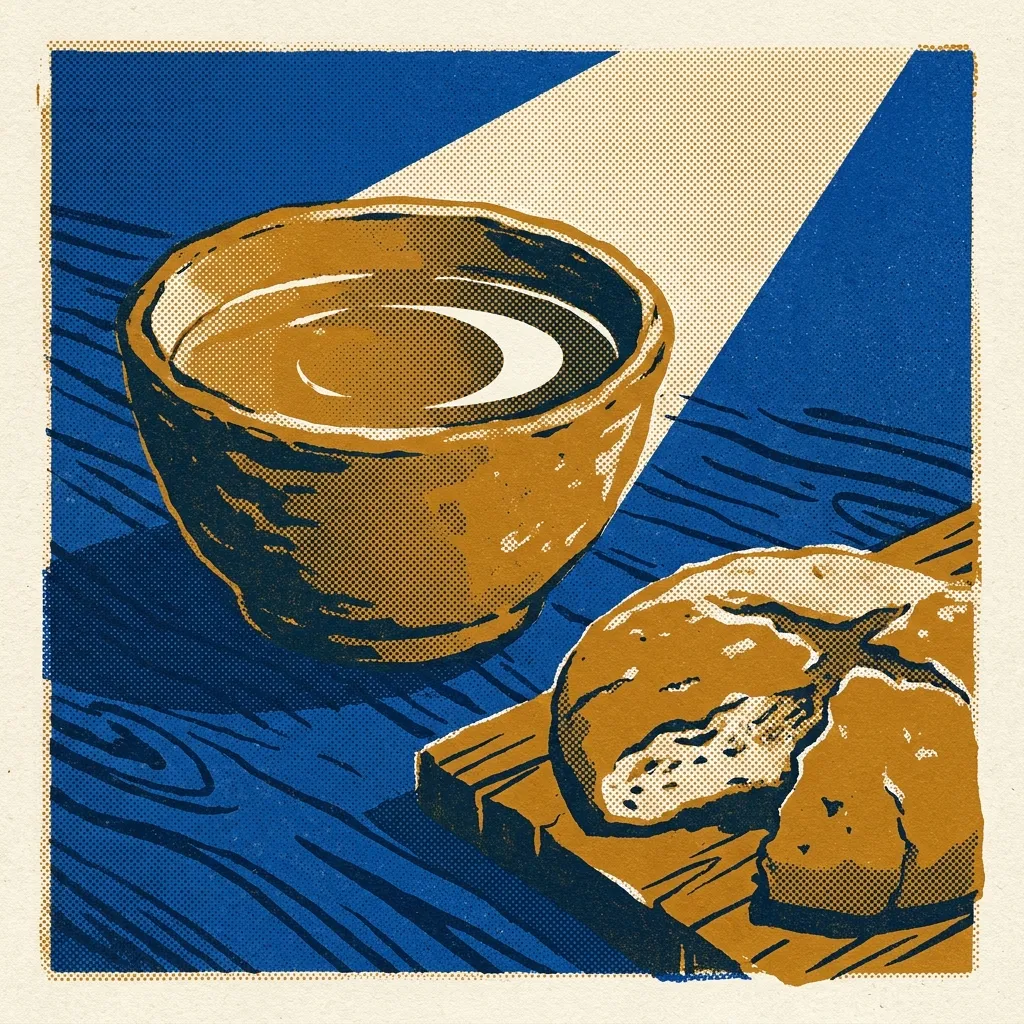
Jesus declares ‘I am the bread of life’ — the first of seven great ‘I am’ statements, claiming to be the ultimate source of spiritual satisfaction
John 6:34-35
Opening
Then Jesus declared, ’I am the bread of life. Whoever comes to me will never go hungry, and whoever believes in me will never be thirsty.’
John 6:35 (NIV)

“Obj Menorah Seven Flames” — Christopher James Parker + AI, to God be the Glory, 2026
Jesus is not just the provider of the bread; he is the bread of life. True, lasting satisfaction is found not in the gifts God gives, but in God himself.
Jesus’s statement, ‘I am the bread of life,’ is the first of seven such ‘I am’ statements in John’s Gospel. These are not casual descriptions. The phrase ego eimi is a direct echo of God’s revelation of his covenant name to Moses in Exodus 3:14. When Jesus uses this phrase, he is making a claim to divine identity. He is saying, ‘I am the personal, self-existent God, present and active among you.’ By linking this divine name to ‘the bread of life,’ Jesus is claiming to be the ultimate source of all spiritual nourishment and satisfaction.
Jesus attaches a double promise to this declaration. First, ‘Whoever comes to me will never go hungry.’ This speaks to the deepest longings and desires of the human heart — the hunger for meaning, purpose, love, and acceptance. Jesus claims that a personal relationship with him satisfies this hunger completely and permanently. Second, ‘Whoever believes in me will never be thirsty.’ This addresses our spiritual thirst — the thirst for righteousness, for forgiveness, for a right relationship with God. Jesus claims that belief in him quenches this thirst forever.
The parallelism of ‘coming to me’ and ‘believing in me’ shows that these are two sides of the same coin. True belief is not just intellectual assent; it is an active coming to Jesus, a personal entrusting of oneself to him.
It is important to understand what Jesus is not promising. He is not promising that believers will never be physically hungry or thirsty. He is not promising a life free from hardship, desire, or struggle. He is promising that in him, we can find a deep, abiding satisfaction of the soul that transcends our physical and emotional circumstances. This is the satisfaction that the apostle Paul spoke of in Philippians 4:12-13: ‘I know what it is to be in need, and I know what it is to have plenty. I have learned the secret of being content in any and every situation… I can do all this through him who gives me strength.’
The Wrong Bread
Liam watched as his family began to pack up their leftovers, dividing the remains of the Thanksgiving feast into containers. There was so much food, yet he knew that by tomorrow, it would be gone. The satisfaction was temporary. It was just manna.
He thought about his conversation with his father on the porch. It hadn’t been a dramatic, movie-like moment of reconciliation. His father had simply listened, nodded, and then said, ‘I’m tired, son. I’m just tired of it all.’
It was a simple admission, but it was more honest than anything Liam had ever heard him say. It was a confession of a deep, unsatisfied hunger, a weariness that no amount of business success could cure.
Later that evening, as the house grew quiet, Liam found his father in the living room, looking at old family photo albums. Liam sat down beside him.
‘You know,’ his father said, pointing to a picture of a much younger version of himself, standing proudly in front of his first office, ‘I thought that was it. I thought if I could just build this business, provide for my family, make a name for myself… I thought that would be enough. I thought that would be the bread that would make me feel full.’
He sighed, a deep, weary sound. ‘But the hunger never goes away. You just get hungrier for more. More success, more recognition, more security. It’s a treadmill.’
Liam, feeling a boldness he didn’t know he had, replied, ‘Jesus said, “I am the bread of life.” He didn’t say, “I will give you bread.” He said he is the bread. The satisfaction isn’t in what he gives us — success, health, a good life. The satisfaction is in him.’
His father was quiet for a long time. He slowly turned the pages of the album, past the pictures of business openings and awards, until he came to a photo of Liam’s baptism as a child. He stared at the picture, at the image of his young son, full of a simple, uncomplicated faith.
‘Maybe you’re right,’ his father said, his voice thick with emotion. ‘Maybe I’ve been eating the wrong bread my whole life.’
It wasn’t a conversion. It wasn’t a dramatic turnaround. But it was a crack in the armor. It was the beginning of a new kind of hunger, a hunger for something real, something that would last. It was a turning away from the temporary manna of the world and a turning toward the true bread of life.
Liam felt a profound sense of peace. The need to prove himself, to perform, to bring his own achievements to the family feast, had vanished. He had nothing to offer but his own hunger, and he was beginning to realize that was the only thing required. He had come to the feast empty-handed, only to find that the feast itself was being offered to him.
Liam’s father represents the universal experience of pursuing temporary bread — career success, legacy, material provision — only to discover a hunger that never goes away. Jesus’s claim to be the bread of life speaks directly to this unfillable void.
The First 'I Am' — A Claim to Divine Identity
Jesus’s claim to be the source of ultimate satisfaction is a theme that runs throughout the Old Testament. The prophets often spoke of a future time when God would satisfy the deepest longings of his people. Isaiah 55:1-2 says, ‘Come, all you who are thirsty, come to the waters; and you who have no money, come, buy and eat! … Why spend money on what is not bread, and your labor on what does not satisfy? Listen, listen to me, and eat what is good, and you will delight in the richest of fare.’ Jesus is now claiming to be the fulfillment of this invitation. He is the ‘richest of fare,’ the one who truly satisfies. The invitation to ‘come, buy and eat’ is fulfilled in his call to ‘come to me and believe.’
HISTORICAL CONTEXT
The ‘I am’ statements in John’s Gospel are among the most significant christological claims in the New Testament. The phrase ego eimi echoes God’s self-revelation to Moses at the burning bush (Exodus 3:14), where God said, ‘I AM WHO I AM.’ For a first-century Jewish audience, this claim would have been unmistakable — and either the most wonderful truth or the most outrageous blasphemy.
The Greek double negative ou me used in John 6:35 (‘will never go hungry… will never be thirsty’) is the strongest form of negation possible in the Greek language. It means ‘by no means,’ ‘never ever,’ or ‘absolutely not.’ Jesus is making the strongest possible promise of complete and permanent satisfaction.
BRIDGE TO CHRIST
ANCIENT TRUTH
Jesus made the astonishing claim ‘I am the bread of life,’ using the divine name ego eimi to identify himself as the ultimate source of spiritual nourishment. He promised that whoever comes to him and believes will never hunger or thirst again.
The same restless hunger that drove the crowd to ask for bread drives us to pursue temporary satisfaction. The answer is the same: come to Jesus and believe. He is not just a teacher pointing the way; he is the bread of life itself.
MODERN APPLICATION
We still try to satisfy our spiritual hunger with substitutes — career achievements, relationships, entertainment, material possessions. Jesus’s promise remains: he alone can satisfy the deepest longings of the human heart. The satisfaction is not in what he gives, but in who he is.
NEW TESTAMENT ECHO
Paul echoes this theme of contentment in Christ in Philippians 4:12-13: ‘I know what it is to be in need, and I know what it is to have plenty. I have learned the secret of being content in any and every situation… I can do all this through him who gives me strength.’
REFLECT
What am I currently using as a substitute ‘bread of life’ to satisfy my spiritual hunger? How is it failing to deliver on its promise?
“Sym Bread Loaf Burgundy Linocut” — Christopher James Parker + AI, to God be the Glory, 2026
PRAYER
Posture: surrender
Jesus, you are the bread of life. Forgive me for trying to satisfy my soul with things that can never last. I come to you today, hungry and thirsty. Satisfy me with yourself. Amen.
IN YOUR OWN WORDS
TAKEAWAY
Stop snacking on spiritual junk food. Today, consciously turn away from one thing you use to numb your spiritual hunger (e.g., social media, entertainment, busyness) and spend that time feasting on the presence of Christ through prayer or Scripture.
LEAVING AT THE CROSS
RECEIVING FROM THE CROSS
CHECK YOUR UNDERSTANDING
FOR REFLECTION
FOR ACCOUNTABILITY PARTNERS
FURTHER READING
RELATED SCRIPTURES
John 6:25-40
The full passage covering the Bread of Life discourse
Exodus 3:14
God said to Moses, ‘I AM WHO I AM.’
Isaiah 55:1-2
Come, all you who are thirsty, come to the waters… Why spend money on what is not bread, and your labor on what does not satisfy?
Philippians 4:12-13
I have learned the secret of being content in any and every situation… I can do all this through him who gives me strength.
FOR DEEPER STUDY
Study all seven ‘I am’ statements in John’s Gospel (6:35, 8:12, 10:7, 10:11, 11:25, 14:6, 15:1)
GREEK VOCABULARY
The Bread of Life
In this passage, Jesus makes the first of his seven great ‘I am’ statements in John’s Gospel. He drops the metaphor and makes a direct, personal, and astonishing claim: he himself is the bread of life. Using the divine name ego eimi, he claims to be the ultimate source of spiritual life and the only one who can truly satisfy the deepest longings of the human heart.
I am the bread of life. Whoever comes to me will never go hungry, and whoever believes in me will never be thirsty.
LESSON FOR US
True, lasting satisfaction is not found in the gifts God gives, but in God himself. Jesus is not just the provider of the bread; he is the bread of life. The invitation is to come and believe — to find our deepest satisfaction in his person, not just his provisions.
Finished reading? Mark this day read.
BEFORE YOU GO
Anything you want to keep from today?
EUANGELION is a product of WokeGod LLC. Copyright © 2026 WokeGod LLC. All rights reserved.v0.8.37TermsPrivacyCookie PolicyCommunity GuidelinesContent Disclaimer