All those the Father gives me will come to me, and whoever comes to me I will never drive away.
John 6:37 (NIV)
EU•AN•GE•LION (YOO-AN-GEL-EE-ON) · εὐαγγέλιον — Good News
EUANGELION is a product of WokeGod LLC. Copyright © 2026 WokeGod LLC. All rights reserved.v0.8.37TermsPrivacyCookie PolicyCommunity GuidelinesContent Disclaimer
EU•AN•GE•LION (YOO-AN-GEL-EE-ON) · εὐαγγέλιον — Good News
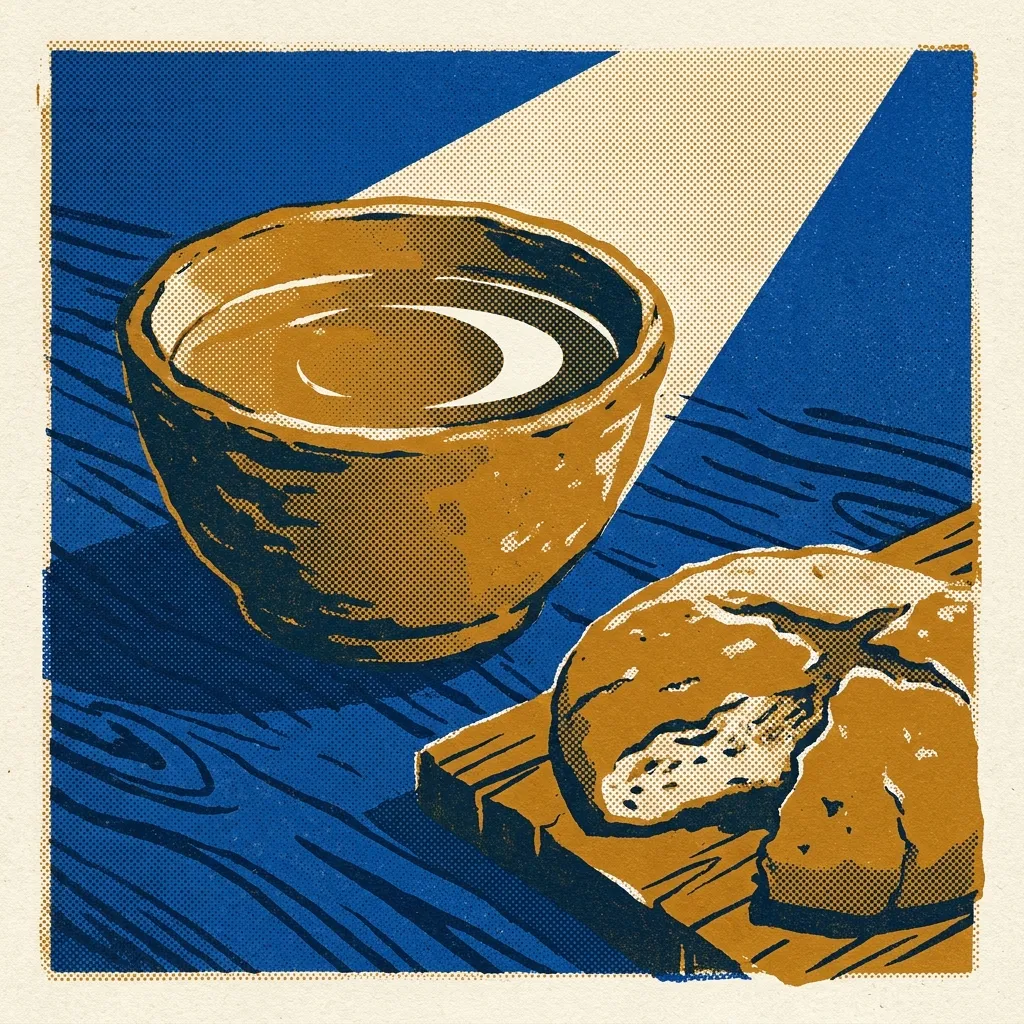
Holding in tension the seemingly contradictory truths of God’s sovereign choice and our personal responsibility to believe
John 6:36-37
Opening
All those the Father gives me will come to me, and whoever comes to me I will never drive away.
John 6:37 (NIV)

“Sym Thorn Branch Burgundy Linocut” — Christopher James Parker + AI, to God be the Glory, 2026
The tension between divine sovereignty and human responsibility is not a problem to be solved, but a comfort to be embraced. It means that our salvation is both divinely secured and personally assured.
Jesus begins verse 36 with a blunt diagnosis: ‘But as I told you, you have seen me and still you do not believe.’ Despite the miracles, despite the teaching, despite his clear declaration of being the bread of life, their hearts remain closed. This is the tragic reality of human unbelief.
In verse 37, Jesus presents two truths that seem to be in tension, but are in fact two sides of the same coin.
The first truth is divine sovereignty: ‘All those the Father gives me will come to me.’ This speaks to God’s sovereign initiative in salvation. It is the Father who chooses, who draws, who ‘gives’ people to the Son. Our salvation does not ultimately depend on our own wisdom, strength, or goodness, but on God’s gracious choice. This truth provides security and humility. It is security because our salvation is held in the powerful hands of God. It is humility because we cannot take credit for our own salvation; it is a gift from beginning to end.
The second truth is human responsibility and assurance: ‘Whoever comes to me I will never drive away.’ This speaks to the open invitation of the gospel and our responsibility to respond. The call is to ‘whoever’ — it is universal and unconditional. The promise is one of radical acceptance: ‘I will never drive away.’ No matter who you are, what you have done, or how weak your faith is, if you come to Jesus, he will receive you. This truth provides assurance and responsibility. It is assurance because we don’t have to wonder if we are ‘elect’; we just have to come. It is responsibility because the choice to come is ours to make.
John’s Gospel simply presents both truths side-by-side without trying to resolve the philosophical tension. Perhaps the best way to understand this is to see it from two different perspectives. Looking back from the perspective of a believer, one can see God’s sovereign hand at work, drawing them to himself at every step. Looking forward from the perspective of a seeker, one is confronted with a simple, direct command: come to Jesus. The choice is theirs to make, and the promise of acceptance is absolute.
The Football and the Paradox
Liam found his brother, Mark, in the backyard, throwing a football with his son. Mark was the successful one, the one who seemed to have it all figured out. He was a partner at his law firm, had a beautiful family, and lived a life that Liam had always envied.
‘He’s got a great arm,’ Liam said, nodding toward his nephew.
‘He does,’ Mark agreed, a rare, unguarded smile on his face. ‘But he’s got no interest in playing for the school team. He’d rather be in the drama club.’
‘Nothing wrong with that,’ Liam said.
‘I know. It’s just… not what I expected.’ Mark paused, then looked at Liam. ‘You seem different this year. Calmer.’
Liam was surprised. He hadn’t realized it was so noticeable. ‘I guess I am,’ he said. ‘I’ve been doing a lot of thinking. About what really matters.’
He decided to take a risk. ‘I’ve been reading the Bible. The Gospel of John.’
Mark raised an eyebrow. ‘Still into that stuff, huh? I grew out of it in college. All the contradictions, the theological debates… I couldn’t reconcile it all. Sovereignty and free will, predestination and choice… it’s a mess.’
‘I used to think so too,’ Liam said. ‘I used to think I had to have it all figured out before I could believe. But I read something that changed my perspective.’
He pulled out his phone and found the verse. ‘Jesus says, “All those the Father gives me will come to me, and whoever comes to me I will never drive away.”’
‘See?’ Mark said, gesturing with the football. ‘Contradiction. Either God chooses us, or we choose him. It can’t be both.’
‘I don’t think it’s a contradiction,’ Liam said slowly, working it out as he spoke. ‘I think it’s a paradox. It’s two truths held in tension. It’s like… it’s like this football. From my perspective, I can choose to pick it up or leave it on the ground. That’s my choice. But from a higher perspective, the laws of physics are governing everything about this ball — its mass, its velocity, the force of gravity acting on it. My choice and the laws of physics are both true at the same time. They operate on different levels.’
He continued, ‘The first part of the verse — “All those the Father gives me will come to me” — that’s God’s perspective. It’s the ultimate reality, the divine physics of salvation. It gives me security, knowing that this whole thing is in his hands, not mine.
‘The second part — “whoever comes to me I will never drive away” — that’s my perspective. It’s the human experience. It’s the open invitation. It gives me responsibility and assurance. It means the door is always open. I don’t have to worry about whether I’m one of the “chosen.” I just have to come.’
Mark was silent, looking at the football in his hands. He didn’t seem convinced, but he was listening.
‘I spent my whole life trying to earn my way, to prove I was good enough,’ Liam said. ‘For Dad, for you, for God. I thought it was all up to me. But realizing that God is the one doing the work, that he’s the one drawing me… it’s like a huge weight has been lifted. And at the same time, knowing that the invitation is open to whoever comes… it makes me want to come. It’s not a contradiction; it’s a comfort.’
He didn’t know if his words had made any difference to his brother. But they had made a difference to him. In trying to explain the paradox, he had come to understand it more deeply himself. His faith was not a philosophical puzzle to be solved, but a relationship to be lived, held securely in the tension between God’s sovereign hand and his open arms.
Liam’s conversation with his brother illustrates how the theological tension between sovereignty and free will can be a stumbling block for some, but when understood as a paradox rather than a contradiction, it becomes a source of deep comfort and security.
Two Truths, One Salvation
The interplay between divine sovereignty and human responsibility is a theme that runs throughout the Old Testament. In the story of Joseph, God sovereignly ordained Joseph’s journey to Egypt to save his family from famine. Yet, at every step, Joseph and his brothers made real, responsible choices — some good, some evil. At the end of the story, Joseph says to his brothers, ‘You intended to harm me, but God intended it for good’ (Genesis 50:20). Both truths were operative at the same time. Similarly, God sovereignly chose the nation of Israel to be his covenant people. Yet, he continually called them to choose to love and obey him (Deuteronomy 30:19-20).
HISTORICAL CONTEXT
Throughout church history, theologians have debated how to reconcile divine sovereignty and human responsibility. Some emphasize God’s sovereignty to the point of minimizing human responsibility (Calvinism). Others emphasize human free will to the point of minimizing God’s sovereignty (Arminianism). John’s Gospel simply presents both truths side-by-side without trying to resolve the philosophical tension.
In verse 37, notice the shift from the neuter collective ‘pan ho’ (‘all that’ the Father gives — referring to believers as a group) to the masculine singular ‘ton erchomenon’ (‘the one who comes’ — referring to the individual). God sees his people as a collective whole, but he welcomes them as individuals. This grammatical shift beautifully illustrates the two perspectives of salvation.
BRIDGE TO CHRIST
ANCIENT TRUTH
Jesus presented two truths in perfect tension: the Father sovereignly gives believers to the Son, and the Son will never drive away anyone who comes. The crowd had seen Jesus with their own eyes and still did not believe, revealing the tragic reality of human unbelief.
The same tension between divine initiative and human response plays out in our daily lives. We make real choices, and God is sovereignly at work. Rather than seeing this as a contradiction, we can embrace it as a comfort: God is in control, and the door is open.
MODERN APPLICATION
We often want to resolve the tension between sovereignty and free will into a neat theological formula. But the Bible invites us to live in the paradox. From God’s perspective, our salvation is secure in his sovereign hands. From our perspective, the invitation is open and the promise is absolute: come, and you will never be turned away.
NEW TESTAMENT ECHO
Paul holds both truths together in Philippians 2:12-13: ‘Continue to work out your salvation with fear and trembling, for it is God who works in you to will and to act in order to fulfill his good purpose.’ Human responsibility and divine sovereignty, side by side.
REFLECT
Do I tend to focus more on my responsibility to believe, or on God’s sovereign grace in drawing me? How does holding both truths in tension change my perspective?
“Obj Broken Pottery Shard” — Christopher James Parker + AI, to God be the Glory, 2026
PRAYER
Posture: trust
Father, thank you for the gift of faith. Thank you for drawing me to your Son. Jesus, thank you for the promise that you will never drive me away. Help me to rest in the security of your sovereign grace. Amen.
IN YOUR OWN WORDS
TAKEAWAY
Stop trying to figure it all out. Today, instead of trying to resolve the theological tension between sovereignty and free will, simply rest in the two promises of this verse: God is sovereignly at work, and Jesus will never turn you away.
LEAVING AT THE CROSS
RECEIVING FROM THE CROSS
CHECK YOUR UNDERSTANDING
FOR REFLECTION
FOR ACCOUNTABILITY PARTNERS
FURTHER READING
RELATED SCRIPTURES
John 6:25-40
The full passage covering the Bread of Life discourse
Genesis 50:20
You intended to harm me, but God intended it for good.
Deuteronomy 30:19-20
I have set before you life and death, blessings and curses. Now choose life.
Philippians 2:12-13
Continue to work out your salvation with fear and trembling, for it is God who works in you to will and to act in order to fulfill his good purpose.
FOR DEEPER STUDY
Read John 6:44-65 for more on divine drawing and human response
GREEK VOCABULARY
Those Who Saw but Did Not Believe
Despite seeing Jesus’s miracles, hearing his teaching, and witnessing his claim to be the bread of life, many in the crowd still did not believe. Jesus diagnosed their condition bluntly: ‘You have seen me and still you do not believe.’ Their unbelief set the stage for Jesus’s teaching on the Father’s sovereign role in drawing people to himself.
You have seen me and still you do not believe.
LESSON FOR US
Seeing is not always believing. Evidence alone does not produce faith. True belief requires both divine initiative (the Father drawing us) and human response (our choice to come). The good news is that the invitation is open to whoever will come, and the promise of acceptance is absolute.
Finished reading? Mark this day read.
BEFORE YOU GO
Anything you want to keep from today?
EUANGELION is a product of WokeGod LLC. Copyright © 2026 WokeGod LLC. All rights reserved.v0.8.37TermsPrivacyCookie PolicyCommunity GuidelinesContent Disclaimer