What shall we say, then? Shall we go on sinning so that grace may increase? By no means! We are those who have died to sin; how can we live in it any longer?
Romans 6:1-2 (NIV)
EU•AN•GE•LION (YOO-AN-GEL-EE-ON) · εὐαγγέλιον — Good News
EUANGELION is a product of WokeGod LLC. Copyright © 2026 WokeGod LLC. All rights reserved.v0.8.37TermsPrivacyCookie PolicyCommunity GuidelinesContent Disclaimer
EU•AN•GE•LION (YOO-AN-GEL-EE-ON) · εὐαγγέλιον — Good News

How did the early church understand the relationship between God’s grace and moral responsibility?
Romans 6:1-2
Opening
What shall we say, then? Shall we go on sinning so that grace may increase? By no means! We are those who have died to sin; how can we live in it any longer?
Romans 6:1-2 (NIV)

“Sym Pitcher Clay Linocut” — Christopher James Parker + AI, to God be the Glory, 2026
Grace doesn’t give us license to continue in sin but transforms our relationship to sin, making us people who are grieved by failure rather than comfortable with it.
Paul’s emphatic rejection of the idea that grace encourages sin addresses a theological error that has appeared throughout church history, known as antinomianism (literally ‘against law’). Some in the Roman church were apparently arguing that since grace increases where sin abounds, believers should sin more to give God more opportunities to show his grace.
The objection follows a certain logic: God’s grace is magnified when it covers great sin (Romans 5:20), more sin would result in more grace and greater glory to God, therefore Christians should sin more. This logic appears sound on the surface but reveals a fundamental misunderstanding of what grace actually does in the believer’s life.
Paul’s response—μή γένοιτο (me genoito)—is his strongest possible rejection. The strength of his rejection indicates that he considers this misunderstanding of grace to be not just wrong but dangerous and offensive.
Paul’s argument against antinomianism is based on the reality of what happens to believers in conversion. He argues that believers have ‘died to sin’ (v. 2), which makes continued living in sin both illogical and impossible for those who truly understand their new identity. This ‘death to sin’ is not a gradual process but a definitive event that occurred at conversion.
Paul uses baptism as an illustration of the believer’s union with Christ in his death and resurrection (vv. 3-4). Going under the water symbolizes death and burial with Christ, representing the end of the old life dominated by sin. Coming up from the water symbolizes resurrection with Christ, representing the beginning of new life characterized by righteousness.
Paul’s concept of dying to an old way of life echoes the Exodus narrative. Just as Israel ‘died’ to their old life of slavery in Egypt and was ‘raised’ to new life as God’s free people, believers die to slavery to sin and are raised to freedom in Christ. The concept also appears in Ezekiel’s vision of the valley of dry bones (Ezekiel 37), where God promises to bring his people from death to life.
Central to Paul’s argument is union with Christ—believers are so closely identified with Jesus that his death and resurrection become theirs. Christ’s death to sin becomes the believer’s death to sin, Christ’s resurrection to new life becomes the believer’s resurrection to new life, and Christ’s victory over sin and death becomes the believer’s victory.
Paul describes the believer’s former identity as having been ‘crucified with him’ (v. 6). The ‘old self’ refers to the person we were before conversion. This crucifixion is described as a completed event, not an ongoing process.
Based on the reality of what God has done, Paul issues commands: ‘Count yourselves dead to sin’ (v. 11), ‘Don’t let sin reign’ (v. 12), and ‘Offer yourselves to God as instruments of righteousness’ (v. 13).
Paul concludes by explaining that believers are ‘not under law but under grace’ (v. 14). Grace doesn’t eliminate moral standards but provides both the motivation and the power to meet them. This teaching helps distinguish between legitimate struggle (believers who hate their sin, confess it, and genuinely desire to change) and illegitimate license (using grace as an excuse to continue in sin without genuine repentance).
From License to Transformation
One month after his conversation with Pastor Williams, Marcus Thompson found himself in an unexpected situation. His gambling addiction support group had asked him to share his story with a new member—a young man named Jake who was struggling with the same issues Marcus had faced.
‘The thing is,’ Jake said after Marcus had shared about his repeated failures and God’s ongoing forgiveness, ‘it sounds like you’re saying God will just keep forgiving me no matter how many times I mess up. So why should I even try to stop? If his grace covers everything, maybe I should just accept that I’m going to be a gambling addict and trust that God will forgive me each time.’
Marcus felt a chill as he recognized his own thinking from just a few months earlier. He had used God’s promise of forgiveness as a kind of insurance policy—a safety net that allowed him to continue in destructive behavior without fully confronting the need for change.
‘Jake, I understand why you’d think that way because I thought the same thing,’ Marcus replied. ‘But I’ve learned there’s a huge difference between struggling with sin and using grace as an excuse to keep sinning. When I was using God’s forgiveness as a license to gamble, I wasn’t really repenting—I was just managing my guilt.’
Marcus paused, remembering his own journey. ‘Real repentance isn’t just feeling sorry about the consequences of sin. It’s recognizing that the sin itself is incompatible with who I am in Christ. When I gamble, I’m not just making a poor choice—I’m acting like someone who doesn’t trust God to provide for my needs, someone who thinks I can find satisfaction in something other than him.’
Jake looked skeptical. ‘But you said you’ve failed repeatedly. How is that different from what I’m talking about?’
‘The difference is direction and desire,’ Marcus explained. ‘When I fail now, it grieves me because it contradicts who I know I am in Christ. I don’t want to gamble—it feels foreign to my new nature. Before, when I was using grace as a license, I wanted to gamble and was just looking for a way to manage the guilt. The struggle itself is evidence that God is changing me, even when I don’t see perfect victory.’
Marcus opened his Bible to Romans 6. ‘Paul addresses this exact question. Some people in the early church were apparently saying, “If grace increases where sin abounds, let’s sin more so grace can abound even more.” Paul’s response is basically, “Are you crazy? That completely misunderstands what grace does to us.”’
As their conversation continued, Marcus realized that his own understanding of grace had been transformed through his struggle. He had moved from seeing grace as permission to sin to seeing it as power to change. The same forgiveness that covered his failures also provided the motivation and strength to pursue transformation.
Marcus’s mentoring conversation with Jake illustrates the critical difference between struggling with sin while grieving over it and using grace as a license to continue sinning without genuine repentance.
Grace as Power, Not Permission
Paul’s teaching had several practical implications for how the early church should understand and live out their faith: **Baptismal Significance:** Baptism wasn’t just a ceremony but a declaration of radical transformation and commitment to new life. **Community Standards:** The church should expect and encourage holy living among its members, not tolerate continued sinful behavior. **Pastoral Care:** Church leaders should help believers understand their new identity and live consistently with it. **Evangelistic Message:** The gospel includes both forgiveness of sin and transformation of life—it’s not just about getting to heaven but about becoming new people. Paul’s teaching continues to address contemporary misunderstandings of grace, including cheap grace (the idea that grace costs nothing and requires no response), therapeutic Christianity (focusing on how faith makes us feel better while ignoring its moral demands), and cultural accommodation (using grace to justify conformity to cultural standards that contradict biblical values). On the other hand, it also addresses perfectionism—the opposite error of thinking that any ongoing struggle with sin indicates false faith. Paul’s teaching maintains a careful balance: Grace provides forgiveness, new identity, power for transformation, and ultimate victory over sin. Responsibility involves recognizing our new identity, choosing to live consistently with it, and actively resisting sin’s influence. This balance avoids both legalism and antinomianism.
HISTORICAL CONTEXT
The theological error Paul addresses—antinomianism, literally ‘against law’—has appeared throughout church history in several forms: practical antinomianism (using grace as an excuse for continued sin), theological antinomianism (teaching that God’s law has no role in Christian life), and evangelical antinomianism (emphasizing justification by faith while neglecting sanctification).
Paul’s phrase me genoito (‘By no means!’) is the strongest possible rejection in Greek. He uses it fourteen times in Romans alone, always to reject conclusions that would logically follow from his teaching if misunderstood. The phrase could be translated ‘God forbid!’ or ‘Perish the thought!’—indicating he considers the misunderstanding not just wrong but dangerous and offensive.
BRIDGE TO CHRIST
ANCIENT TRUTH
Paul emphatically rejected the idea that God’s grace encourages sin. He taught that believers have died to sin through union with Christ, making continued living in sin both illogical and incompatible with their new identity.
The same misunderstanding of grace that Paul confronted in the first-century Roman church appears in every generation. Different cultures, same temptation to cheapen grace. Different centuries, same need to understand that grace transforms rather than permits.
MODERN APPLICATION
Stop using God’s grace as an excuse for continued sin. Identify one area where you’ve been presuming on his forgiveness instead of seeking his power for transformation. The difference between struggling with sin and using grace as license is the direction of your desire.
NEW TESTAMENT ECHO
Paul’s teaching that believers have ‘died to sin’ doesn’t mean they never sin, but that sin no longer has the right or power to rule over them. The old self was crucified with Christ—the question is whether we’ll live in the reality of that truth.
REFLECT
How does understanding that I have ‘died to sin’ change my relationship to patterns of behavior that once controlled me?
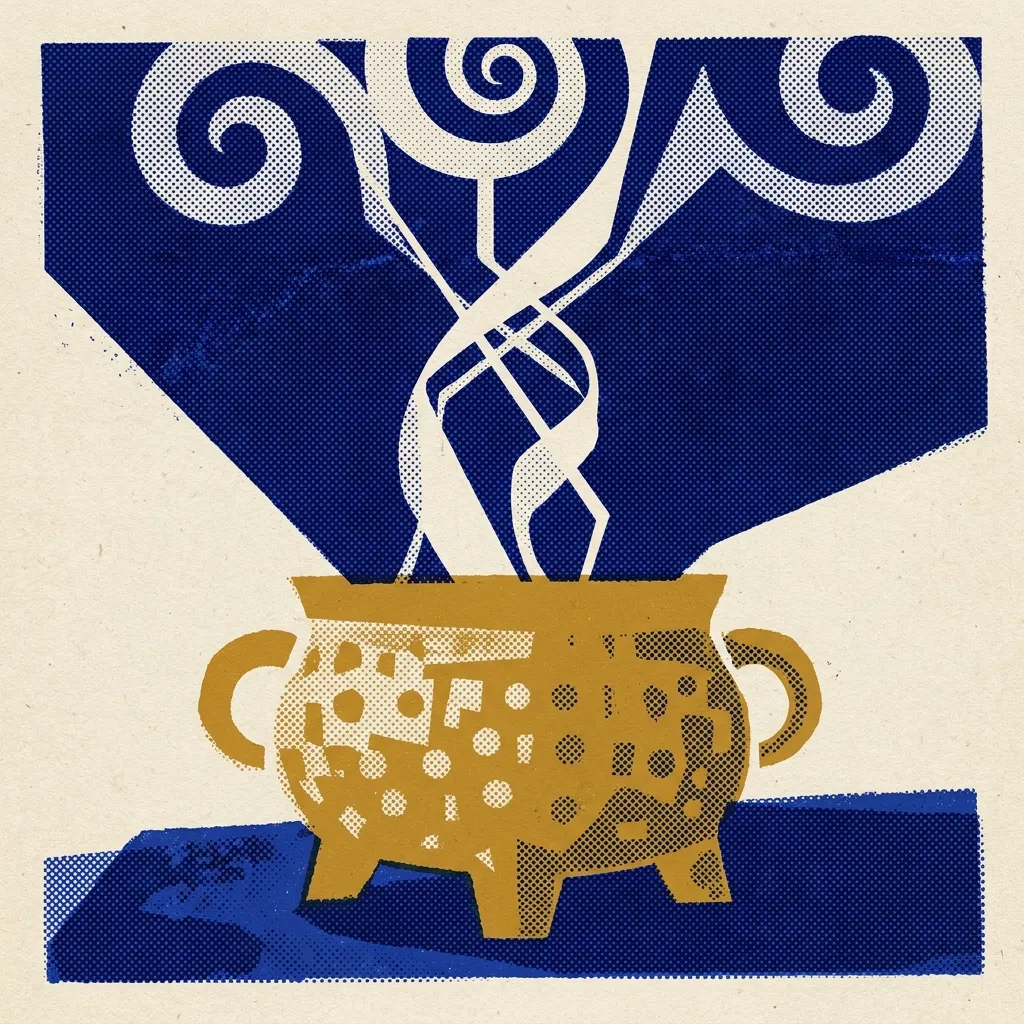
“Obj Bronze Censer Smoke” — Christopher James Parker + AI, to God be the Glory, 2026
PRAYER
Posture: surrendered-trust
Help me understand what it means to have died to sin and to live in the power of your resurrection. Show me where I’ve been using your grace as an excuse rather than as power for change. Give me the courage to count myself dead to sin and alive to you, and to offer every part of myself as an instrument of righteousness. Amen.
IN YOUR OWN WORDS
TAKEAWAY
Stop using God’s grace as an excuse for continued sin. Identify one area where I’ve been presuming on his forgiveness instead of seeking his power for transformation.
LEAVING AT THE CROSS
RECEIVING FROM THE CROSS
CHECK YOUR UNDERSTANDING
FOR REFLECTION
FOR ACCOUNTABILITY PARTNERS
FURTHER READING
RELATED SCRIPTURES
Ezekiel 36:26-27
I will give you a new heart and put a new spirit in you; I will remove from you your heart of stone and give you a heart of flesh. And I will put my Spirit in you and move you to follow my decrees.
Romans 5:20
But where sin increased, grace increased all the more.
Romans 6:14
For sin shall not be your master, because you are not under the law but under grace.
FOR DEEPER STUDY
Read the full context of Paul’s teaching on dying to sin and living in Christ
Study how the abuse of grace has appeared throughout church history and how the church has responded
The Grace Defender
Paul was uniquely qualified to address the abuse of grace because he was the foremost teacher of grace in the early church. He understood that true grace doesn’t lower moral standards but transforms people from the inside out. His emphatic rejection of antinomianism demonstrates that the same apostle who taught ‘where sin increased, grace increased all the more’ also taught that grace demands transformation, not permission to continue sinning.
What shall we say, then? Shall we go on sinning so that grace may increase? By no means! We are those who have died to sin; how can we live in it any longer?
LESSON FOR US
True grace doesn’t give us license to continue in sin but transforms our relationship to sin, making us people who are grieved by failure rather than comfortable with it.
Finished reading? Mark this day read.
BEFORE YOU GO
Anything you want to keep from today?
EUANGELION is a product of WokeGod LLC. Copyright © 2026 WokeGod LLC. All rights reserved.v0.8.37TermsPrivacyCookie PolicyCommunity GuidelinesContent Disclaimer