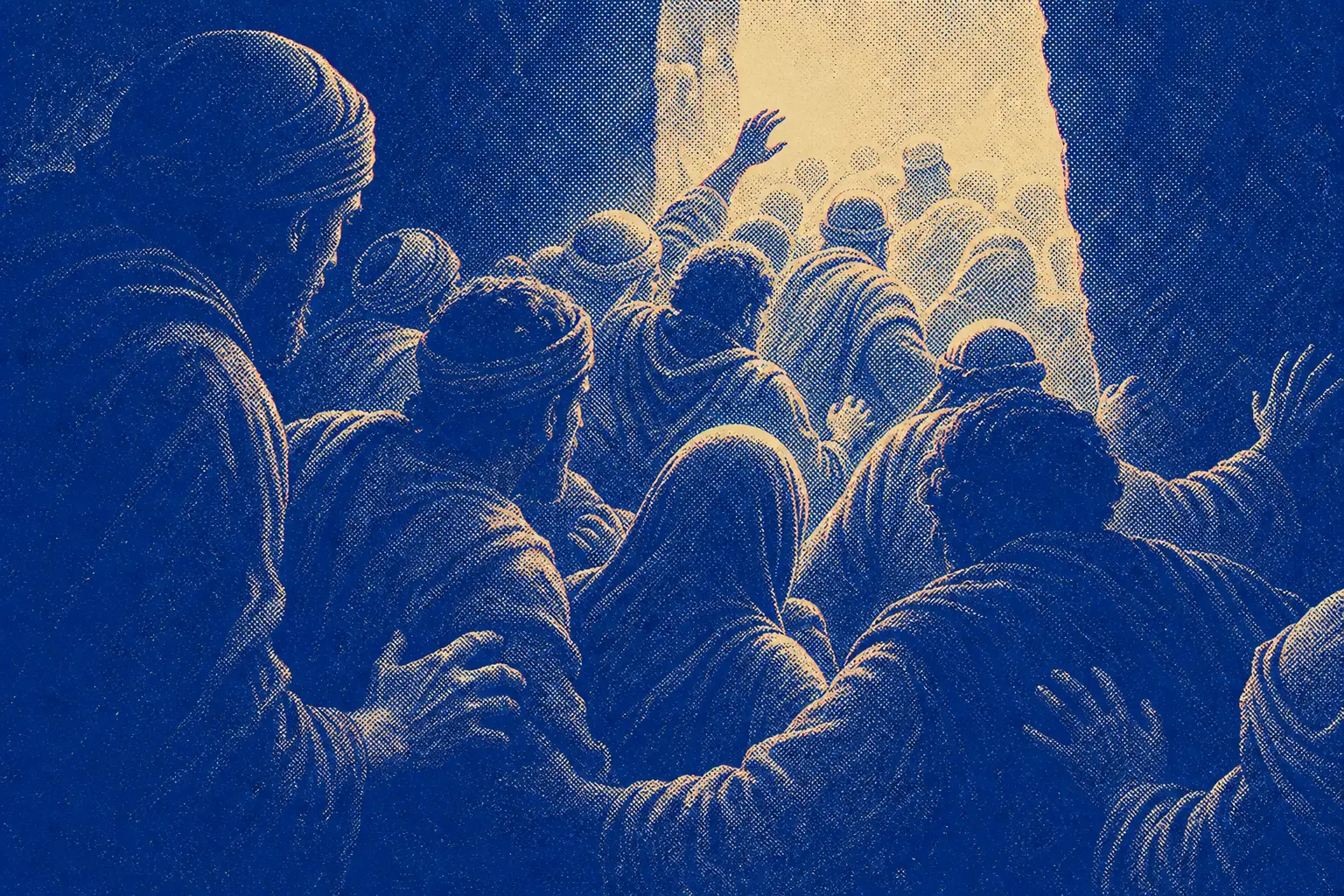
Having therefore, brethren, boldness to enter into the holiest by the blood of Jesus,
Hebrews 10:19 (KJV)
The room from Tuesday, named directly — and the word attached to entering it is boldness.
EU•AN•GE•LION (YOO-AN-GEL-EE-ON) · εὐαγγέλιον — Good News
EUANGELION is a product of WokeGod LLC. Copyright © 2026 WokeGod LLC. All rights reserved.v0.8.37TermsPrivacyCookie PolicyCommunity GuidelinesContent Disclaimer
EU•AN•GE•LION (YOO-AN-GEL-EE-ON) · εὐαγγέλιον — Good News

One man became anyone. One day a year became any day. By proxy became in person.
Hebrews 10:19-22; Romans 8:15-17
Opening
Having therefore, brethren, boldness to enter into the holiest by the blood of Jesus,
Hebrews 10:19 (KJV)
The room from Tuesday, named directly — and the word attached to entering it is boldness.
Of all the words that could have been chosen for how a person now enters God’s presence, this is a surprising one.
Parrēsia is not a religious term. It is a political one. It described the freedom of a citizen to speak plainly in public — the liberty of someone who belongs there and does not have to watch what they say.
That is the word Hebrews attaches to the holiest place. Not permission. Not access. Freedom of speech.
So the invitation is not merely that the door is unlocked. It is that you may come in and talk like someone who belongs in the room.
Tuesday was one man, once a year, in silence, with the tent emptied. Today is anyone, any day, speaking freely.
REFLECT
Do you speak to God like a citizen or like someone who might be asked to leave?
A Short Prayer
Father, I still come to You carefully, as though I were on probation. Teach me the freedom I actually have. Amen.
IN YOUR OWN WORDS
Having therefore, brethren, boldness to enter into the holiest by the blood of Jesus, By a new and living way, which he hath consecrated for us, through the veil, that is to say, his flesh; And having an high priest over the house of God; Let us draw near with a true heart in full assurance of faith, having our hearts sprinkled from an evil conscience, and our bodies washed with pure water.
Hebrews 10:19-22 (KJV)
The invitation, with its grounds stated first. Everything before let us draw near is the reason you may.
Put Tuesday and today side by side, because the letter to the Hebrews clearly means you to.
Tuesday: one man could enter. Today: brethren — the whole room being addressed.
Tuesday: one day in the year. Today: no day is named, because no day is excluded.
Tuesday: the tent had to be emptied of everyone else. Today: let us draw near. Plural. Together.
Tuesday: by proxy, through a priest who went in on your behalf. Today: in person, with a high priest who is already inside and stays there.
Tuesday: in silence, and carefully. Today: with parrēsia, the freedom to speak everything.
Every single limit is turned over. And notice the letter does not do this by lowering the standard. It does not say the holiest place turned out to be less holy than everyone thought.
The room did not change. The way in did.
That distinction is the most important sentence in this week. The holiness did not reduce by one degree. Your standing changed.
There is one more inversion, and it is the quietest of them.
On Tuesday the nation waited outside while one man did the approaching. Whatever happened in there happened to him, and the people received the result of it secondhand.
Today the verb is plural. Let us draw near. Nobody is waiting outside for a report.
That is why Friday will be about one another rather than about private discipline. The letter does not move from drawing near to holding fast to considering one another by changing the subject. Company is what nearness produces.
And he said, I beseech thee, shew me thy glory. And he said, I will make all my goodness pass before thee, and I will proclaim the name of the Lord before thee; and will be gracious to whom I will be gracious, and will shew mercy on whom I will shew mercy. And he said, Thou canst not see my face: for there shall no man see me, and live.
Exodus 33:18-20 (KJV)
Moses asks for the thing this week is about, and is told plainly that it cannot be given.
Moses asks for one thing, and it is the boldest request in the Old Testament. Shew me thy glory.
He is not a beginner. He has already been up the mountain. He speaks with God, the text says elsewhere, as a man speaks to his friend. If anyone had standing to ask, it was him.
And he is refused. Thou canst not see my face: for there shall no man see me, and live.
Notice the refusal is not disciplinary. God is not annoyed with him. The sentence gives a reason, and the reason is about survival, not about worthiness. It is the same otherness Tuesday was about. A man does not survive that unshielded.
What God does instead is famous. He puts Moses in a cleft of the rock, covers him while the glory passes, and lets him see the back of it.
Covered by a hand, in a gap in a rock, allowed a glimpse of the aftermath. That is the high-water mark of nearness in the entire Old Testament. That is as good as it got for the man who knew God best.
Hold that, and then read what Paul says happened to that refusal.
There is a detail in the refusal that is easy to walk past.
God does not simply say no. He says what He will do instead — I will make all my goodness pass before thee, and I will proclaim the name of the Lord before thee.
So the answer to the biggest request in the Old Testament is a partial yes, arranged carefully so the man survives it. Goodness rather than face. A name proclaimed rather than a form seen. A rock, and a hand.
Even in refusal, God is engineering the maximum nearness the situation allows. That is the character running under this whole week. He is not rationing out of reluctance. He is rationing out of physics.
The holiness did not reduce by one degree. Your standing changed.
But their minds were blinded: for until this day remaineth the same vail untaken away in the reading of the old testament; which vail is done away in Christ. But even unto this day, when Moses is read, the vail is upon their heart. Nevertheless when it shall turn to the Lord, the vail shall be taken away. Now the Lord is that Spirit: and where the Spirit of the Lord is, there is liberty. But we all, with open face beholding as in a glass the glory of the Lord, are changed into the same image from glory to glory, even as by the Spirit of the Lord.
2 Corinthians 3:14-18 (KJV)
Paul answers Exodus 33 directly, using the vocabulary of veils and of glory that Moses was refused.
Paul is not making a general point about spiritual insight here. He is answering Moses.
The request in Exodus was to see glory. The refusal was that no man sees and lives. The compromise was a cleft, a covering hand, and a glimpse of the back.
Paul writes: we all, with open face, beholding the glory of the Lord.
Every term is the Exodus term, and every one is reversed. Not one man but we all. Not covered but with open face. Not the back of the glory but the glory of the Lord. Not a glimpse that nearly killed him but a beholding that changes you.
And sitting in the middle of it: where the Spirit of the Lord is, there is liberty.
That is the second freedom word in one day. Hebrews gives parrēsia for how you enter; Paul gives liberty for what it is like once you are in.
Then the outcome, and it takes us all the way back to Monday. We are changed into the same image — eikōn, the Genesis word — from glory to glory.
The image made in Genesis 1 and hidden in Genesis 3 is being restored. And the mechanism is not effort. It is looking at what Moses was not allowed to look at.
It is worth asking what beholding actually means here, because it is not a technique.
Paul says we behold as in a glass — a mirror. Ancient mirrors were polished metal, so the image was real but not sharp. He is not claiming we see more clearly than Moses did in every respect. He is claiming the covering is gone.
And the change he describes is passive. We are changed. Not we change ourselves by concentrating hard enough.
That is the difference between this and every self-improvement scheme that has ever borrowed Christian vocabulary. The looking is the participation. The changing is done to you.
For as many as are led by the Spirit of God, they are the sons of God. For ye have not received the spirit of bondage again to fear; but ye have received the Spirit of adoption, whereby we cry, Abba, Father. The Spirit itself beareth witness with our spirit, that we are the children of God: And if children, then heirs; heirs of God, and joint-heirs with Christ; if so be that we suffer with him, that we may be also glorified together.
Romans 8:14-17 (KJV)
Paul names what kind of nearness this is. Not audience with a monarch. Family.
Everything so far today has been about access. Romans goes further and names the relationship.
Paul says you did not receive the spirit of bondage again to fear. That phrase is doing careful work. He is not saying fear was never appropriate. He is saying it is not the arrangement you are under now, and you are not to go back to it.
What you received instead is the Spirit of adoption, whereby we cry, Abba, Father.
Abba is not a technical term and it is not baby talk either. It is ordinary household language for a father. It is what you would actually call him at the table.
So hold the two pictures against each other. Tuesday: one man, in a room, once a year, with the tent emptied and the nation waiting outside. Today: a child using the ordinary word for father, at any hour, out loud.
And then Paul escalates twice more, quickly. If children, then heirs. Not just welcomed — inheriting. And joint-heirs with Christ, which is a phrase worth stopping at, because it means the inheritance is not a smaller portion set aside for the newcomers.
This is the inner frame of the whole week. Permission became proximity. You are not a petitioner who got approved. You are family, in the house, with standing.
One caution, because this is the day people overcorrect.
Adoption language does not make God your equal or your peer. Romans keeps both things in one paragraph — Abba, Father, and heirs of God, and suffering with him. Familiarity and weight sit together without embarrassment.
Friday will make this explicit with a sentence from Hebrews about a kingdom that cannot be moved and a God who is a consuming fire, arriving immediately after an instruction to serve Him acceptably.
Reverence and boldness are not on a dial where more of one means less of the other. The people in Scripture who speak to God most freely are the ones who know exactly who He is.
A Royal Priesthood
Peter reaches for an old phrase to describe ordinary Christians, and where he gets it from matters. He calls them a chosen generation, a royal priesthood, an holy nation. That language comes from Exodus 19:6, spoken to Israel at Sinai — the same book, the same era, the same covenant that then set up a priesthood of one family and a room that almost nobody entered. Tuesday had one priest who could go in, and he could die in there. Peter says you are one now. That is not a promotion earned by better behaviour. It is a description of what the torn veil made true about ordinary people.
HISTORICAL CONTEXT
1 Peter 2:9, quoting Exodus 19:6. The phrase was spoken to the whole nation before the Levitical priesthood was established, which is part of why Peter can apply it the way he does.
Ancient and Now
ANCIENT TRUTH
Moses asked to see glory and was covered in a cleft of rock, shown only the back of it, because no man sees God and lives.
Paul answers Exodus 33 with its own vocabulary — veil, glory, face — and reverses every term.
MODERN APPLICATION
You are invited to behold with an open face, and the beholding is what changes you into what you were made to be.
NEW TESTAMENT ECHO
2 Corinthians 3:18 — “we all, with open face beholding as in a glass the glory of the Lord, are changed into the same image from glory to glory.”
REFLECT
What would you say to God today if you genuinely had freedom of speech in the room?
Practice
A short written exercise. Ten minutes, and be concrete rather than pious.
Write the careful version
Write the prayer you would normally pray about the thing that is heaviest right now. The polite one, with the qualifications in it.
Underline the hedging
Go back and underline every phrase that was there to make you sound acceptable. If it is only, just, if it be Thy will used as a shield, or a reason you deserve to ask.
Write it again
Same request, no hedging. Address it to Abba. Say the thing plainly, the way you would to a father at a table.
Notice the difference
Read both. The second one is the one parrēsia describes. Nothing about God changed between the two.
It is worth being careful about what today does and does not claim, because the careless version of this day does real damage.
The careless version says God became more approachable — that He softened, that the fierce God of Tuesday matured into the warm God of Thursday. That is not what any of these texts say, and it quietly makes the Old Testament into an embarrassment.
Hold the line instead. There is none holy as the Lord, and there is none beside Him, and that was as true this morning as it was in Isaiah’s vision. The seraphim have not uncovered their faces. The whole earth is still full of His glory.
What changed is not the room. It is the way in — a new and living way, consecrated, through a veil that turned out to be a body.
So the boldness of today is not casualness. Parrēsia is not the confidence of someone who has decided God is not that serious. It is the confidence of someone who has understood exactly how serious He is, and has been told the way is open anyway.
That is a much better thing than a God who lowered the bar. It means the nearness you have is nearness to the real one.
Here is the practical shape of that, and it is worth taking into the rest of the day.
If God had merely softened, then your access would depend on Him staying in a good mood, and you would be reading Him constantly for signs of the weather changing back.
A lot of people pray exactly like that. Testing the temperature. Starting with something small to see how it lands.
But if the way in was opened by a finished work, the weather is not a factor. The route does not close on days when you have been unimpressive. It was not opened by your impressiveness in the first place.
That is what full assurance of faith means in verse 22. Assurance about the way, not about yourself.
Every Ground Is Given Before the Invitation
Look at the order of Hebrews 10:19-22 once more, because the sequence is the pastoral point. Having boldness — by the blood of Jesus. By a new and living way — which he hath consecrated. Having an high priest. Three grounds, all of them things done by someone else. Then, and only then, the imperative: let us draw near. Nothing in the list is a quality you supply. The invitation arrives already paid for, and the assurance mentioned in verse 22 is full assurance of faith — not full assurance of having done well this week.
HISTORICAL CONTEXT
The Greek keeps the participles subordinate to the main verb: three descriptions of what is already true, and one exhortation that follows from them.
Prayer
Father, Moses asked to see Your glory and was hidden in a rock and shown the back of it. I have been offered an open face, and I have spent most of my life looking somewhere else. Thank You that the way in is new and living, and that it was opened by someone who is already inside. Teach me to come in and speak freely, like a child at a table, and not like a man waiting to be told he may. Amen.
BREATH PRAYER
Not bondage — adoption.
IN YOUR OWN WORDS
Carry This
Today I will pray once without hedging, as a child and not a petitioner.
LEAVING AT THE CROSS
RECEIVING FROM THE CROSS
One Question
What changed between the arrangement of Leviticus and the invitation of Hebrews 10?
A Voice From the Church
Traditionally the thirteenth century BC
The man who spoke with God as a man speaks to his friend, led a nation out of Egypt, and still had to be hidden in a rock and covered by a hand when he asked to see glory.
I beseech thee, shew me thy glory.
LESSON FOR US
Moses wanted exactly the right thing and was told it would kill him. That request is the one this week answers — and the answer took a torn veil, not a change of mood.
Sources & Further Study
Learn Where Heaven and Earth Overlap
Strong's G3954 / G1504
RELATED SCRIPTURES
Exodus 19:6 (KJV)
“Ye shall be unto me a kingdom of priests, and an holy nation” — the phrase Peter applies to ordinary Christians.
1 Peter 2:9 (KJV)
“A royal priesthood” — Tuesday had one priest who could enter; today you are one.
Romans 8:29-30 (KJV)
Conformed to the image of his Son, and them he also glorified — the same road as 2 Corinthians 3:18, run inside one chapter.
Finished reading? Mark this day read.
BEFORE YOU GO
Anything you want to keep from today?
EUANGELION is a product of WokeGod LLC. Copyright © 2026 WokeGod LLC. All rights reserved.v0.8.37TermsPrivacyCookie PolicyCommunity GuidelinesContent Disclaimer