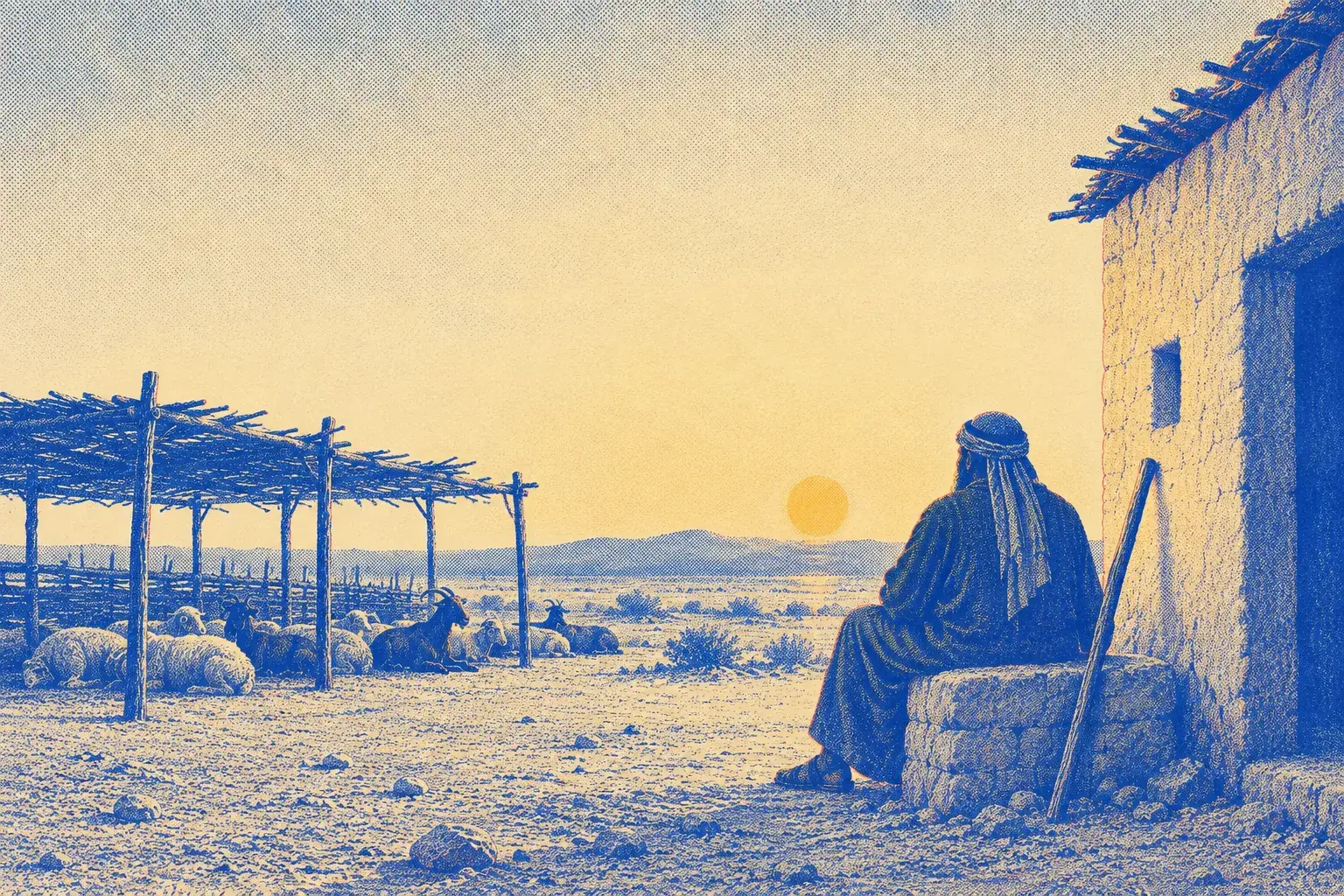
Your statutes are songs to me in the house of my pilgrimage.
Psalm 119:54 (BSB)
One line, and the whole week is in it. A man calls his life temporary lodging and calls the legal material his music.
EU•AN•GE•LION (YOO-AN-GEL-EE-ON) · εὐαγγέλιον — Good News
EUANGELION is a product of WokeGod LLC. Copyright © 2026 WokeGod LLC. All rights reserved.v0.8.33TermsPrivacyCookie PolicyCommunity GuidelinesContent Disclaimer
EU•AN•GE•LION (YOO-AN-GEL-EE-ON) · εὐαγγέλιον — Good News

One psalm verse holds the whole week: the statutes are songs to a man who calls his own life a stopover. Here is the week gathered, and the material to keep going without us.
Psalm 119:54
Your statutes are songs to me in the house of my pilgrimage.
Psalm 119:54 (BSB)
One line, and the whole week is in it. A man calls his life temporary lodging and calls the legal material his music.
Five days ago this started with a claim: the Law is wilderness literature, given to people between a rescue and an arrival.
The psalmist got there first, in nine words.
Your statutes are songs to me in the house of my pilgrimage.
Two halves. The statutes, which is the legal material — the fire regulations, the ordinances about ashes, the food rules. And the house of my pilgrimage, which in Hebrew is plural — the house of my sojournings. The word is the ordinary legal vocabulary for living somewhere you hold no title to, the way a resident foreigner does. It is about tenancy rather than travel.
He puts them together without explaining himself. The legislation is his music, and the reason is his address.
That is the whole week. Not that the Law is pleasant. That it is the right material for someone who has not arrived.
And it tells you something about when these books open up. Not when you have the time. When you are between things.
Today gathers up the five days, names two things this reading deliberately refused to claim, and hands you what you need to keep going without us.
REFLECT
Do this today: pick the one day of the five that stayed with you and read it again. Just that one. Do not start over from Monday.
A Two-Minute Prayer
Father, You gave these words to people on the move, and I have been on the move. Make them songs rather than weight. Amen.
IN YOUR OWN WORDS
The Five Days, One Sentence Each
Monday — Given In The Wilderness. Deuteronomy 8:2. Not one word of the Law was given to a settled nation in a finished country, and the stated purpose of the forty years was disclosure: to know what was in your heart. In Hebrew that clause has no verb in it at all, so it reads, word for word, that which is in your heart.
Tuesday — Your Sandals Did Not Wear Out. Deuteronomy 29:5. Forty years of provision recorded as the absence of wear, which is the kind you cannot see while it is happening. And the same sentence says they had no bread and no wine, which is why the verse cannot be used to promise anybody comfort.
Wednesday — Strange Fire. Leviticus 10:1-3. The same fire that consumed the offering while the nation cheered consumed two priests eight days later, and the wording is identical on purpose. Nearness is on God's terms, the terms were published in advance, and Aaron said nothing. We left the silence where the text leaves it.
Thursday — The One Who Cleanses Becomes Unclean. Numbers 19:21. The water that makes an unclean person clean makes a clean person unclean, and the chapter says so of four different men in turn. The remedy costs whoever administers it, and Hebrews names those exact ashes before saying how much more.
Friday — Not Too Difficult For You. Deuteronomy 30:14. After all the statutes, Moses says the word is not out of reach — not in heaven, not across the sea, but in your mouth and in your heart. Paul quotes it and says the near word is Christ. Then Deuteronomy 31 says to read the whole thing aloud to the children and the foreigners who do not know it yet.
Two Things We Refused To Claim
Both of these were available all week and both were left alone on purpose. Naming them is part of the week.
We did not tell you what your wilderness is for. Deuteronomy 8 says God led Israel and states His purpose for those forty years. It does not hand anybody the authority to interpret somebody else's hard stretch, and this reading did not try. The most Monday claimed is that the question changes shape: from why am I here to what is this surfacing. Anyone who tells you the specific purpose of your worst year is guessing, and they are usually guessing about somebody else's pain.
We did not resolve Leviticus 10. Two men died, their father said nothing, and God gave no reason. Wednesday ended there. Hebrews 10 opens a door in that passage and it does not explain it, and the honest thing was to say so rather than to finish the chapter on God's behalf. If that day left you unsettled, it was supposed to.
One smaller thing, in the same spirit. Tuesday's observation that Israel's sandals were intact while the Gibeonites faked worn ones is a reading of two texts side by side. It is not standard commentary, and it was offered as an observation rather than as received interpretation. You should know which parts of a week are the text and which are somebody's noticing.
Reading The Law On Your Own
This is the part that matters most, because the point of Friday was that the word is not out of reach and does not need a specialist to fetch it.
A passage trail, in order, roughly a week each. Start where the week ended and keep going. Deuteronomy 8 in full, then Deuteronomy 29 and 30 together, then Leviticus 8 through 10 as one unit, because the ordination and the fire belong together. Then Numbers 19 on its own, slowly. Then Hebrews 9 and 10, which will now read as an argument rather than as theology. Then Deuteronomy 31 and 32, the handover and the song. If you want the whole Torah, Exodus 19 through 24 is the covenant at the mountain and is the best place to begin the legal material properly.
How to read a legal chapter without stalling. Read it once for what it tells people to do. Read it again asking who pays, who is included, and who is protected — the Law answers those three questions constantly, and they are usually the argument. Then look for the reason clauses. The phrases beginning so that and because are where the legislation explains itself, and they are easy to skim past.
Free primary texts, all of them lawful to read without paying anyone. The Berean Standard Bible is public domain and is the translation used all week. The King James, American Standard, Young's Literal, Darby and the Bible in Basic English are all public domain, and reading a legal verse in two of them at once shows you where the translators were uncertain. For commentary, John Calvin's harmony of the last four books of Moses and his Romans commentary are both free at the Christian Classics Ethereal Library, as are Chrysostom's homilies on Matthew, Romans and Hebrews and Gregory of Nazianzus's second oration. Every quotation used this week came from those editions and each one is cited by volume and translator in that day's resources.
Videos worth the time. The BibleProject animated overviews of Leviticus, Numbers and Deuteronomy run eight to nine minutes each and give you the shape of a book before you read it. Their overview of Hebrews does the same for the letter that argues from all of this. The four used this week are embedded in days one through five.
And the practice from Deuteronomy 31. Read some of it out loud to somebody who does not know it. That instruction was given as a standing practice rather than as a reward for having understood it first.
Carrying It Forward
I will read one more chapter of the Law this week than I would have, and I will read some of it out loud to one person.
LEAVING AT THE CROSS
RECEIVING FROM THE CROSS
Sources & Further Study
RELATED SCRIPTURES
FOR DEEPER STUDY
Hebrew: the form in Psalm 119:54 is megurai, a masculine plural construct with a first-person suffix, from the noun at Strong’s H4033, a sojourning-place; Brown-Driver-Briggs cites this verse and renders it “in the house of my pilgrimage”, and cites Genesis 47:9 for the years of a sojourning. The root is gur, Strong’s H1481, which BDB gives as turning aside from the road for a lodging, dwelling as a newcomer without original rights; the related noun ger, Strong’s H1616, is the resident alien named in Deuteronomy 31:12 among those the Law is to be read aloud to. Two cautions are observed in the text above. The King James “pilgrimage” suggests a journey with a destination to a modern ear, and the Hebrew root is about staying somewhere as a non-citizen rather than travelling, so the image used here is tenancy. And the verse makes the statutes the psalmist’s songs in the house, not the house itself; the reading that Scripture becomes the sojourner’s shelter is a devotional addition rather than the text. Hebrew: chuqqim, Strong’s H2706, statutes or decrees, the legal material the psalmist calls his songs. No new external quotations are introduced on this day, in keeping with the house rule that a recap adds no new teaching; every quotation used in this week is cited by volume, translator and edition in the resources of the day it appears on. Public-domain sources named above are the Berean Standard Bible, which is released to the public domain, and the King James, American Standard, Young’s Literal, Darby and Bible in Basic English versions, all public domain; the commentaries named are available free at the Christian Classics Ethereal Library. The series brief, including the per-day translation rationale and the editorial decisions this day names, is at content/series-briefs/given-in-the-wilderness.md and the source pack at content/source-packs/given-in-the-wilderness.md.
Finished reading? Mark this day read.
BEFORE YOU GO
Anything you want to keep from today?
EUANGELION is a product of WokeGod LLC. Copyright © 2026 WokeGod LLC. All rights reserved.v0.8.33TermsPrivacyCookie PolicyCommunity GuidelinesContent Disclaimer