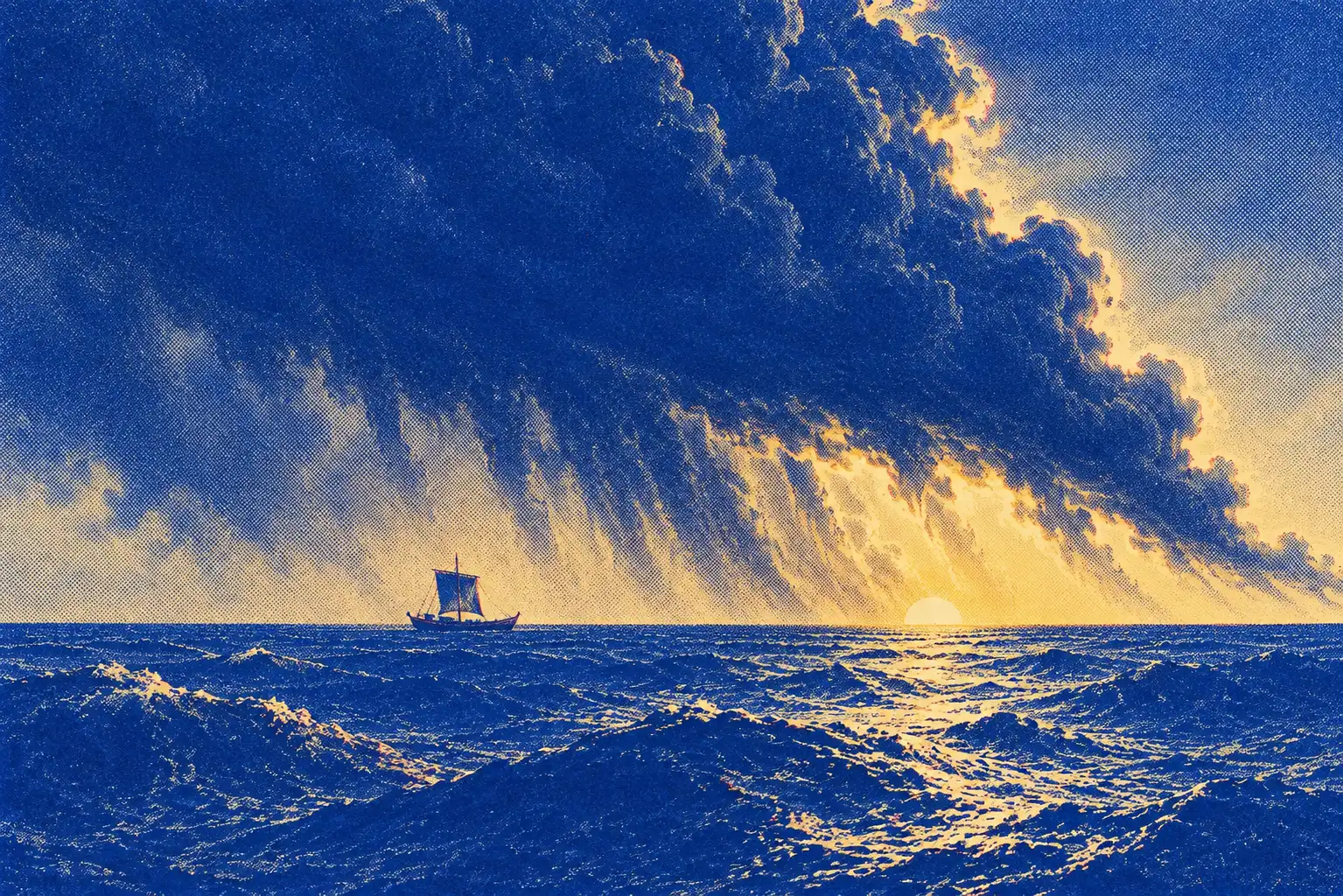
But my eyes are fixed on You, O GOD the Lord. In You I seek refuge; do not leave my soul defenseless.
Psalm 141:8 (BSB)
A prayer that carries David’s name, prayed with trouble all around him. It gathers this week into a single line.
EU•AN•GE•LION (YOO-AN-GEL-EE-ON) · εὐαγγέλιον — Good News
EUANGELION is a product of WokeGod LLC. Copyright © 2026 WokeGod LLC. All rights reserved.v0.8.37TermsPrivacyCookie PolicyCommunity GuidelinesContent Disclaimer
EU•AN•GE•LION (YOO-AN-GEL-EE-ON) · εὐαγγέλιον — Good News
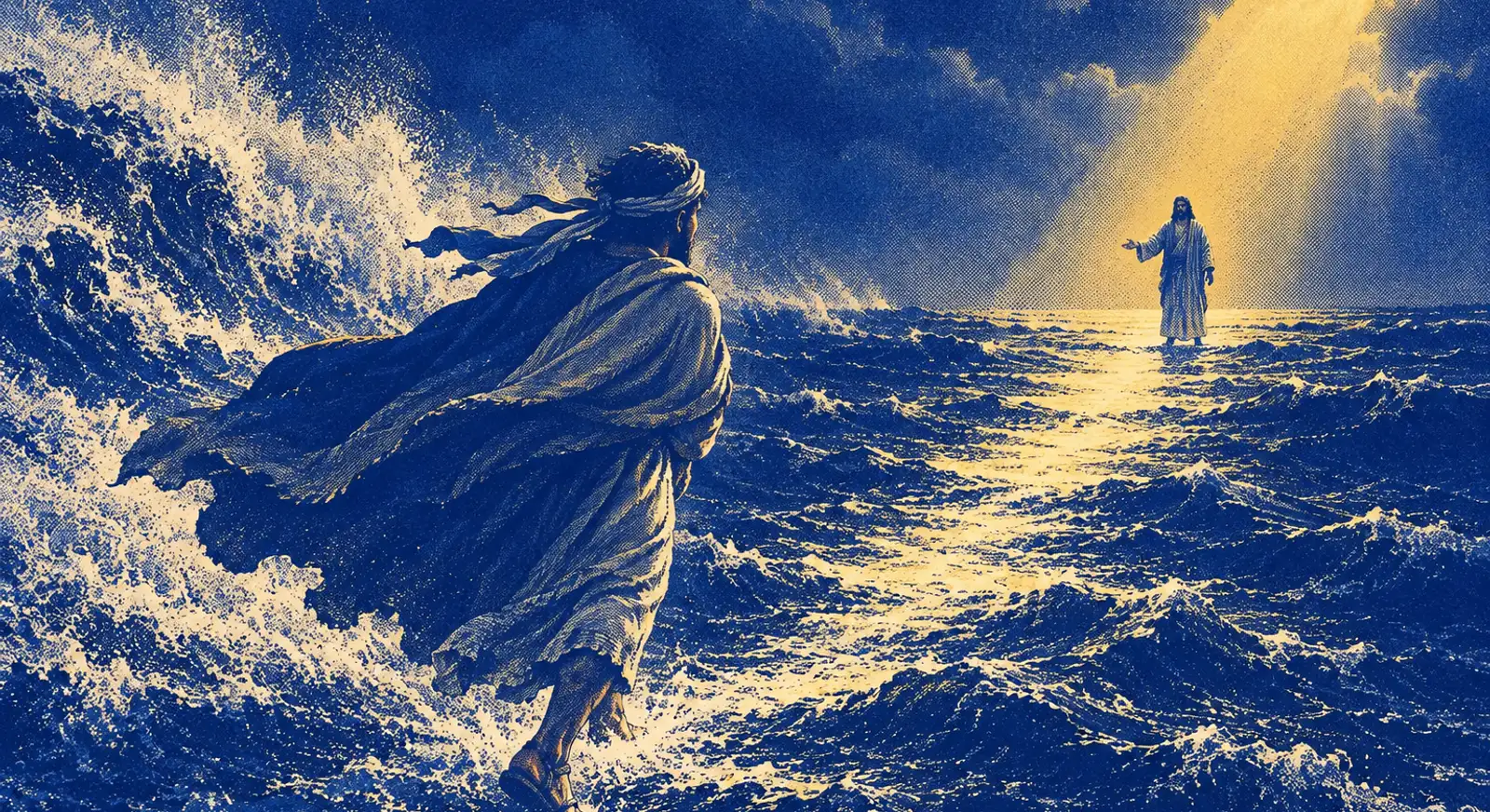
Five days on one lake: sent out, spoken to, called, held, and joined in the boat. Day 6 gathers them, hands back one word and one practice from each, and says plainly what the week did not claim.
Psalm 141:8; Matthew 14:22-33
Opening
But my eyes are fixed on You, O GOD the Lord. In You I seek refuge; do not leave my soul defenseless.
Psalm 141:8 (BSB)
A prayer that carries David’s name, prayed with trouble all around him. It gathers this week into a single line.
This week needed five days to walk through twelve verses. Today it can be said in one line of a psalm. But my eyes are fixed on You.
The psalm begins that line with the word but. David is praying about people who mean him harm, and the very next verse asks God to keep him from the snares they have laid. He does not pretend they have gone away. They are there, but his eyes are somewhere else.
The wind was real from the first evening to the last minute of that night. Nobody in the story is told to deny it. They are shown, one day at a time, somewhere better to look.
If you remember nothing else from these days, keep that one small word. The trouble is what it is, but my eyes are on You.
REFLECT
Do this today: write Psalm 141, verse 8 on a card and put it wherever you most often check the thing you worry about. It might be beside your phone, on a screen, or on the dashboard. Let it be the first thing your eyes meet there.
A Two-Minute Prayer
Lord, the wind has not gone anywhere, and I will not pretend it has. But my eyes are fixed on You. In You I seek refuge. Do not leave me defenseless. Amen.
IN YOUR OWN WORDS
The Five Days
Day one: He Made Them Get In. Jesus compelled the disciples into the boat and went up the mountain to pray. The boat met a headwind on the route He chose. They could not see Him, and Mark says that He could see them. A storm does not prove that you left the path, and a storm that began some other way is seen just the same. Psalm 77 gave us a road through the sea with no footprints on it. Hudson Taylor, nearly wrecked in his first week at sea, said he was content to be found seeking to obey.
Day two: It Is I. In the last watch of the night He came walking on the sea, where Job says God alone walks, and they took Him for a ghost. He spoke before He did anything about the wind. Take courage! It is I. Do not be afraid. Fear had given Him the wrong name, and He answered it with His own. David Livingstone read one promise beside the Zambezi and wrote, I feel quite calm now, before anything around him had changed.
Day three: Seeing the Wind. Peter asked for a command and was given one word. He walked on the water, and then he saw the wind, though Matthew reports no change in the weather. Ecclesiastes names the mistake: he who watches the wind will fail to sow. Jehoshaphat shows the way out when he prays, we do not know what to do, but our eyes are upon You. Looking at real things is no fault. The fault is looking that never ends in a step. Lilias Trotter called the cure standing full face to God.
Day four: Lord, Save Me. Sinking, Peter prayed three words, and the hand came immediately. Jesus called him little-faith while He was holding him, and little faith is still faith. Not everyone in deep water is pulled out, and the chapter that tells Peter's rescue begins with the death of John the Baptist. So we read on in Hebrews, to the one who shared our humanity so that by His death He might free those held by the fear of death. John Chrysostom pictured a mother bird under a falling nestling. Dwight Moody admitted that on the sinking ship it was different, and that relief came in prayer.
Day five: Those in the Boat. The wind grew tired when Jesus climbed in. The men in the boat bowed down and said, Truly You are the Son of God. Nobody was given an explanation. Agur's riddle asked who has gathered the wind in His hands. The boat held the answer. Long afterward Peter, expecting to die, told the church to keep its eyes on the word, as on a lamp shining in a dark place, until the day dawns. Jonathan Edwards, once terrified of thunder, learned to sing in it.
Where the Week Sits in the Story
We spent the week in the MINISTRY of Jesus, on a single night after He fed five thousand. That night kept speaking in the language of the EXODUS: a sea, a night watch, a road through deep water, and a hand that takes hold.
The prayers came from the KINGDOM, in psalms that picture trouble as a flood and God's help as a hand from above. The honesty came from the wisdom books, where Job, Agur and the Teacher of Ecclesiastes all admit that no human being holds the wind.
The night also looks ahead. The words spoken in the boat are spoken again at the cross, in the PASSION, and the one who took hold of Peter went through death Himself and was raised. Peter's letter carries the lesson into the CHURCH, where it is still being learned.
One Word for Each Day
This week leaned harder than usual on the Greek and the Hebrew. You do not need to keep all of it. Keep one word for each day.
Day one is anankazo, to compel. Jesus made them get in. Day two is ego eimi, it is I. Day three is shomer ruach, a watcher of wind. Day four is oligopistos, little-faith, which is still faith. Day five is kopazo, to grow weary, which is what the wind did when He got in. And today's is einai, my eyes.
The other words are in the notes on this day's page.
What Each Day Left You
Each day also left you something to do. None of it expires when the week does.
On the first day it was a breath prayer: I cannot see You, and You can see me. On the second you wrote down what fear had been calling the thing you dread, and folded the page into Matthew 14. Take it out today, and under fear's name for the thing, write what you would call it now.
On the third day you lifted your eyes off something that moves and prayed Jehoshaphat's sentence. On the fourth you learned Peter's prayer with your hands, one wrist gripped by the other. On the fifth you drew a boat with thirteen in it and wrote your own name inside.
Keep whichever one you will still be doing in a month.
What This Week Did Not Claim
Three things were left unsaid on purpose.
The words It is I are ordinary Greek speech, and they are also how the Greek Isaiah voices God. The words alone do not prove who Jesus is. The setting carries that weight.
The saying that Peter took his eyes off Jesus is not in the Gospel in those words. An early form of it comes from Matthew Henry, whom we quoted. Matthew says only that Peter saw the wind and was afraid, and he never says whether the wind rose while Peter walked.
And we did not say that every prayer for rescue is answered as Peter's was. The same Lord who caught him on the lake went through death Himself, and He holds His people through it.
Today's Commitment
I will carry one line out of this week: But my eyes are fixed on You. When the wind gets my attention, I will say that line out loud.
LEAVING AT THE CROSS
RECEIVING FROM THE CROSS
Sources & Further Study
RELATED SCRIPTURES
Matthew 14:27
But Jesus spoke up at once: “Take courage! It is I. Do not be afraid.”
Matthew 14:31
Immediately Jesus reached out His hand and took hold of Peter. “You of little faith,” He said, “why did you doubt?”
Ecclesiastes 11:4
He who watches the wind will fail to sow, and he who observes the clouds will fail to reap.
2 Chronicles 20:12
We do not know what to do, but our eyes are upon You.
Psalm 123:2
As the eyes of servants look to the hand of their master, as the eyes of a maidservant look to the hand of her mistress, so our eyes are on the LORD our God until He shows us mercy.
FOR DEEPER STUDY
Further Your Learning. A passage trail to read in order: Exodus 14:19 to 31; Psalm 77; Job 9:1 to 12; First Kings 19:9 to 13; Ecclesiastes 11:1 to 6; Second Chronicles 20:1 to 17; Matthew 14:1 to 36; Mark 6:30 to 56; John 6:1 to 21; Hebrews 2:14 to 18; Second Peter 1:12 to 19. A guided read: read Matthew 14:22 to 33 three times on three days. The first time, follow Jesus only, and note every place He is and everything He does. The second time, follow Peter only. The third time, follow the wind: mark where it starts, who notices it, and when it stops. Videos, all from BibleProject: “Gospel of Matthew Summary: A Complete Animated Overview (Part 2)”; “Dragons in the Bible? Yes.”; “God’s Name Has Changed?! (Learn Its Interesting Biblical History)”; “Book of Ecclesiastes Summary: A Complete Animated Overview”; “Why the Holy Spirit Isn’t Just a ‘Force’”; “Book of Psalms Summary: A Complete Animated Overview”; “Mark”; “Why Jesus Called Himself the Son of Man”; “Book of Job Summary: A Complete Animated Overview.” Free books to read online. At Project Gutenberg: J. Hudson Taylor, A Retrospect; John Bunyan, The Pilgrim’s Progress; Alexander Maclaren, Expositions of Holy Scripture on Matthew; W. G. Blaikie, The Personal Life of David Livingstone. At the Christian Classics Ethereal Library: Matthew Henry’s Commentary; Calvin’s Harmony of the Evangelists; the Olney Hymns of John Newton and William Cowper. At New Advent: John Chrysostom, Homilies on the Gospel of Matthew, Homily 50. At hymnologyarchive.com: Lilias Trotter, Focussed. At the Internet Archive: W. R. Moody, The Life of Dwight L. Moody; Charles Bridges, An Exposition of the Book of Ecclesiastes; the Works of Jonathan Edwards, volume 1. The words of the week, each with its plain meaning. From the Greek of the Gospels: anankazo, to compel, for what Jesus did when He sent them out. Basanizo, to torment, for what the waves did to the boat. Tharseite, take courage, which in the New Testament is always a command. Ego eimi, it is I. Elthe, come. Katapontizo, to be plunged into the open sea. Epilambanomai, to take hold, the grip of the hand. Oligopistos, little-faith. Distazo, to waver, to be of two minds. Kopazo, to grow weary, for what the wind did when He got in. From the Hebrew of the Old Testament: shemurot, the guards of the eyes, the eyelids. Derekh, a road, from the verb to tread. Iqqevot, heel-prints. Shomer ruach, a watcher of wind. Ruach by itself, which means wind and breath and spirit. Hevel, a vapor. Hoshi’eni, save me. Nephesh, soul or life, and in Psalm 69 perhaps the neck. Re’eh, see. Erekh appayim, long of nostrils, slow to anger. Einai, my eyes. More notes on care. The word for buffeted began on a goldsmith’s touchstone, but in the New Testament it means torment; the storm was never said to be testing the disciples like gold. He intended to pass by them: the verb is the one used when the LORD passes by Moses and Elijah, but Mark never says that he has Sinai in mind. Matthew does not quote Ecclesiastes, and Peter was not quoting Psalm 69; the passages share words and pictures, and that is all that was claimed. Only Matthew tells of Peter’s walk; Mark and John go from the voice straight to the boat. The story that William Cowper wrote his hymn after a cab driver got lost in fog is not supported by his own memoir, and was not used. Tradition names Solomon as the Teacher of Ecclesiastes; the book does not. The full source notes for each quotation and story are at the foot of the day on which it appears.
Finished reading? Mark this day read.
BEFORE YOU GO
Anything you want to keep from today?
EUANGELION is a product of WokeGod LLC. Copyright © 2026 WokeGod LLC. All rights reserved.v0.8.37TermsPrivacyCookie PolicyCommunity GuidelinesContent Disclaimer