Then the righteous will shine like the sun in the kingdom of their Father. He who has ears, let him hear.
Matthew 13:43 (BSB)
Two minutes with the sentence Jesus saved for last — His hardest story’s brightest line.
EU•AN•GE•LION (YOO-AN-GEL-EE-ON) · εὐαγγέλιον — Good News
EUANGELION is a product of WokeGod LLC. Copyright © 2026 WokeGod LLC. All rights reserved.v0.8.39TermsPrivacyCookie PolicyCommunity GuidelinesContent Disclaimer
EU•AN•GE•LION (YOO-AN-GEL-EE-ON) · εὐαγγέλιον — Good News

Jesus finishes His parable day the way He finishes the parable: with light. Wheat comes in, hidden faithfulness stops hiding, and Daniel’s oldest promise names who shines brightest. Between now and then, one thief on a cross shows how late a life can still be gathered.
Matthew 13:43
Opening
Then the righteous will shine like the sun in the kingdom of their Father. He who has ears, let him hear.
Matthew 13:43 (BSB)
Two minutes with the sentence Jesus saved for last — His hardest story’s brightest line.
REFLECT
The verb Jesus chose promises that hidden faithfulness will burst into visibility. What good in your life has gone entirely unseen — and what changes if its audience was never supposed to be now?
A Two-Minute Prayer
Sun of righteousness, the week has taught me how little of the field I can read. Today, show me its ending: light with healing in it, a barn worth the growing, and a gathering that surprises everyone. Keep me sowing toward that morning. Amen.
IN YOUR OWN WORDS
For, behold, the day cometh, that shall burn as an oven; and all the proud, yea, and all that do wickedly, shall be stubble: and the day that cometh shall burn them up, saith the Lord of hosts, that it shall leave them neither root nor branch. But unto you that fear my name shall the Sun of righteousness arise with healing in his wings; and ye shall go forth, and grow up as calves of the stall.
Malachi 4:1-2 (KJV)
שֶׁמֶשׁ צְדָקָה וּמַרְפֵּא בִּכְנָפֶיהָ
The Old Testament’s closing prophet describes a single coming day that arrives two ways: furnace for the arrogant, sunrise with healing for those who fear His name.
Every story hands its meaning backward from the end. A hard road in a tale that finishes at home reads as adventure; the same road in a tale that finishes nowhere reads as waste. People are built this way — we cannot say what a middle meant until we know where it goes. So the week’s last full question is the oldest one: how does the field end?
Jesus answers twice, in the same breath. For the weeds: bundles, fire, done. For the wheat: gather the wheat into my barn — and then, in the interpretation, the line He kept for last: then the righteous will shine like the sun in the kingdom of their Father.
Hold that ending against everything the week has watched, and its strangest gift appears. All season, no one could read the field. The servants could not — the whole drama ran on their blindness. So the harvest, when it comes, does more than sort; it discloses. For the first time, which stalk was which becomes public knowledge — and the reveal runs in both directions. Rows everyone had circled as ruined stand up golden. Stalks everyone had certified turn out hollow. The end of this story does more than relocate the wheat — it corrects every early reading anyone ever ran.
And mark the destination. A barn is where a farmer keeps what the whole year was for. The wheat comes in because it is wanted — carried, kept, brought home. Everything this week rehearsed — readings retired, wrath forwarded, tables kept — was the middle of a story that ends with the Owner walking His crop through His own doors and the light going on.
The rest of today walks that ending slowly: one day with two faces, a shore where a long catch finally gets sorted, and a promise about stars.
The harvest does not just sort the field. It publishes it.
In the Christian ordering of the Old Testament, the last prophetic voice belongs to Malachi, and his final page describes one day arriving two ways. For the arrogant and the evildoer: “the day cometh, that shall burn as an oven,” leaving “neither root nor branch” — stubble, the field’s leftover straw once the grain is gone. Evil’s long run ends as agricultural residue: nothing to regrow from, nothing to spread by. And the same sunrise lands on another group as something else entirely: “But unto you that fear my name shall the Sun of righteousness arise with healing in his wings; and ye shall go forth, and grow up as calves of the stall.” The identical morning — fire from one angle, medicine from the other, and afterward that giddy closing image: penned animals released into open pasture.
This is the double ending Jesus compresses into His parable’s final verses, and the church needs both halves as much as it ever did. Drop the stubble, and the barn goes sentimental — a hope with no answer for Ravensbrück, or the camps, or the weeds that broke into any particular life; mercy weighs little where nothing was ever at stake. Drop the sunrise, and the fire becomes the whole forecast — a religion of dread. Scripture refuses the choice. Spurgeon, in his sermon on the wheat and the barn, laid the two eras side by side in one calm sentence: “The word for this present is, ‘Let both grow together,’ but there will come a time when a final separation will be made.” The present has its word; the future has its own; confusing the two is where the week’s every error began.
And the interval between those two words is not slack in the schedule. Peter named its substance on the pivot day: patience, aimed at repentance. While the present’s word runs, the day’s assignments remain unpublished — no one alive stands finally filed under stubble or sunrise. Deferred judgment therefore reads less like neglect and more like a held door. The day is fixed; the lists are not; and the God who fixed the day has said plainly which face of it He wants each person to meet.
Which raises the question the rest of today answers: how late in a life can the door still be used? Scripture’s reply is a single scene on a hill outside Jerusalem, and it is more extreme than anyone would dare invent.
Ancient Truth, Modern Life
ANCIENT TRUTH
Malachi hands history one ending with two experiences: the same rising day, furnace to entrenched evil, healing light to those who fear God’s name. Nothing on the field survives unsorted — and nothing gets sorted before that morning.
A reckoning certain but future changes the present’s assignment. Since nothing is filed yet, every act toward another person is still input: the sown word, the kept table, the patient year may all be inside whatever turning their story has left. The sickle swings once, at ripeness, at a command that is not ours to give.
MODERN APPLICATION
The modern eye reads whole persons from single frames — one post, one failure, one bad year — and files them permanently. The Bible’s ending forbids exactly that speed. The day that sorts has not arrived, so every current reading of a person is a draft.
NEW TESTAMENT ECHO
“Then another angel came out of the temple, crying out in a loud voice to the One seated on the cloud, ‘Swing Your sickle and reap, because the time has come to harvest; for the crop of the earth is ripe.’” — Revelation 14:15 (BSB)
Begin with the verb. Not endure, not survive — shine, and in Greek a verb the New Testament spends exactly once: eklampsousin, light bursting out of concealment, sun from behind cloud. Jesus is drawing on a hope His hearers knew by heart, Daniel’s: “And many who sleep in the dust of the earth will awake… Then the wise will shine like the brightness of the heavens.” Resurrection language — the plainest the Old Testament gives — with Matthew’s intensifier on it: not the firmament’s glow but the sun’s. The harvest, in other words, ends in an unveiling. Lives illegible all season become suddenly, gloriously readable; the field’s whole hidden history comes to light at once. Which presses an urgent question on every life still in the rows: how late can a stalk still turn out to be wheat?
Scripture’s answer is a scene. Three crosses; the middle one bearing the Sower Himself, absorbing His field’s whole harvest of evil. On either side, two men under identical sentences. One mocks. The other, out of nowhere, tells the truth — “We are punished justly, for we are receiving what our actions deserve. But this man has done nothing wrong” — and then turns his head: “Jesus, remember me when You come into Your kingdom!” The answer comes back before sundown: “Truly I tell you, today you will be with Me in Paradise” (Luke 23:41-43). Weigh what that exchange establishes. Here is a life that read as weed from every angle, to every observer, for its entire length — a life with no years left to reform, no restitution possible, no fruit to show and no season left to grow any. And it is gathered. Not grudgingly, not provisionally: today, with Me. The final hour of a ruined life was still early enough, because who a person finally is gets settled at the end — and settled by the Judge, never by the crowd. One caution rides with the comfort, and honesty keeps it attached: the same afternoon held two thieves, and only one turned.
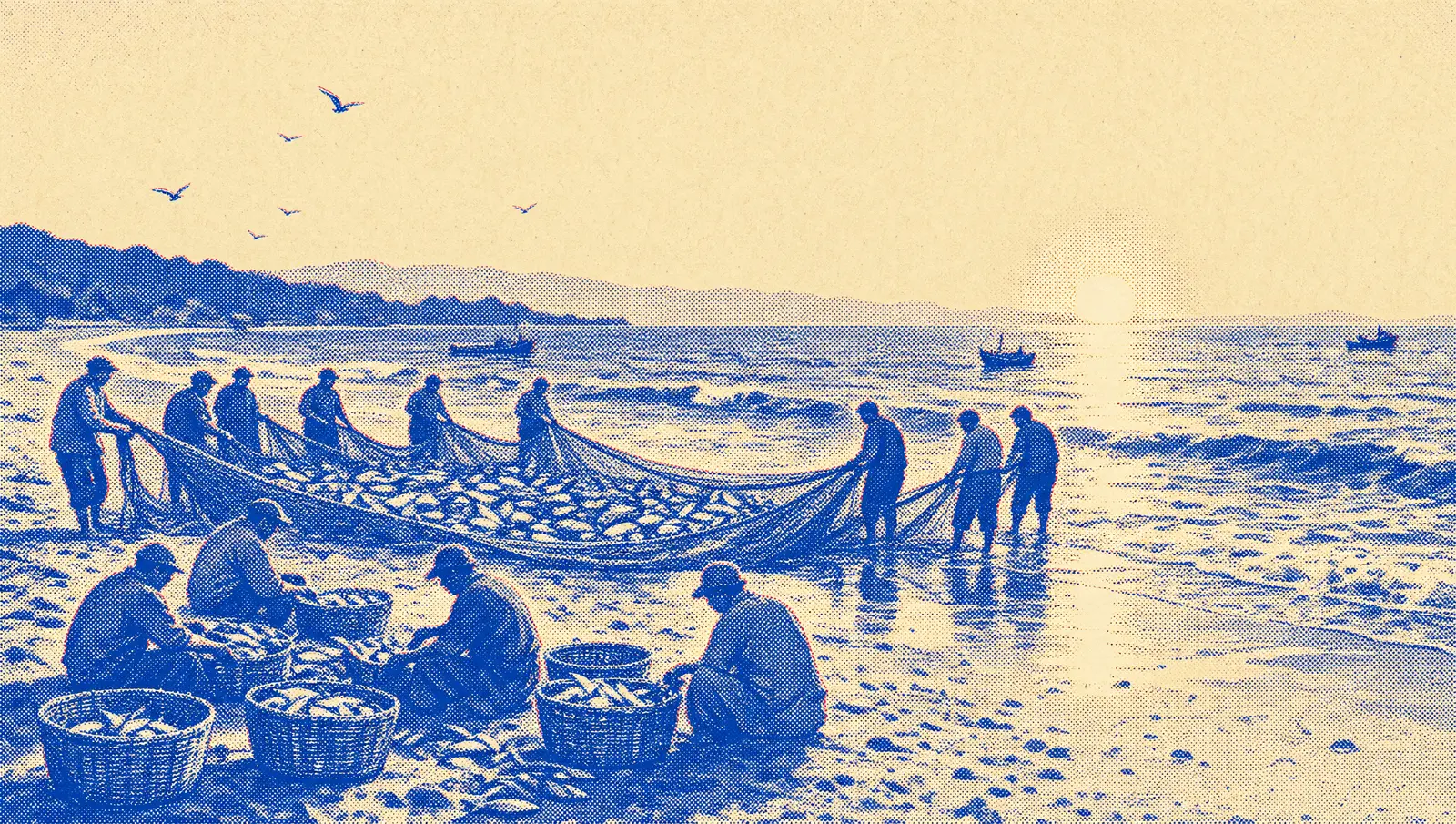
Jesus knew the point needed telling twice, so He closed His parable day by retelling the whole ending from the water. “Once again, the kingdom of heaven is like a net that was cast into the sea and caught all kinds of fish. When it was full, the men pulled it ashore. Then they sat down and sorted the good fish into containers, but threw the bad away. So will it be at the end of the age: The angels will come and separate the wicked from the righteous, and throw them into the fiery furnace, where there will be weeping and gnashing of teeth” (Matthew 13:47-50). Everything the field taught, the sea confirms. A dragnet is the least selective tool a fisherman owns — it sweeps, and takes all kinds. No sorting happens in open water; the crew sits down to it on the shore, unhurried, and the crew is the same one the field employed: angels. Even the furnace sentence returns nearly word for word — the Teacher underlining His own ending. And with that, the day’s full architecture stands visible: it opened with a sower throwing seed at every ground and closes with a net gathering every kind. Indiscriminate at both doors, and every act of separation reserved for the end.
Then Daniel finishes the promise with an aim. “And those who lead many to righteousness will shine like the stars forever and ever.” The brightest thing a human being can become, in the Bible’s oldest resurrection text, is a guide — a life other lives followed home. The ending reaches back into the middle and revalues it: every patient conversation, every unglamorous year of witness, every seed thrown at unpromising ground is raw material for that shining.
C.S. Lewis, closing his chapter on why God delays, drew the only sane conclusion: “God will invade… When that happens, it is the end of the world. When the author walks on to the stage the play is over… It will be too late then to choose your side… Now, today, this moment, is our chance to choose the right side.” The ending’s certainty was built to summon, with a deadline no one has seen — urgent because the shore exists, hopeful because the net is still moving.
Seven Years to the First Sheaf
William Carey reached India in November 1793 with a conviction, a reluctant family, and almost nothing else. What followed tested every sentence he had ever preached about perseverance: fever, poverty, isolation — and seven full years of ministry without a single convert. The cobbler-turned-linguist kept translating, kept preaching, kept planting a mission with nothing visible to show for it.
Then, on the last Sunday of 1800, his journal-letter finally recorded the day he had crossed an ocean for: “Dec. 29. — Yesterday was a day of great joy. I had the happiness to desecrate the Gunga, by baptising the first Hindoo, viz. Krishna, and my son Felix.” Krishna Pal, a Serampore carpenter of about thirty-five, went into the Hooghly River with the Danish governor watching from the bank — one convert after seven years, and Carey wrote “great joy” without a trace of irony.
Eleven years later the work burned. On the evening of March 11, 1812, fire took the Serampore print shop: fourteen founts of Asian type, ten Scripture translations in press, and the manuscript of his massive polyglot dictionary. Standing in the ruins, by an eyewitness’s report, he said that in one short evening the labors of years had been consumed, and that the Lord had laid him low that he might look more simply to Him. His own letter two weeks later held the same line: “The Lord has smitten us, he had a right to do so, and we deserve his corrections… I now, however, turn to the bright side… Our loss, so far as I can see, is reparable in a much shorter time than I should at first have supposed.”
Asked, near the end, how he wished to be remembered, he told his nephew — who printed the words after his death: “If he give me credit for being a plodder, he will describe me justly… I can plod. I can persevere in any definite pursuit. To this I owe every thing.” The plodding compounded: by the time he died, the mission he seeded had put the Scriptures into dozens of Asian languages — and the sheaves have not stopped coming in.
Carey is Daniel’s promise in work clothes — a life spent leading many toward righteousness, funded through seven empty years by a harvest he could not yet see. The certainty of the barn is what makes that kind of patience reasonable; the tears-to-sheaves arithmetic below is the math he banked on.
The Sower's Arithmetic
Psalm 126 states a promise with the precision of a ledger: “They that sow in tears shall reap in joy” — and then doubles down with Scripture’s most confident adverb: whoever goes out weeping with seed “shall doubtless come again with rejoicing, bringing his sheaves with him.” The psalm does not treat the tears as overhead; it counts them as seed — planted, not spent. For anyone whose long witness has produced mostly silence, that arithmetic reverses the books: nothing sown toward another person’s turning is lost inventory, whatever the current field shows. Carey drew on exactly this account for seven years, and it paid in sheaves.
HISTORICAL CONTEXT
Psalm 126 is a song of the return from exile — composed by a people who had done their sowing in Babylon’s fields and lived to carry sheaves home from ground that had once been their prison.
What does a certain, unveiling, twice-told ending change about an ordinary week? Three funded practices.
It funds the plod. Most witness is Carey’s kind — cumulative, unglamorous, results indefinitely pending. On any shorter accounting it looks like failure, which is why so much of it gets abandoned in year two. The barn re-runs the numbers. Work invested toward a scheduled harvest is agriculture, plain and long. The sower who keeps a long row going — the prayers kept up, the conversations reopened, the translation redone after the fire — is not being stubborn against the evidence. The decisive evidence simply is not in yet, and the psalm has already published the ending: sheaves, doubtless.
It closes the sorting office. The shore crew is staffed, the position was never posted, and every mid-water reading of a person now stands doubly discredited: wrong on the field’s terms, since green plants defy grading, and wrong on the net’s, since nothing is decided until the sand. Whatever roster survives in us after four days of this parable, today’s retelling repossesses it. All kinds are still in the sweep. Every file is still open. The catch has not landed.
And it recruits the voice. Daniel’s stars go to those who lead many to righteousness — a plural, active, speaking word. If the ending is fixed and the door is open, silence toward the people in our reach is the one posture with no future in it: kindness alone cannot tell anyone why the door exists or that it closes. Lewis’s now, today, this moment was written for readers, not professionals — for the friendship where the subject has never been raised, the table where hope has stayed politely implicit for years. The plod supplies the credibility; the voice supplies the news; the ending supplies the deadline. A fieldhand’s week has room for all three.
None of this asks anyone to manufacture certainty about who will stand where. The week’s whole discipline has been surrendering exactly that. It asks something smaller and harder: to live now as if the unveiling is real — sowing like the sheaves are certain, speaking like the door is open, refusing every reading the shore will overturn.
They that sow in tears shall reap in joy. He that goeth forth and weepeth, bearing precious seed, shall doubtless come again with rejoicing, bringing his sheaves with him.
Psalm 126:5-6 (KJV)
The exiles’ harvest song — tears counted as seed, sheaves promised with Scripture’s most confident adverb.
REFLECT
Carey worked seven years before the first sheaf. Which long row of yours is currently showing nothing — and what would this month look like if you trusted the reaping to God’s calendar instead of yours?
Today's Practice: A Picture of the Barn
An art response — attention as the offering; no skill required.
Choose
Find or make one image that says gathered, not merely spared: a sunrise, a bound sheaf, a full pantry shelf, a net drying on a rail.
Look
Give it two unhurried minutes. Let the week’s hardest rows — the ones you nearly finished reading — stand inside the same frame as the light.
Mark
Write across or beneath it: Then the righteous will shine like the sun. Put it where your most cynical hour will find it.
The week began in the dark: an enemy in the rows, everyone asleep, ruin sown so well it stayed hidden for a season. Stand at the far end now and look back. The enemy appears in one verse of one evening and never returns; every scene after belongs to the Owner — the No that saved the wheat, the oath that explained the waiting, the mustard and the leaven working the meantime, the fieldhands blessing both crops. And out ahead, fixed and dated, a morning: stubble where entrenched evil stood, healing carried in the light itself, the barn full, the hidden faithful blazing like the sun, stars for the guides. The dark was real all week. It was never winning.
Now bring the face you have carried through these days into that morning — the one you love who wants nothing to do with the God of this field. Their chapter tonight is not their ending; the thief’s eleventh hour is on the record precisely so that no watcher of any life concludes too early. While the net moves, they are in the sweep. While the door stands, the Voice is still calling down their road. And while you wait, your part has never changed: sow toward them, speak when the opening comes, keep their chair — and let God keep the timeline.
Tomorrow gathers the whole discourse into one view. The day after, the week closes in rest. Tonight, one sentence is enough to carry into sleep, and it should be His rather than ours: Then the righteous will shine like the sun in the kingdom of their Father. He who has ears, let him hear.
Prayer
Sun of righteousness, rise with healing — on the rows I tend, the rows I grieve, and the rows I have never noticed. Thank You for a thief remembered at the last hour, for a net still moving through the water, for sheaves promised to tears. I hand back, one more time, the sorting You never assigned me, and I ask instead for a sower’s stamina and a guide’s voice. When the unveiling comes, let people stand in the light because somebody kept sowing toward them — and let some of them stand there because of me. Amen.
BREATH PRAYER
Inhale: Sowing in tears — Exhale: reaping in joy.
IN YOUR OWN WORDS
Today's Commitment
I will keep my longest bare row in cultivation this month — the prayer resumed, the conversation reopened — and before the week ends I will tell one person, plainly and kindly, the hope I am holding for them.
LEAVING AT THE CROSS
RECEIVING FROM THE CROSS
Community Reflection
Malachi’s final prophecy describes the same coming day arriving as two different experiences. Which two?
A Voice From the Story
1761-1834, Northamptonshire and Serampore, India
A village cobbler who taught himself Greek, Hebrew, and half a dozen living languages over the workbench, then carried his family to India in 1793 to attempt what almost no Protestant had tried. Seven years passed before the first baptism — Krishna Pal, in the Hooghly, December 28, 1800, alongside Carey’s own son Felix. The 1812 fire took years of translation work in one evening; he rebuilt. By his death the Scriptures existed in dozens of Asian languages that had never before held them.
I can plod. I can persevere in any definite pursuit. To this I owe every thing.
LESSON FOR US
Carey never saw most of what he planted come in — he worked against the visible evidence, on the strength of a promised ending. That is witness funded by the barn: plodding toward sheaves that are certain, on a schedule that was never disclosed.
Sources & Related Study
C.S. Lewis, Mere Christianity, Book II, ch. 5, "The Practical Conclusion" (1952)
Source of today’s quotation on God’s delay and the Author walking on stage — verbatim from the full text: ‘When the author walks on to the stage the play is over… Now, today, this moment, is our chance to choose the right side.’
William Carey — primary sources
His journal-letter of December 29, 1800 (‘a day of great joy… baptising the first Hindoo, viz. Krishna, and my son Felix’) and his letter to Ryland of March 25, 1812 after the Serampore fire, both printed in Eustace Carey’s Memoir of William Carey (1836) and George Smith’s Life of William Carey (1885). ‘I can plod’ is the nephew’s printed recollection of Carey’s spoken words (Memoir, 1836); the fire-ruins sentence is eyewitness-reported speech (Thomason).
Charles Spurgeon, Sermon #3393, "Wheat in the Barn" (Matthew 13:30), MTP Vol. 60
Source of ‘The word for this present is, Let both grow together, but there will come a time when a final separation will be made.’
Hebrew and Greek data
eklampō (G1584, NT hapax; its form matches the Greek Daniel 12:3 the early church read); shemesh tsedaqah / umarpe bikhnafeha (Malachi 4:2 — H8121, H6666, H4832, H3671) — BibleHub interlinear and Strong’s.
RELATED SCRIPTURES
Daniel 12:2-3 (BSB)
“And many who sleep in the dust of the earth will awake… Then the wise will shine like the brightness of the heavens, and those who lead many to righteousness will shine like the stars forever and ever.”
Luke 23:42-43 (BSB)
“Then he said, ‘Jesus, remember me when You come into Your kingdom!’ And Jesus said to him, ‘Truly I tell you, today you will be with Me in Paradise.’”
Matthew 13:47-48 (BSB)
“Once again, the kingdom of heaven is like a net that was cast into the sea and caught all kinds of fish. When it was full, the men pulled it ashore. Then they sat down and sorted the good fish into containers, but threw the bad away.”
FOR DEEPER STUDY
Read Malachi 3:16-4:6 — the book of remembrance and the two-faced day — then sit once more with Luke 23:39-43, and let the thief’s afternoon set the outer limit of your hope for every unfinished life.
Finished reading? Mark this day read.
BEFORE YOU GO
Anything you want to keep from today?
EUANGELION is a product of WokeGod LLC. Copyright © 2026 WokeGod LLC. All rights reserved.v0.8.39TermsPrivacyCookie PolicyCommunity GuidelinesContent Disclaimer