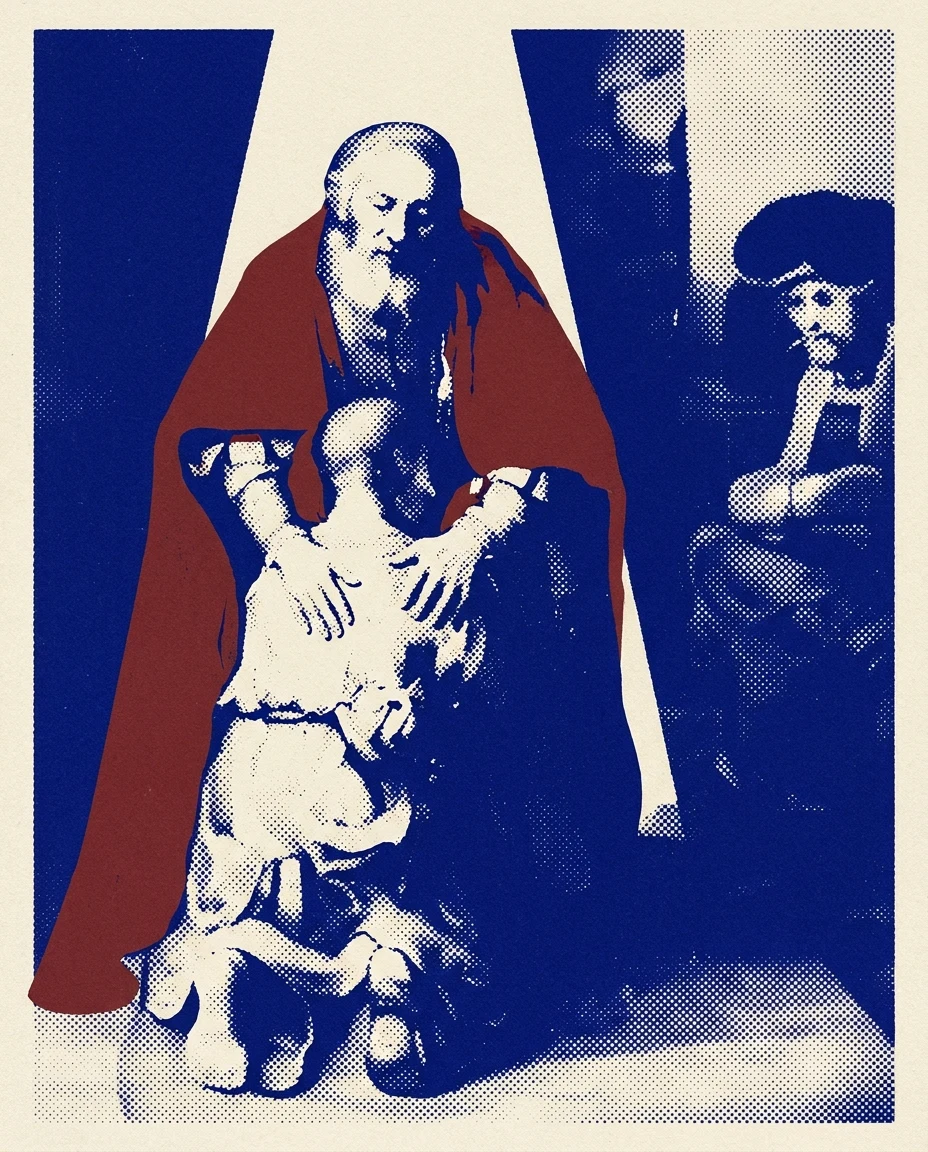
After this manner therefore pray ye: Our Father which art in heaven, Hallowed be thy name.
Matthew 6:9 (KJV)
The first words of the pattern. Before the petitions, the address.
EU•AN•GE•LION (YOO-AN-GEL-EE-ON) · εὐαγγέλιον — Good News
EUANGELION is a product of WokeGod LLC. Copyright © 2026 WokeGod LLC. All rights reserved.v0.8.39TermsPrivacyCookie PolicyCommunity GuidelinesContent Disclaimer
EU•AN•GE•LION (YOO-AN-GEL-EE-ON) · εὐαγγέλιον — Good News

Matthew and Luke both begin with a word most of us have heard too often to hear. Today we slow it down: what kind of Father, and who is allowed to say it.
Matthew 6:9; Luke 11:1–2
Title
After this manner therefore pray ye: Our Father which art in heaven, Hallowed be thy name.
Matthew 6:9 (KJV)
The first words of the pattern. Before the petitions, the address.
Matthew does not write, ‘When you pray, use these words.’ He writes, ‘After this manner therefore pray ye.’ The words are a pattern, and the pattern opens with a name. That name tells you who is speaking and who is listening before you have asked for anything.
The Greek word is πατήρ (pater), the ordinary word for a father in a household. Then comes ἡμῶν (hēmōn), ‘our.’ The prayer was not written for a single person alone with God. It was written for a crowd, people who must learn to say ‘we’ before they can say ‘I’ with any honesty.
Today’s reading is short on purpose. Before you analyze any of the seven petitions that follow, let the first word do its work. Notice what it asks of you, and what it does not ask.
REFLECT
When you say the word ‘Father’ in prayer, what picture comes up first, and where did that picture come from?
A Two-Minute Prayer
Father, I come with the people who are saying your words today. Teach me to say ‘our’ and mean it, even for the ones I find hard to pray beside. Amen.
IN YOUR OWN WORDS
And it came to pass, that, as he was praying in a certain place, when he ceased, one of his disciples said unto him, Lord, teach us to pray, as John also taught his disciples. And he said unto them, When ye pray, say, Our Father which art in heaven, Hallowed be thy name. Thy kingdom come. Thy will be done, as in heaven, so in earth.
Luke 11:1-2 (KJV)
Luke sets the prayer in a moment of request, not a lecture.
Luke tells us where this prayer came from. Jesus has been praying in a certain place. When he stops, one of his disciples asks him for something. The request is simple: ‘Lord, teach us to pray.’
The disciple has noticed something. Jesus prays, and the praying makes the disciple want to pray too. Luke puts that request before the words, which is a good order to read in. The prayer is not a password. It is a lesson in how a person talks to God.
The first lesson is that God is already listening. The disciple is not asking Jesus to make God pay attention. He is asking to learn how to join a conversation that is already going on.
That is a hopeful thing to notice on a first read. The prayer does not start by fixing a broken connection. It starts from a connection that was already there, and it teaches the one praying how to take part in it.
Count the pronouns in the prayer. Our Father. Give us. Forgive us. Our debts. As we forgive. Lead us not. Deliver us. Almost every request in Matthew 6 is said in the plural. The prayer teaches a single person to speak for a group, and it never lets the speaker step outside the group to make the request alone.
This matters because most of us pray the way we were taught to shop. We know what we need and we say so, and God is the clerk. The Lord’s Prayer does something different. It makes the one praying a member of a household before it makes them a customer. The word ‘our’ changes what kind of request is possible.
The plural is also a kind of check. When you say ‘us,’ you cannot ask for bread for yourself and forget the person at the next table. The grammar was built to keep the request honest.
Luke’s version is shorter overall, with fewer requests. Both Gospels open with ‘Our Father which art in heaven’ in the King James text, and that opening sets the community in the address itself. Either way, the prayer assumes that the first person to be addressed is a Father who belongs to more than one child.
Matthew’s address also has a plain echo in the other Gospels. In Gethsemane, Matthew records Jesus praying ‘O my Father, if it be possible, let this cup pass from me’ (Matthew 26:39, KJV). The one who taught the disciples to say ‘Our Father’ calls on the same Father in the hardest hour of his own prayer life. The word is not reserved for easy days.
Be not ye therefore like unto them: for your Father knoweth what things ye have need of, before ye ask him.
Matthew 6:8 (KJV) (KJV)
Jesus has just warned against heaping up words. The Father already knows the need.
Like as a father pitieth his children, so the Lord pitieth them that fear him.
Psalm 103:13 (KJV)
The Old Testament already calls God a father who has compassion on his children.
A Preacher on What the Name Brings With It
John Chrysostom, a Christian preacher, took up this opening in his homily on Matthew 6. He wrote: “For one cannot call God Father, without having attained to all those blessings.” He is not saying that a person must be perfect before saying the word. He is saying that the word carries a set of gifts with it, and that a person who uses it is claiming a place in a family. The name is not a title for a distant ruler. It is the name of someone who has taken responsibility for you. The point is worth keeping plain. Chrysostom reads the first word as a gift that shapes everything after it. Chrysostom’s language is pastoral. He is not writing a legal definition. He is telling people what they are getting when they say the word, and he expects them to be glad of it. A reader who has never thought of ‘Father’ as a gift may find that his sentence changes how the whole opening sounds.
HISTORICAL CONTEXT
John Chrysostom, Homilies on the Gospel of St. Matthew, Homily XIX, on Matthew 6:9. Translated by George Prevost and revised by M. B. Riddle, in Nicene and Post-Nicene Fathers, First Series, vol. 10, ed. Philip Schaff (1888). Online text: https://www.newadvent.org/fathers/200119.htm. Chrysostom was a Christian preacher, and his sermons were addressed to Christians.
Grammar tells you what is first. In Matthew 6:9–13 the address comes before the seven requests, and the requests come in a fixed order. Before the prayer asks for bread, it names the Father. Before it asks for forgiveness, it names the Father again through the plural ‘us.’ The relationship is the setting for every petition, not one petition among the rest.
Luke 11:11–13 makes the same argument in another form. Jesus asks his listeners what a father would do if a son asked for bread, or for a fish, or for an egg. None of them would give a stone or a snake or a scorpion. Then he draws the conclusion: if imperfect fathers know how to give good gifts, how much more will the heavenly Father give the Holy Spirit to those who ask him. The argument runs from the human father to the divine one. It does not work the other way. The asking is safe because of who is being asked.
The prayer also shows that the Father is known through the Son. When Jesus rises, he tells Mary Magdalene to go to his brothers and say (BSB, John 20:17): ‘I am ascending to my Father and your Father, to my God and your God.’ The same word, Father, is used of two relationships. The son is the Father’s son by nature. The disciples are the Father’s children by the Son who brought them in. The prayer that begins ‘Our Father’ is the disciples learning what this means, which is why the Lord’s Prayer can only be said by people who were already drawn into the family.
There is a second grammatical point to notice. The request, ‘Give us,’ is an imperative, a command in form, but it is a command addressed to someone who has already promised to give. The mood tells the petitioner what to do, and the address tells the petitioner who will do the giving. A child is allowed to ask because the parent has already shown a willingness to answer. The structure of the prayer teaches this before any content does.
Dana: A Composite Case
This is an illustrative case built to show how the opening works. It is not a report about any one person. A woman we will call Dana grew up with a father who was hard to be near. Her father’s voice was the first voice she learned to fear. When she started praying as an adult, the word ‘Father’ stuck in her throat. She could say ‘God’ without flinching. She could not say ‘Father.’
Her prayers were short and polite and far from the table. She prayed the way she would talk to a landlord. A friend suggested she start with the first word and let it be slow. Dana tried it. For weeks she only said ‘Our Father’ and stopped. She did not ask for anything else. The word was not comfortable, but it was given to her. She was not required to feel it before she used it.
The prayer did not fix her history. It gave her a word that was larger than the one her history had put in her mouth. Over time she could say it without the old voice answering. The word was the same. The one she was saying it to had been described to her differently.
Dana did not stop feeling what she felt. She stopped treating the feeling as the final word on the subject. Some weeks the word still came out slowly. Other weeks it came out whole. The change was not in her feelings alone. It was in what she was willing to say to the person the word named.
Her friend later asked whether the prayer had worked. Dana said it had not made her father into a different man. It had given her a Father she could address without first making herself small, and that was a change she could keep.
Where This Opening Sits in God's Story
ANCIENT TRUTH
The first readers of Matthew lived under Rome, in a region where a father’s word could decide whether a son inherited, married, or was sent away. A household was a working unit with a head who answered for everyone in it. When Jesus taught people to begin with ‘Our Father,’ he used the household as the picture of what God is to those who pray.
This is the MINISTRY stretch of God’s story, the point where the King is teaching his subjects how to talk to the Father who rules. The Sermon on the Mount sets the terms of that kingdom, and the prayer is the first thing it teaches people to say.
MODERN APPLICATION
Most people now meet the word ‘father’ inside a family that either worked or did not. The household picture still holds, but it arrives with more weight. Some readers have a father who is gone, some have one who was cruel, and some have a good one they still miss. The prayer does not ask any of them to pretend. It names God in a word the household already knew, and lets the word carry more than any single family could give.
NEW TESTAMENT ECHO
Romans 8:15 names the same relationship from the other side: the Spirit of adoption that lets us cry ‘Abba, Father.’ The prayer is the form that the adoption takes when it speaks.
This practice is small. Choose a time when you pray, morning or evening, and begin with only the first two words of the prayer. Say them slowly. Let them stay in the room for a breath before you go on.
This is not a trick for feeling close to God. It is a way of letting the prayer set the terms. You did not write the words. Jesus gave them as a pattern to be learned, and you learn a pattern by saying it until your mouth knows the shape.
If the word ‘Father’ brings up something hard, you do not have to pretend it does not. You can say the word and then say what is true about the hardness. Scripture does not hurry people past their griefs. The prayer simply puts the Father at the front of the sentence, so that the griefs are spoken to him and not kept in a private room with the door shut.
The plural helps here too. If you are praying with a group, or even thinking of the people you pray for, you can say ‘our Father’ for them as well as for yourself. Some of them may not be able to say the word yet. The prayer is built so that you can say it on their behalf until they can.
This is not a way of avoiding your own prayer. It is a way of letting the prayer do the work it was built to do, which is to carry people who cannot yet carry themselves. The word was made for a family, and families pray for the ones who are absent.
Our is the second word of the prayer, and it is the word that lets a crowd say it together.
REFLECT
Which of the people you pray for would be hardest to include in ‘our Father,’ and what would it take for you to say it anyway?
A Practice for Today
A breath prayer built from the first half of the prayer. Five slow breaths. Do it before the day gets loud.
In
Breathing in, silently: Our Father.
Out
Breathing out, silently: in the heavens.
Repeat
Five times. Notice which line you rush. That is where to slow down.
One last thing before the day closes. The prayer does not ask you to arrive at a good feeling about God before you may begin. It gives you the first word and asks you to use it as it is.
You may come to this word with a hard history, a sore heart, or no words at all. The pattern was made for people who came to it in exactly that state. Luke’s disciples did not have a finished theology. They had noticed Jesus praying and wanted in.
Say the first word tomorrow. Say it when you wake, or when you stop at a red light. You do not need to say anything after it.
Jesus did not invent the word. Israel had called God Father before Jesus came, and the prayer gathers that older language into the disciples’ mouths. What is new is the family that now says it together, and the Son who makes the family possible. The rest of the prayer will come in its own order, and each petition is easier to say when the first word has already been said.
You will not need to get the whole prayer right on the first day. You will need to say the first word, and then the second, and then leave the rest for tomorrow. That is enough for a reading. It is the same shape the prayer itself takes: one petition at a time, each one resting on the one before.
Tomorrow the prayer moves from the address to the name. The name is the first request, and it is the first place the prayer asks God to act on something larger than our own lives. Read the next line slowly, and notice how the address you have practised today is already doing its work in it.
Prayer
Our Father in the heavens, you were already listening before I learned to ask. Teach me to begin where the prayer begins. Make the word bigger than my worst memory of a father, and let me say it with the people who need it too. Amen.
BREATH PRAYER
Our Father — in the heavens
IN YOUR OWN WORDS
Today's Commitment
I will say the first two words of the prayer once each morning this week, and I will pray with ‘our’ for at least one person I find difficult.
LEAVING AT THE CROSS
RECEIVING FROM THE CROSS
One Question
In Matthew 6:9, what does the word ‘our’ tell the one praying?
Sources & Further Study
Chrysostom, Homilies on the Gospel of St. Matthew, Homily XIX
Translated by George Prevost, revised by M. B. Riddle, in Nicene and Post-Nicene Fathers, First Series, vol. 10, ed. Philip Schaff (Buffalo: Christian Literature Publishing Co., 1888). Online at https://www.newadvent.org/fathers/200119.htm. Quoted: ‘For one cannot call God Father, without having attained to all those blessings.’ Chrysostom was a Christian preacher writing for Christians.
Greek of Matthew 6:9 and Luke 11:1–2
Verified word by word at the Matthew 6 and Luke 11 interlinear pages on Bible Hub (biblehub.com/interlinear). Strong’s numbers G3962 and G3772 as printed there.
RELATED SCRIPTURES
Matthew 6:8 (KJV)
Your Father already knows what you need before you ask. The same chapter sets the prayer apart from the crowd’s wordy habits.
Luke 11:11–13 (KJV)
The argument from human fathers to the heavenly Father. The asking is safe because of who is asked.
John 20:17 (KJV)
The Father of Jesus and the Father of his disciples. The same word, two relationships, and the cross and resurrection between them.
REFLECT
What is the one thing you would ask of a Father who was already listening before you began?
Finished reading? Mark this day read.
BEFORE YOU GO
Anything you want to keep from today?
EUANGELION is a product of WokeGod LLC. Copyright © 2026 WokeGod LLC. All rights reserved.v0.8.39TermsPrivacyCookie PolicyCommunity GuidelinesContent Disclaimer