Give us this day our daily bread.
Matthew 6:11 (KJV)
The fourth petition is the first one that names a physical need.
EU•AN•GE•LION (YOO-AN-GEL-EE-ON) · εὐαγγέλιον — Good News
EUANGELION is a product of WokeGod LLC. Copyright © 2026 WokeGod LLC. All rights reserved.v0.8.39TermsPrivacyCookie PolicyCommunity GuidelinesContent Disclaimer
EU•AN•GE•LION (YOO-AN-GEL-EE-ON) · εὐαγγέλιον — Good News

The fourth petition is the first one that names a body’s need. Its key word appears in only two places in all of Greek literature, and the wilderness explains why the bread is asked for one day at a time.
Matthew 6:11; Luke 11:3; Exodus 16:19–21
Title
Give us this day our daily bread.
Matthew 6:11 (KJV)
The fourth petition is the first one that names a physical need.
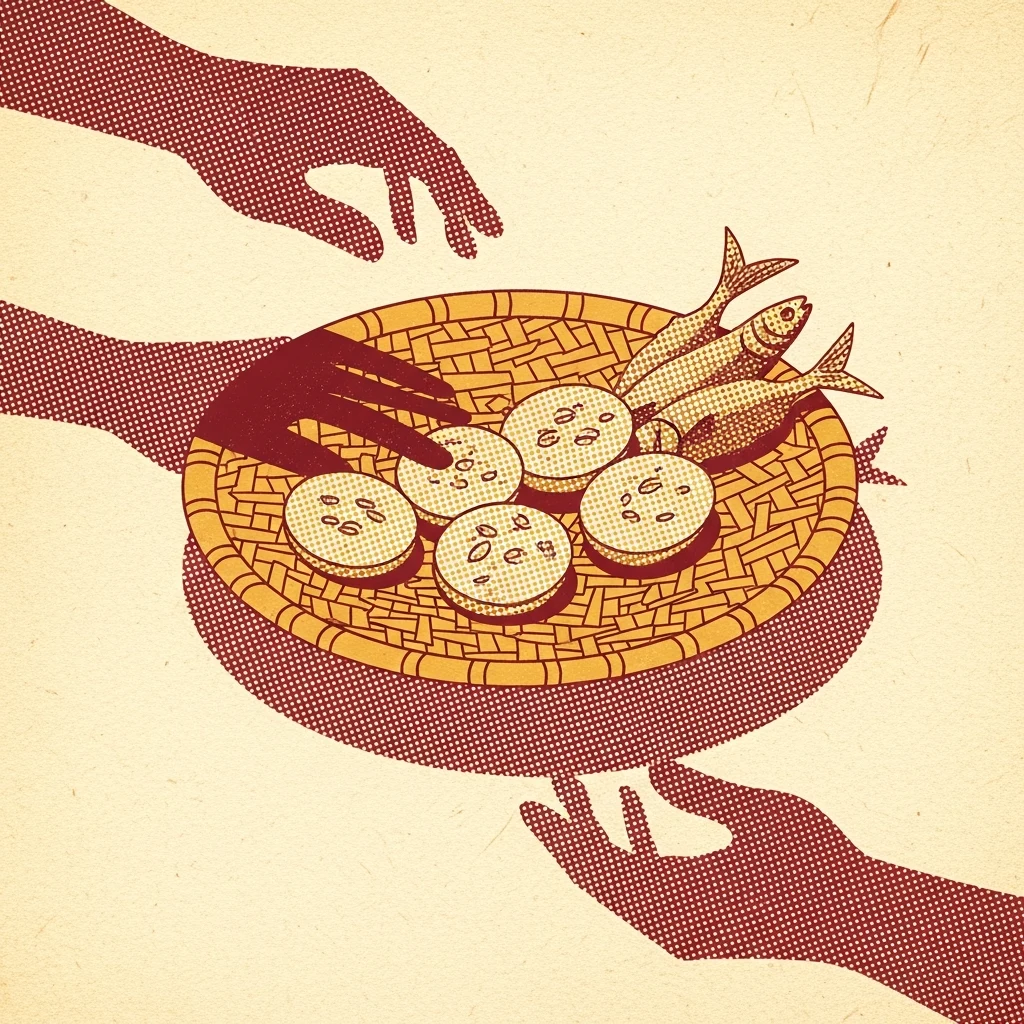
After the petitions for God’s name, kingdom, and will, the prayer turns to something ordinary. Give us our bread. The request is simple enough for a child to say, and it covers the most basic thing a body needs.
The prayer asks for bread for today. Matthew writes σήμερον (sēmeron), ‘today.’ The request is for what is needed now, not a store that will last for years. That is a deliberate limit. It keeps the petitioner in the position of someone who must come back tomorrow and ask again.
The request is also plural. ‘Give us’ is said by a group, and the group is asking for bread that will be shared. The day’s bread is not only for the person who prays. It is for the household, the neighbour, and the stranger at the door. The petition is small in its words and wide in its reach.
REFLECT
What did you eat today, and who helped to bring it to your table?
A Two-Minute Prayer
Give us today the bread we need. Help me ask for only what is needed and to share what I have. Amen.
IN YOUR OWN WORDS
Give us day by day our daily bread.
Luke 11:3 (KJV)
Luke’s version of the same petition, in which the verb is present and the phrase is ‘day by day.’
Put the two versions next to each other. Matthew says, ‘Give us this day our daily bread.’ Luke says, ‘Give us day by day our daily bread.’ The petition is the same, but the grammar shifts.
In Matthew the verb is δὸς (dos), an aorist imperative. In Luke it is δίδου (didou), a present imperative. The difference is one of aspect. The aorist treats the giving as a single act. The present treats it as something that goes on. Luke’s disciples are asking for a continuing supply, given again and again, and Matthew’s disciples are asking for the portion of this day.
The phrase καθ’ ἡμέραν (kath’ hēmeran), ‘day by day,’ does the same work. It is a repeated pattern that the Gospel asks the praying person to join. Both versions teach the same lesson in different angles. The bread is given in the present, and we return to receive it in the present.
Keep falsehood and deceitful words far from me. Give me neither poverty nor riches; feed me with the bread that is my portion. Otherwise, I may have too much and deny You, saying, ‘Who is the LORD?’ Or I may become poor and steal, profaning the name of my God.
Proverbs 30:8–9 (BSB) (BSB)
A wise man’s prayer for bread that is enough, and no more, so that he does not deny God or steal.
And he said unto them, Which of you shall have a friend, and shall go unto him at midnight, and say unto him, Friend, lend me three loaves; For a friend of mine in his journey is come to me, and I have nothing to set before him? And he from within shall answer and say, Trouble me not: the door is now shut, and my children are with me in bed; I cannot rise and give thee. I say unto you, Though he will not rise and give him, because he is his friend, yet because of his importunity he will rise and give him as many as he needeth.
Luke 11:5-8 (KJV)
Luke follows the prayer with a story about bread asked for at midnight.
Luke does not leave the bread petition alone. Right after the prayer, he tells a story about a man who goes to a friend’s house at midnight and asks for three loaves, because a traveller has arrived and there is nothing to set before him. The friend inside says the door is shut and the children are in bed. The story then makes its point: though the friend will not rise because they are friends, he will rise because of the man’s persistence, and give him as many as he needs.
The story is not a lesson that God is reluctant and must be worn down. Jesus makes the comparison in the other direction: if a neighbour will answer a bold request at an inconvenient hour, how much more will the Father answer. The point is that the bread petition is asked for in earnest, and it is asked for other people. The traveller has no bread because the traveller’s need has come upon the host without warning. The petitioner asks for bread for someone else’s table.
This is why the bread petition belongs in Luke’s setting of prayer. It is prayer for a need that arrives suddenly and must be met today. The traveller does not know how to meet it alone, and he does not pretend that he can.
A Word Found Nowhere Else
The word ἐπιούσιος (epiousios) appears in the New Testament only in these two prayers. Thayer’s Greek-English lexicon says so directly: the word is ‘found only in Matthew 6:11 and Luke 11:3.’ Thayer’s also reports that Origen, an early Christian writer, said the word was not in use in ordinary speech, and that it ‘seems to have been coined by the Evangelists themselves.’ The Evangelists did not borrow a common phrase. They put a new word into the prayer, and they expected it to carry weight. Thayer’s notes that Jerome, in Matthew, only translates the phrase by what Thayer calls ‘the barbarous phrase panis supersubstantialis.’ Other readers have explained the word as bread for sustenance, or as bread for the coming day. The lexicon weighs these options and does not settle the matter cleanly. What is clear is the prayer’s direction. The word is attached to bread and to the coming day, and the reader is asked to pray for what is needed for the next day to be lived. The series called All These Things, which earlier took up Matthew 6:33, looks at the same worry about food from the other side. There the question was what to seek first. Here the question is what to ask for today. The two readings belong together, because a person who has sought the kingdom first can still find the daily bread petition hard to pray without fear.
HISTORICAL CONTEXT
Thayer’s Greek-English Lexicon of the New Testament, entry ἐπιούσιος (G1967), read on Blue Letter Bible, blueletterbible.org/lexicon/g1967. The quotations of Origen (de orat. 27) and Jerome are as Thayer’s reports them; this reading did not check Origen or Jerome directly.
Where Daily Bread Sits in the Story
ANCIENT TRUTH
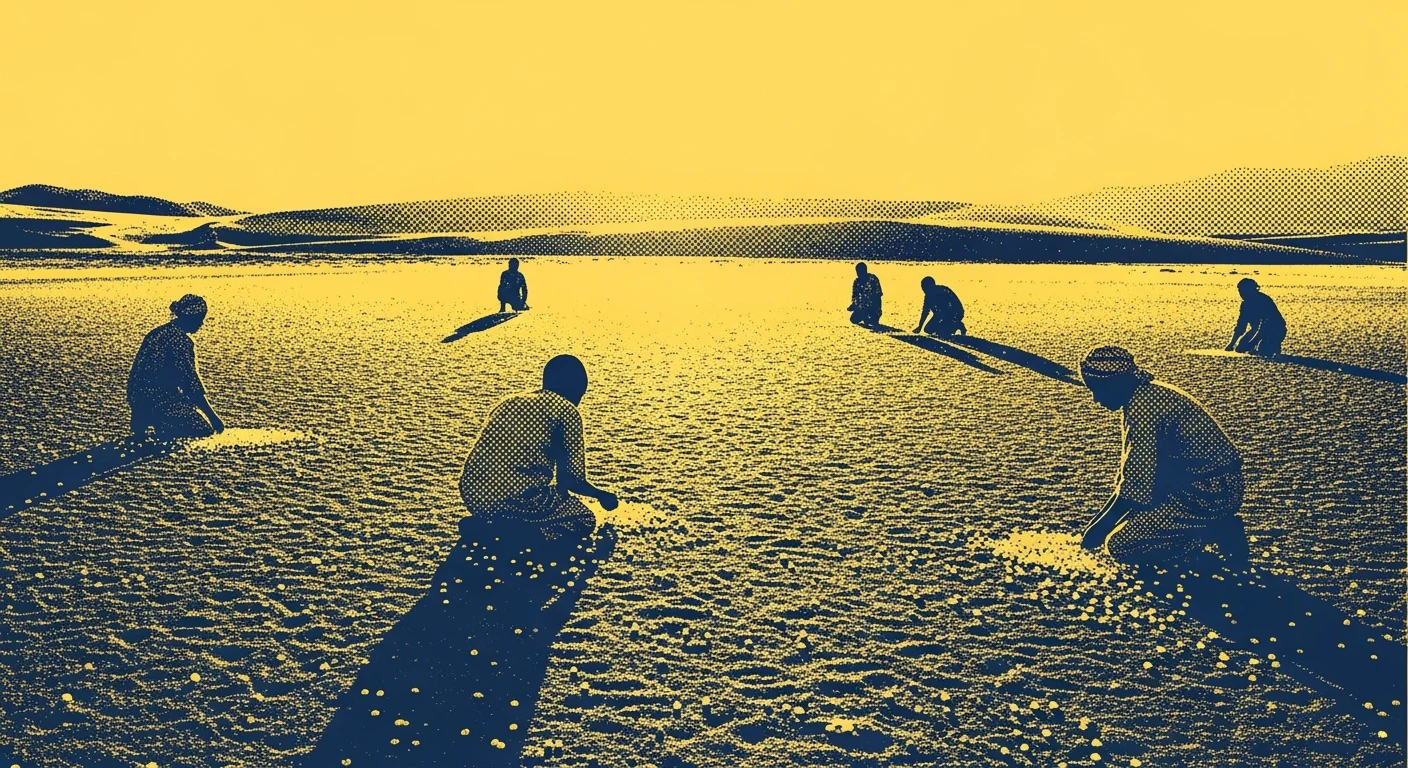
Israel learned daily dependence in the wilderness. Each morning the people gathered manna, and each portion was enough for the day. When some of them kept it overnight, it rotted. The story teaches that God’s provision comes in the present tense.
This is the WILDERNESS stretch of God’s story, the place where Israel was taught to ask each day and receive each day as a gift from the hand of God.
MODERN APPLICATION
Many people now measure security by how much they store. Savings are wise, and planning is part of love. The prayer does not ban either. It reminds us that the dependence the wilderness taught is still the ground we stand on.
NEW TESTAMENT ECHO
In John 6:35 Jesus says, ‘I am the bread of life: he that cometh to me shall never hunger.’ The bread the prayer asks for points toward a bread that is more than food.
The manna story is the clearest Old Testament commentary on the daily bread petition. Moses gives the rule: ‘Let no man leave of it till the morning.’ Some of the people did not listen. ‘Notwithstanding they hearkened not unto Moses; but some of them left of it until the morning, and it bred worms, and stank’ (Exodus 16:20, KJV). The Berean Standard Bible describes the same result: the leftovers became infested with maggots and began to smell. The bread was good for the day it was gathered, and it was spoiled by the attempt to hold it for the next.
The lesson is not that saving is sinful. The lesson is that the bread was given as a daily act of God’s care, and the people who tried to turn it into a private reserve found that the reserve went bad. The manna was provision, and it was also a training in trust. Each morning the people had to go out and receive what they needed, and each morning they were reminded that the next day was not theirs to manage alone.
Proverbs gives a related prayer. The wise man asks for neither poverty nor riches, and he asks for the bread that is his portion (Proverbs 30:8–9, BSB). Poverty could drive a person to steal and profane God’s name. Riches could make a person forget the Lord. The portion is enough. The prayer asks for that middle place, where a person has what is needed and does not feel the need to take more.
Jesus takes this into his own identity.
The Berean Standard Bible adds one more detail that is easy to miss. The manna ‘melted away’ once the sun grew hot (Exodus 16:21). The bread had a daily window. It could be gathered in the morning and it was gone by midday, so the people had to come out again the next day. The provision was real, and it was also short, and the shortness was part of what it taught. He says he is the bread of life, and that whoever comes to him will not hunger. The daily bread petition, read in that light, is a prayer that God’s ordinary provision and his greater provision might be received in the same posture of trust. The one who prays for bread for today is also praying for the one who is the bread that does not spoil.
Lena: A Composite Case
This is an illustrative case built to show how the petition works in an ordinary budget. It is not a report about any one person. A woman we will call Lena works at a grocery store. Her paycheck arrives on the same day each fortnight, and most of it goes out in the first week. She has never had a savings account that lasted more than a month. For years she prayed the daily bread petition the way she heard it preached: as a request for enough. She did not feel that she had enough.
One winter her hours were cut. She had to go to a food pantry for the first time. Standing in the line, she noticed that the people around her were praying the same petition in their own way. Some of them were sharing what they had with the person in front of them. One man gave her a bag of rice and said that God would take care of the rest.
Lena did not feel rescued at once. She did feel fed, and she began to pray the petition differently. She asked for the bread for the day, and she asked for the eyes to share what she had when someone else was short. Her savings were still thin, but her prayer had become less about hoarding and more about enough.
The daily bread petition shapes how we handle what we have. The manna was not given to one family alone, and the petition is said in the plural. When we ask for our bread, we ask for enough to share.
This is hard for anyone who lives close to the edge. The instinct to hold on is strong when there is little to hold. Scripture does not shame that instinct. It asks us to place it under the care of a God who gathered Israel in the wilderness and kept them alive. The petition is not a demand that we feel secure before we give. It is a request that the security we need be given in a form we can share.
Sharing is also a discipline of trust. When we give away bread that we would like to keep, we are saying that the Father who gave it can give again tomorrow. The one who gave manna each morning did not fail the people who shared it with a neighbour.
A church, a family, or a small group that prays this petition together has a practical way to learn it. They can name a need in the room each week and ask for bread for it, then act on what they are able to give. The prayer becomes a set of hands rather than only a set of words. Some weeks the answer is a meal. Some weeks it is a promise to drive someone to a clinic. The petition is answered in the ordinary logistics of care, and it keeps the room honest about who is still hungry.
This is a practical application, and it can start small. Choose one item of food this week to give away, or one hour of time to offer to someone who has less. Then ask for bread for the day, and notice what comes to you as a result. The petition is answered in the body of the people who share.
There is a quieter form of bread sharing that does not involve money at all. Some of the people who pray this petition are the ones who have time to give. A visit, a meal, a ride to an appointment, a listening ear on a bad day. These are bread too. The petition does not separate the bread of the body from the bread of companionship. Both come from the same Father, and both are asked for together.
The bread is given for the day. Ask for the day, receive the day, and share what the day brings.
REFLECT
What would you be tempted to store up this week if you were not sure the bread would come again tomorrow?
A Practice for Today
Memorize the daily bread petition in the King James wording, one line at a time. Say it three times a day for a week. Use a technique: link each line to an ordinary meal, so that the line returns when you sit down to eat.
Line one
Give us this day our daily bread. Say it at breakfast.
Line two
And forgive us our debts. Say it at lunch, and keep that for tomorrow.
Line three
Repeat both lines at supper, and let the day’s bread be the reason.
One last thing before the day ends. The bread petition is short enough to pray in a breath, and it is meant to be prayed again tomorrow. That repetition is the point. The prayer does not give you a supply for a year. It gives you a relationship with the one who supplies each day.
You may have a fear about money, health, work, or the future that the petition does not answer in full. That is not a failure of the prayer. The manna did not answer every question either. It answered the question of the day, and it asked the people to trust the next morning to the same hand.
Tomorrow the prayer turns from bread to debts.
A reader who finds this petition easy to say and hard to live should not be discouraged. The prayer was given to people who had to learn it over time. The daily return is the discipline. Each morning the petition is said again, the reader is reminded that the bread is given and not earned, and the reader is free to share what has been received. Forgiveness is the next thing a person needs, and it is also a kind of bread: the bread of a clean conscience, offered by the one who has already paid for it.
Prayer
Father, give me the bread I need today, and no more than I can carry in trust. Keep me from hoarding out of fear, and from taking what belongs to someone else. Teach me to share the bread you give, and to come back to you tomorrow with empty hands and a thankful heart. Amen.
BREATH PRAYER
Give us this day — our daily bread
IN YOUR OWN WORDS
Today's Commitment
Tomorrow morning I will ask for the bread I need for that day, and I will name one thing I can give away before the day ends.
LEAVING AT THE CROSS
RECEIVING FROM THE CROSS
One Question
In Exodus 16:20, what happened to the manna that some people kept until morning?
Sources & Further Study
Thayer's Greek-English Lexicon, entry G1967 (epiousios)
Read on Blue Letter Bible, blueletterbible.org/lexicon/g1967. Quoted: the word is found only in Matthew 6:11 and Luke 11:3, and Origen testifies that it was not in ordinary use.
Greek of Matthew 6:11 and Luke 11:3
δὸς (dos) and δίδου (didou), σήμερον (sēmeron) and καθ’ ἡμέραν (kath’ hēmeran), verified at the Matthew 6 and Luke 11 interlinear pages on Bible Hub, Strong’s G1967, G2596, and G4594 as printed there.
RELATED SCRIPTURES
Exodus 16:19–21 (BSB)
Manna gathered each morning, and the portion that was kept overnight.
Proverbs 30:8–9 (BSB)
A prayer for neither poverty nor riches, and for the bread that is my portion.
John 6:35 (KJV)
I am the bread of life.
REFLECT
What is the bread you are tempted to store up instead of asking for it today?
Finished reading? Mark this day read.
BEFORE YOU GO
Anything you want to keep from today?
EUANGELION is a product of WokeGod LLC. Copyright © 2026 WokeGod LLC. All rights reserved.v0.8.39TermsPrivacyCookie PolicyCommunity GuidelinesContent Disclaimer