But seek ye first the kingdom of God, and his righteousness; and all these things shall be added unto you.
Matthew 6:33 (KJV)
Two minutes with one sentence that has an order in it and a promise attached to the order.
EU•AN•GE•LION (YOO-AN-GEL-EE-ON) · εὐαγγέλιον — Good News
EUANGELION is a product of WokeGod LLC. Copyright © 2026 WokeGod LLC. All rights reserved.v0.8.37TermsPrivacyCookie PolicyCommunity GuidelinesContent Disclaimer
EU•AN•GE•LION (YOO-AN-GEL-EE-ON) · εὐαγγέλιον — Good News
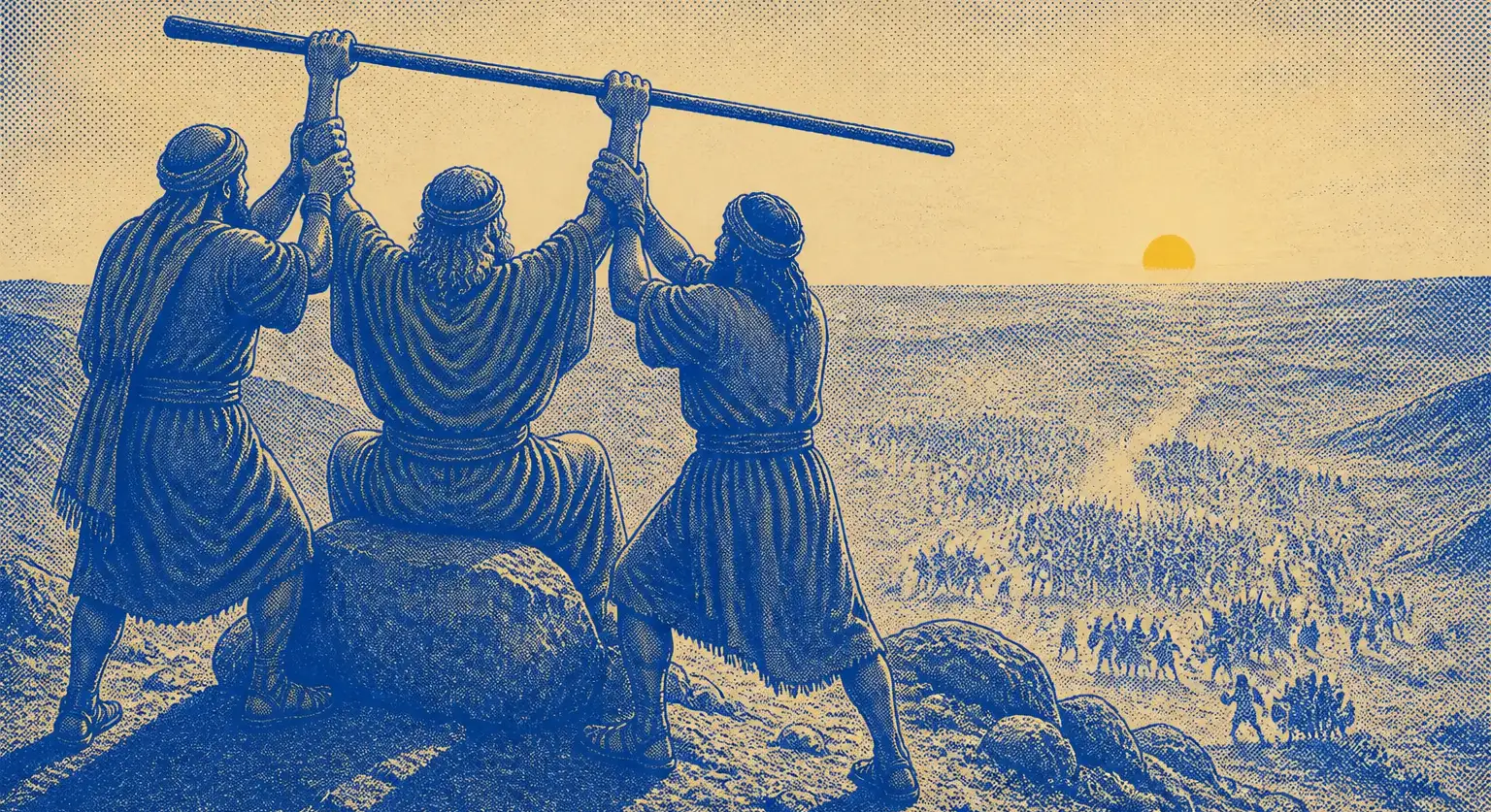
The famous verse has an order in it and a passive verb at the end. One of those tells you what to do. The other tells you what was never your job — and most of what goes wrong with this promise comes from confusing the two.
Matthew 6:31-33; 1 Kings 3:9-13
Opening
But seek ye first the kingdom of God, and his righteousness; and all these things shall be added unto you.
Matthew 6:33 (KJV)
Two minutes with one sentence that has an order in it and a promise attached to the order.
The verse is famous enough to have gone smooth. It gets printed on things. So it is worth slowing down on what it actually says, which is stranger and more demanding than the decoration suggests.
It is not a promise with a condition bolted on. It is an instruction about sequence. Seek first. Something goes at the front, and other things follow it.
And the promise attached is in the passive voice. All these things shall be added unto you. Not: you will get them. Not: you will earn them. They will be added — by someone else, and the sentence does not bother to say who because everyone listening already knew.
So two things are being handed over at once. A job, and a job that is not yours.
Yours is the seeking, and the Greek makes it continuous — keep seeking, plural, out loud, together. Not a decision made once at a low moment and then filed away.
The adding is God’s. That half is not your assignment, and treating it as though it were is most of what goes wrong with this verse.
This week is about that division of labour, and about what happens in us when the second half seems to be running late.
REFLECT
If someone watched your week without hearing you explain it, what would they conclude you were seeking first?
A Two-Minute Prayer
Father, I have been carrying both halves of this — the seeking and the supplying — and only one of them was ever mine. Show me which is which today. Amen.
IN YOUR OWN WORDS
Therefore take no thought, saying, What shall we eat? or, What shall we drink? or, Wherewithal shall we be clothed? (For after all these things do the Gentiles seek:) for your heavenly Father knoweth that ye have need of all these things. But seek ye first the kingdom of God, and his righteousness; and all these things shall be added unto you.
Matthew 6:31-33 (KJV)
The promise with its own definition attached. Read verse 31 before verse 33 and the famous line changes size.
Before anything else, the passage tells you what it is talking about, and it is not what the verse is usually used to promise.
Two verses before the famous line, Jesus lists the items. What shall we eat. What shall we drink. What shall we wear. Food, drink, clothing. Then He says your heavenly Father knows that you have need of them.
That is the content of “all these things.” Not prosperity, not margin, not a good year. The short list of what a body needs to stay alive.
This matters because the sentence has been made to carry a great deal of freight it was never given. Read as a wealth formula, it becomes a machine for blaming people: if the things did not arrive, the seeking must have been faulty. That reading has been used on the poor for a long time, and it collapses the moment anyone reads two verses up.
Read as it stands, it is both smaller and more serious. Smaller, because bread is not a fortune. More serious, because bread is not optional, and the promise is about the thing you actually cannot do without.
There is one more detail in the setup. The people described as chasing after all these things are the Gentiles — which in this sermon means the people outside the covenant, the ones with no Father to know what they need. That is the contrast being drawn. Not between people who want food and people who are above wanting food. Between people who have no one to ask and people who do.
The alternative to anxiety here is not indifference about whether you eat. It is having somewhere to take the question.
The Argument From The Greater
John Chrysostom preached through Matthew in Antioch around the year 390, and on this passage he puts the logic in two sentences. “He therefore that hath given the greater, how shall He not give the less? He that hath fashioned the flesh that is fed, how shall He not bestow the food?” That is the shape of the whole argument, and it is the same shape Jesus uses with the birds and the flowers. Not: God will probably come through, on past form. But: the larger gift has already been made, and the smaller one is a smaller question.
HISTORICAL CONTEXT
Homily XXI on the Gospel of St. Matthew, preached at Antioch c. 390. Quoted here in the original Nicene and Post-Nicene Fathers wording (trans. George Prevost, rev. M. B. Riddle, 1888), which keeps the archaic “hath”; some editions silently modernise it.
You are told to seek. You are not told to add. One of those verbs is in your hands and the other one never was.
Give therefore thy servant an understanding heart to judge thy people, that I may discern between good and bad: for who is able to judge this thy so great a people? And the speech pleased the Lord, that Solomon had asked this thing. And God said unto him, Because thou hast asked this thing, and hast not asked for thyself long life; neither hast asked riches for thyself, nor hast asked the life of thine enemies; but hast asked for thyself understanding to discern judgment; Behold, I have done according to thy words… And I have also given thee that which thou hast not asked, both riches, and honour.
1 Kings 3:9-13 (KJV)
The Old Testament’s own worked example of the principle, several hundred years before the sermon that states it.
God appears to Solomon in a dream at Gibeon and makes an offer with no limits on it. Ask what I shall give thee.
Solomon is new to the throne and says so. I am but a little child, he says. I know not how to go out or come in. Then he asks for an understanding heart to judge the people, and he gives his reason: the nation is too large for him and he cannot tell good from bad without help.
He asks for competence at the job he has been given. That is all.
The text then does something careful. It records God’s own analysis of the request, and the analysis is a list of what Solomon did not ask for. Not long life. Not riches. Not the death of his enemies. Three things a new king in the ancient world would obviously want, named one by one, and passed over.
And then: I have also given thee that which thou hast not asked, both riches, and honour.
That is Matthew 6:33 happening several centuries before it is stated. The ordering came first, the addition came after, and the things that were added were specifically the things that had not been requested.
It is worth being careful about what this does and does not establish. It is one narrative, not a formula, and the same Old Testament contains people who sought God faithfully and died poor. Solomon’s later life is itself a warning about what the added things can do to a person — the same book that records this dream records what the wealth and the alliances eventually cost him.
But as an illustration of the order, it is exact. The seeking was for something that had nothing to do with acquisition. The addition arrived on its own account, from the other side, unrequested.
Where This Week Sits in the Story
ANCIENT TRUTH
This sermon is preached in Galilee to people living close to the edge. Most of the crowd would have been day labourers and small farmers, for whom the question of what to eat tomorrow was a real question and not a figure of speech. Jesus is not addressing an anxious mood. He is addressing food.
This is the KINGDOM stretch of God’s story — the point where God’s reign is announced as arriving in person, and people are asked to reorder their lives around something they cannot yet see in full.
MODERN APPLICATION
The specific fear moves but the shape holds. What shall we eat becomes what happens if the work dries up, or the diagnosis is bad, or the money runs out before the month does.
NEW TESTAMENT ECHO
Four verses before this, in the same sermon, Jesus had already taught them to pray “Give us this day our daily bread.” The prayer and the promise are part of one teaching: ask for today’s food, and do not try to secure the rest of the year in advance.
And why take ye thought for raiment? Consider the lilies of the field, how they grow; they toil not, neither do they spin: And yet I say unto you, That even Solomon in all his glory was not arrayed like one of these.
Matthew 6:28-29 (KJV)
The same chapter names Solomon by name — and puts him second to a wildflower.
Five verses before the promise, Jesus mentions Solomon, and it is not a compliment.
Consider the lilies of the field. They do not work and they do not spin thread. And even Solomon, in all his glory, was not dressed like one of these.
Whoever was listening knew exactly what Solomon in all his glory meant. He was the wealth story of the nation. The Queen of Sheba came to look and reportedly ran out of things to say. If you wanted a single image for what added things look like when God adds them without being asked, it was him.
And Jesus uses that image to make a wildflower look better dressed.
Hold this next to the Gibeon story and something clarifies. Both passages are true, and they are pointing in the same direction. Solomon got the riches. The riches were real, and they were a gift, and God gave them without being asked. And they are still second-rate compared to what happens in a field, for free, every spring, to something that will be dead by summer.
The passage says exactly that about the flower, and does not soften it. Here today, and tomorrow thrown into the furnace.
So the promise in verse 33 is not being oversold by the person making it. He raises the subject of added things and then, in the same breath, tells you not to be too impressed by them. The best-case version of getting everything is already outclassed by grass.
Which takes some of the weight off. If the added things were the point, their delay would be the end of the world. He is saying, in advance and to people who were genuinely hungry, that they are not the point — and He is saying it without once suggesting they do not matter.
The Man Who Turned Down Both Offers
David Brainerd was expelled from Yale in the winter of 1742, in his third year. He was licensed to preach that July, and in November was commissioned as a missionary.
On 1 April 1743 he wrote in his diary about arriving at Kaunaumeek. He describes riding into the wilderness, roughly twenty miles from Stockbridge, and lodging with a poor Scotchman about a mile and a half from the people he had come to serve. He records where he slept: on a little heap of straw, in a log room without any floor.
Six weeks later he wrote it out more fully. “I live in the most lonesome wilderness; have but one single person to converse with that can speak English.” Then the details. Most of his diet was boiled corn and hasty-pudding. He lodged on a bundle of straw. His labour was hard and extremely difficult. And he adds the line that keeps the entry from being heroic: “I have little appearance of success to comfort me.”
The cost is documented on the other side as well. His editor, Jonathan Edwards, records that as Brainerd left Kaunaumeek he was holding an earnest and unanimous call to East-Hampton on Long Island, and a second call to Millington, near his home town. Settled congregations. He took neither.
He died in 1747, at twenty-nine.
Brainerd is not an illustration of the promise paying out. He is an illustration of the ordering itself — a man who put the kingdom first and whose recorded return, in his own words, was straw, boiled corn, and little appearance of success. The promise in Matthew 6:33 has to be readable by people whose lives look like his, or it is not worth much.
What Edwards Left In
There is something worth noticing about how this diary reached us at all. Jonathan Edwards edited Brainerd’s papers for publication after his death, and Edwards was not a neutral party. He was presenting Brainerd as a model of genuine religion, in the middle of an argument about what genuine religion was. An editor building a monument would have trimmed the despair. Edwards left it in — the loneliness, the poor diet, the flat admission of little appearance of success, and the long stretches where Brainerd records finding nothing in himself worth reporting. The result is a book that has been read for two hundred and fifty years partly because it refuses to be inspiring on demand.
HISTORICAL CONTEXT
The Life of Rev. David Brainerd, Chiefly Extracted from His Diary, edited by Jonathan Edwards, 1749. The diary entries quoted above are Brainerd’s own and are dated. The account of the two declined calls is Edwards’ editorial narration drawn from Brainerd’s papers, not a first-person statement in the diary — a distinction worth keeping.
REFLECT
Solomon asked for the ability to do the job in front of him. What is the equivalent request for you this week — the thing you actually need to be faithful where you already are?
A Practice for Today
A breath prayer built from the verse itself, using its two halves. Six slow breaths. It works best before the day gets loud.
In
Breathing in, silently: I will seek first.
Out
Breathing out, silently: You will add what is needed.
Repeat
Six times. Notice which of the two lines is harder to say without adding a footnote. That is where this week is going to do its work.
One thing before this day closes, because it decides how the rest of the week lands.
The command is plural and continuous. Keep seeking, all of you. That is not a small grammatical footnote. It means the instruction was never designed for a person doing it alone, on willpower, in private.
And the promise is passive. It will be added. Which means that if you have spent years quietly grading yourself on whether the things arrived, you have been marking an exam that was never yours to sit.
So today asks for something small. Not a rearranged life by Friday. Just an honest look at the order things currently sit in, and one adjustment.
The rest of the week goes somewhere harder. Tomorrow it takes up the word for anxiety and what has been done with it to people who are already suffering. Wednesday it stands in the gap where the promise has not arrived and refuses to explain it away.
But it starts here, with a sentence that divides the labour. You seek. He adds. And He already knows what you need, which the verse says out loud two lines before the part everybody quotes.
One last thing about the plural, because it is easy to read past.
The sermon this comes from was preached outdoors to a crowd. When Jesus says seek ye first, He is not addressing a reader alone with a book. He is addressing a group of people who were going to walk back down the hill together and be hungry in the same week.
That has a practical consequence. A promise about bread, given to a community, is partly kept through that community. The people who gathered manna gathered it near each other. The church Paul writes to in Philippians had sent him money more than once, which is why he can write about contentment without it sounding theoretical.
So if you are trying to work out what it looks like to trust God for provision, one honest answer is that it has rarely looked like a private arrangement between one person and heaven. It has looked like people telling each other the truth about what they need.
Prayer
Father, You know what I need. The verse says so before it says anything else, and I would rather start there than with my own list. I have been carrying the adding as well as the seeking, and it has made me tired and quietly suspicious of You. Take back the half that was always Yours. Teach me to seek first — not once, and not by myself. And where I have made this promise mean more than bread, bring it back down to its real size, which is large enough. Amen.
BREATH PRAYER
In: I will seek first — Out: You will add what is needed
IN YOUR OWN WORDS
Today's Commitment
I will name the one thing that currently sits first, and I will put the kingdom in front of it for one ordinary decision today.
LEAVING AT THE CROSS
RECEIVING FROM THE CROSS
One Question
According to the passage itself, what does “all these things” refer to?
The Voice Behind Today
tenth century BC, the united kingdom of Israel
The king who asked for an understanding heart and was given wealth he had not requested. The same books that record the dream at Gibeon record what the wealth and the foreign alliances eventually did to his reign, which is why he appears twice in this reading and not only once.
Give therefore thy servant an understanding heart to judge thy people, that I may discern between good and bad.
LESSON FOR US
Solomon is the Old Testament’s clearest illustration of the order in Matthew 6:33 and its clearest warning about the added things. Both lessons come from the same life, and Scripture does not let you take one without the other.
Sources & Further Study
Greek: zēteite, Strong's G2212
Verified at the Matthew 6:33 interlinear as a present imperative active, second person plural — continuous action, addressed to a group. The lexical range runs well past “look for,” including to investigate and to strive after.
Greek: prostethēsetai, Strong's G4369
Verified at the same interlinear as future indicative passive, third person singular. The passive voice, and the unnamed actor behind it, is the grammatical basis for everything this reading says about the division of labour.
Scripture texts
Matthew and 1 Kings quoted from the King James Version, chosen for this day because “seek ye first” is the phrasing the passage is carried in. Translation choices for the week are documented in the series brief.
RELATED SCRIPTURES
Matthew 6:9-13 (KJV)
“Give us this day our daily bread” — the prayer that sits four verses before this promise, asking for one day at a time.
1 Kings 3:5-13 (KJV)
The dream at Gibeon in full, including God’s own list of what Solomon did not ask for.
1 Kings 11:1-8
The rest of Solomon’s story, which is why this reading treats the added things with care rather than enthusiasm.
Exodus 16:19-21 (BSB)
Manna gathered daily, and what happened to the portion that was kept overnight. Tomorrow’s reading takes this up.
Luke 12:22-31 (BSB)
Luke’s version of the same teaching, given in a different setting, ending in the same instruction.
Finished reading? Mark this day read.
BEFORE YOU GO
Anything you want to keep from today?
EUANGELION is a product of WokeGod LLC. Copyright © 2026 WokeGod LLC. All rights reserved.v0.8.37TermsPrivacyCookie PolicyCommunity GuidelinesContent Disclaimer