Let your moderation be known unto all men. The Lord is at hand.
Philippians 4:5 (KJV)
Four words at the end of a verse about behaviour, and they change everything around them.
EU•AN•GE•LION (YOO-AN-GEL-EE-ON) · εὐαγγέλιον — Good News
EUANGELION is a product of WokeGod LLC. Copyright © 2026 WokeGod LLC. All rights reserved.v0.8.37TermsPrivacyCookie PolicyCommunity GuidelinesContent Disclaimer
EU•AN•GE•LION (YOO-AN-GEL-EE-ON) · εὐαγγέλιον — Good News
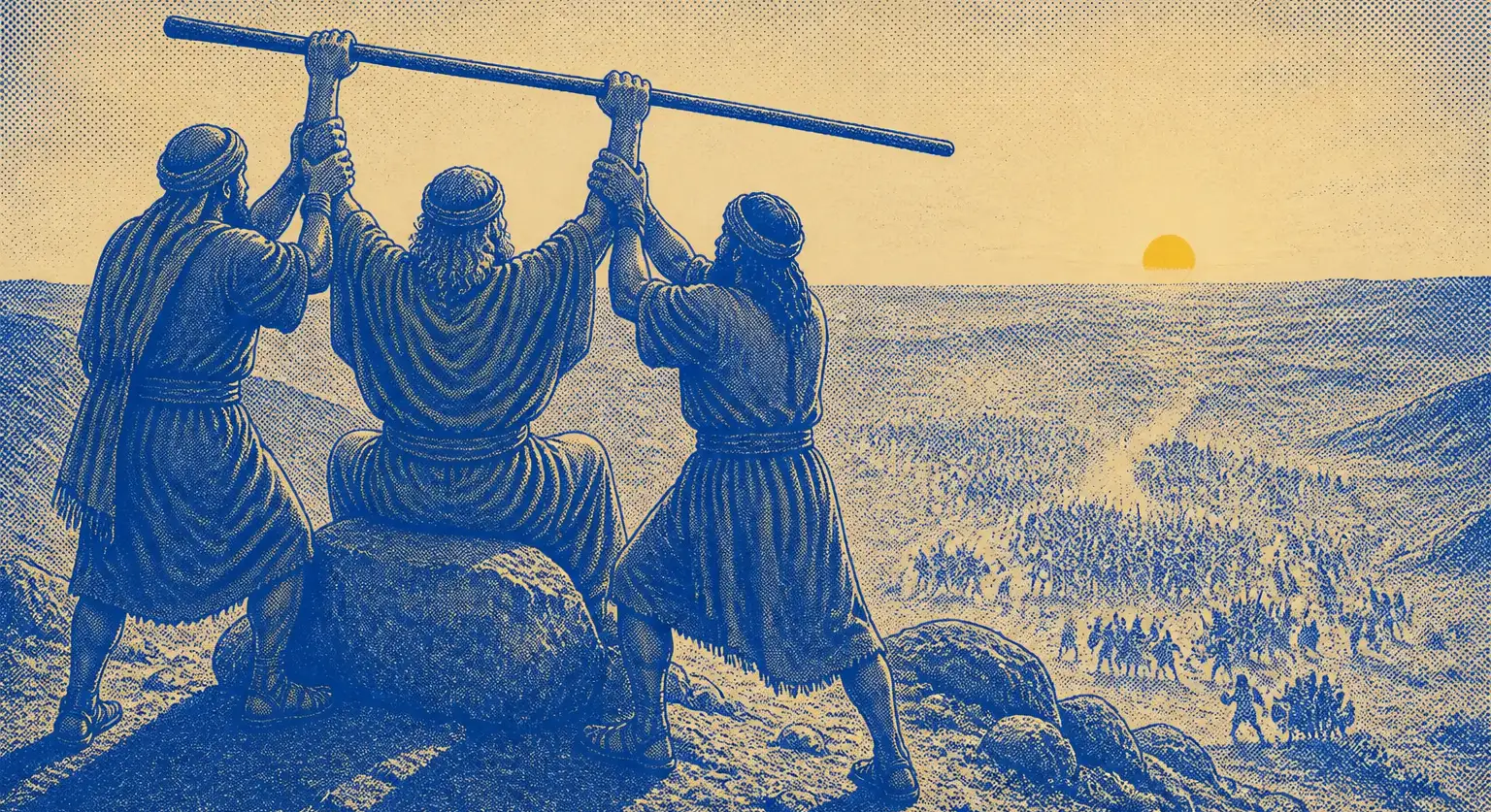
Immovable things are usually far away. A cliff does not know your name. The New Testament’s claim is that the rock became approachable without a broker — and that the barrier was opened from the inside, downward, by someone who was dying at the time.
Philippians 4:5; Deuteronomy 32:4; Hebrews 4:14-16
Opening
Let your moderation be known unto all men. The Lord is at hand.
Philippians 4:5 (KJV)
Four words at the end of a verse about behaviour, and they change everything around them.
Paul writes four words and does not explain them. The Lord is at hand.
It could be a statement about time. He is coming soon, so hold your behaviour lightly, because this arrangement is temporary. Plenty of readers have taken it that way, and the Greek allows it.
It could equally be a statement about distance. He is close by, right here, near enough to be spoken to. The Greek allows that too, and the verse immediately following is about prayer — about bringing things to God in every thing — which sits more naturally after a claim about nearness than after a claim about a schedule.
The honest answer is that the word carries both and the sentence does not choose. Translators have gone different ways with it for centuries.
Which may be the most useful thing about it. Both readings are consoling and they console differently. If He is near in time, then whatever this is does not go on forever. If He is near in place, then you are not talking into an empty room, which is exactly what yesterday’s reading left open.
Today takes the second sense and follows it, because there is something specific the New Testament says about how near, and about what used to stand in the way.
REFLECT
When you pray, what distance do you unconsciously assume is involved?
A Two-Minute Prayer
Lord, I have been praying as though You were somewhere far off and busy. If You are at hand, let me speak to You like it. Amen.
IN YOUR OWN WORDS
He is the Rock, His work is perfect; all His ways are just. A God of faithfulness without injustice, righteous and upright is He.
Deuteronomy 32:4 (BSB)
הַצּוּר … אֱמוּנָה
Yesterday’s word and today’s word, four words apart, in a song Moses sang at the end of his life.
Yesterday ended on a Hebrew word. Emunah — firmness, steadiness — the word for what a person is asked to live by when nothing is being answered, and the word used for Moses’ arms held up by two men until sunset.
Today begins with the discovery that the same verse which calls God faithful also calls Him a rock.
Deuteronomy 32:4 has both. The first word is tsur — rock, cliff, boulder. Four words later comes emunah. One sentence, two nouns, and between them the whole architecture of this week.
That is worth pausing on, because the two ideas are usually held apart. Steadiness sounds like something we are asked to produce. Rock sounds like something God simply is. But Scripture uses one vocabulary for both ends, which means our steadiness is not a separate achievement running alongside His. It is derivative. The same word covers the cliff and the hands.
Tsur is used of God about thirty-three times in the Old Testament, and the lexicons note what the image is doing: support and defence of His people. It is not primarily about God being hard or unmoved in the sense of unfeeling. It is about there being something under you that does not shift when you put weight on it.
David stacks the images in Psalm 18 — my rock, my fortress, my deliverer, my strength, my high tower — and the point of the list is not variety. It is that every one of them is a thing you get behind or on top of when something is coming.
And here is the part that should be strange, and usually is not because we are used to it. Immovable things are normally far away. Mountains are not intimate. A cliff does not know your name.
That is the tension this day exists to resolve.
A cliff does not know your name. That is the ordinary cost of immovability, and it is the exact cost the New Testament says was cancelled.
When Jesus had cried out again in a loud voice, He yielded up His spirit. At that moment the veil of the temple was torn in two from top to bottom. The earth quaked and the rocks were split.
Matthew 27:50-51 (BSB)
The detail is the direction. A curtain torn by hands tears from the bottom, where hands can reach.
The temple had a curtain, and the curtain had a job. It marked the point past which people did not go. Beyond it was the Most Holy Place, and access was restricted to one man, one day a year, with blood, on a schedule.
That arrangement was not cruelty. It was a statement about the seriousness of who was on the other side. But its practical effect on an ordinary person’s life was simple: there was a system, and you were not in it, and someone else did the approaching for you.
Then the curtain tore.
Matthew records the direction, and the direction is the whole point. From top to bottom. A heavy hanging torn by human hands tears upward from where hands can reach. This one opened from the far end — the end no one could get to.
Whoever opened it was on the inside.
The letter to the Hebrews spells out what that means for anyone reading this now. We have confidence to enter the Most Holy Place by the blood of Jesus, it says, by a new and living way opened for us through the curtain. And then the instruction: let us draw near.
Earlier it puts it in a sentence worth reading slowly. Let us then approach the throne of grace with confidence, so that we may receive mercy and find grace to help us in our time of need.
With confidence. Not with credentials, not through a representative, not on a scheduled day. And notice the stated occasion — our time of need, which is to say the moment you are least composed and least presentable.
So the answer to the tension is not that God became less immovable. He is still the rock. What changed is that the rock became approachable without a broker, and the change was made from His side, downward, through the barrier, while He was dying.
Where This Day Sits in the Story
ANCIENT TRUTH
For most of Israel’s history, approaching God had a physical geography and a staff. There was a building, a room inside it, a curtain across the room, a priesthood, and a calendar. None of it was optional, and none of it was available to the ordinary worshipper directly.
Wednesday left a person praying into apparent silence. Today’s claim is narrower than an answer and more structural: whatever the silence is, it is not a closed door. The door was opened from the other side and the record of it is a torn curtain.
MODERN APPLICATION
The instinct outlived the building. People still assume a queue, a qualification, a right frame of mind to reach before they are allowed to speak — and so they wait until they are calmer, or cleaner, or less angry, which usually means they never come at all.
NEW TESTAMENT ECHO
Paul, writing to Timothy, keeps the point precise: “there is one God, and there is one mediator between God and men, the man Christ Jesus.” One. Which is the same sentence saying there are no others.
This needs saying carefully, because the careless version of it is false and does real damage.
The claim is not that there is no mediator. Scripture is explicit that there is one, and names Him. There is one God, and one mediator between God and men, the man Christ Jesus.
The claim is that there is no longer a human intermediary between you and God — no priest whose presence is required, no qualified person who must carry your request in because you are not permitted to carry it yourself, no queue.
The distinction matters in both directions. Collapse it one way and you get a Christianity where access is brokered again, and people spend their lives waiting for someone more spiritual to pray for them because their own prayers seem not to count. Collapse it the other way and you get the idea that we walk in on our own standing, which the letter to the Hebrews spends chapters ruling out. The confidence to enter is real, and it is explicitly by the blood of Jesus. It is confidence that was purchased, not confidence that was always ours.
So the accurate sentence is that you have direct access because of the Mediator, not instead of one. Which is better news than either shortcut. Access that rested on your own standing would be exactly as reliable as your standing, and this week has already spent a day on how that feels at three in the morning.
What this rules out in practice is a specific and very common experience. It rules out the sense that you have to get yourself into a fit state before you are allowed to start. Hebrews names the moment of approach as the time of need, which is not the tidy moment. The invitation is issued for the worst hour, not the best one.
And it means the person who has nobody — no church at present, no pastor who knows their name, nobody to ask — is not thereby further from God than anyone else. That was the arrangement the curtain enforced. It was torn.
Five Men Who Could Not Help
George Fox worked through the available intermediaries one by one, and recorded each failure by name.
He went to Nathaniel Stevens, the priest of his birth town, who preached on Sundays what Fox had said to him midweek, and who afterwards became, in Fox’s words, his great persecutor.
He went to an ancient priest at Mancetter in Warwickshire and reasoned with him about despair. The man advised him to take tobacco and sing psalms. Fox’s reply is one of the flattest sentences in the book: “Tobacco was a thing I did not love, and psalms I was not in a state to sing; I could not sing.” The priest then repeated Fox’s troubles to his servants.
He walked seven miles to a priest near Tamworth who was accounted an experienced man, and found him, he says, “only like an empty hollow cask.”
He went to a Dr. Cradock of Coventry. He came away, in his own phrase, in sorrow, worse than he was when he came.
He went to one Macham, who prescribed medicine and bleeding. The bleeding did not work either. “But they could not get one drop of blood from me, either in arms or head.”
Then he gives his verdict on the whole search.
“I saw they were all miserable comforters.”
And then the search ran out.
“When all my hopes in them and in all men were gone, so that I had nothing outwardly to help me, nor could I tell what to do; then, O! then I heard a voice which said, ‘There is one, even Christ Jesus, that can speak to thy condition.’”
He adds what it did to him. “And when I heard it, my heart did leap for joy.”
Fox exhausted every intermediary available to him before discovering that the access had never depended on any of them. That is the torn curtain arriving in one man’s biography — not as doctrine, but as the moment the queue ran out and turned out never to have been required.
A Caveat Worth Keeping
Fox’s Journal is retrospective. He dictated it in the 1670s, decades after the events, and it was published after his death in 1694, edited by Thomas Ellwood. So this is first-person testimony recalled long afterward, not a contemporaneous dated diary — and it is worth saying so rather than presenting it as a transcript. What it is very good evidence of is what Fox believed had happened to him, and how he understood it for the rest of a long and costly life. In the same passage he says he came to know Christ “without the help of any man, book, or writing,” and adds four words that became characteristic of him: “this I knew experimentally.”
HISTORICAL CONTEXT
The Journal of George Fox, chapter I, covering 1624 to 1647. The five failed intermediaries and the sentence about Christ speaking to his condition all appear within that chapter and are quoted verbatim above.
Rest in God alone, O my soul, for my hope comes from Him. He alone is my rock and my salvation; He is my fortress; I will not be shaken. My salvation and my honor rest on God, my strong rock; my refuge is in God. Trust in Him at all times, O people; pour out your hearts before Him. God is our refuge. Selah
Psalm 62:5-8 (BSB)
The two ideas of this day, already sitting together in one psalm: an immovable rock, and an instruction to pour your heart out to it.
Psalm 62 got there first, and it is worth noticing how casually it holds what this day has been building.
Six verses of rock language. He alone is my rock and my salvation. He is my fortress. I will not be shaken. My strong rock. My refuge is in God. It is relentless, and every image is architectural — hard, defensive, immovable.
And then, without any transition at all: pour out your hearts before Him.
Those two things do not normally go together. You do not pour your heart out to a fortress. The psalm puts them in consecutive lines as though there were no difficulty, and the reason there is no difficulty is that the rock in question is a person.
The instruction itself is worth taking literally. Pour out is not a tidy verb. It is what you do with a container you are emptying completely, and it does not describe an edited or arranged prayer. It describes getting all of it out.
And the timing given is at all times, which in a psalm this defensive means including the times when the trusting is not going well.
So the practice this day asks for is unglamorous. Not a better technique. Just going directly, without waiting to become the sort of person who deserves to, and saying the whole thing rather than the presentable part.
The rock does not move when you do that. That is what makes it safe to.
REFLECT
The curtain was torn from the top, from the side you could not reach. What in your praying still behaves as though it were intact?
A Practice for Today
One sentence, committed to memory, using a method that works in about five minutes. Take Hebrews 4:16 — “Let us then approach the throne of grace with confidence, so that we may receive mercy and find grace to help us in our time of need.”
Say the whole thing three times
Out loud, slowly, reading it. Do not try to memorise yet. You are only getting the shape of the sentence into your mouth.
Drop the last word
Say it again with the final word covered, supplying it from memory. Then cover the last two words. Then three. Keep going backwards, one word at a time.
Start from the front
When you reach the point where you are supplying most of the sentence, say it from the beginning without looking. Fix any word you missed and go again.
Attach it to a moment
Choose one recurring moment tomorrow — the kettle, the car, the walk from the car park. Say it there. A verse tied to a place gets recalled by the place.
Back to the four words this day started with, now with something behind them.
The Lord is at hand. Near in time, or near in place, and Paul does not say which.
After a day spent on a torn curtain and an open throne, the ambiguity stops feeling like a gap in the text. Both are true, and they support each other. He is near enough to be spoken to now, and this arrangement is not permanent.
Which is why the verse that follows can say what it says. Be careful for nothing — but in every thing, by prayer and supplication with thanksgiving, let your requests be made known unto God. That instruction only works if the address is real and the door is open.
Tuesday said the anxiety has somewhere to go. Today says the somewhere is not behind a queue.
And tomorrow this week finishes where the promise finishes, on a peace described as a garrison — soldiers posted around a heart. Which is a strange image for peace, and it turns out to be the exact right one.
For now: He is a rock, and He is at hand, and those two facts were reconciled at considerable cost, from the top down, at the ninth hour, in the dark.
Prayer
Father, I have been standing outside a door that was opened a long time ago. I have waited to be calmer, cleaner, more sure of myself, and I have called the waiting reverence when it was mostly fear. You tore the curtain from Your side while I was not there and could not have helped. So I am coming in the state I am actually in, at the time You said to come, which is the time of need. You are a rock and You are at hand. Let me stop treating those as though they cancelled each other. Amen.
BREATH PRAYER
In: He is a rock — Out: He is at hand
IN YOUR OWN WORDS
Today's Commitment
I will go straight to God once today without first trying to become the kind of person who is allowed to, and I will say the whole thing rather than the presentable part.
LEAVING AT THE CROSS
RECEIVING FROM THE CROSS
One Question
Why does Matthew record that the temple veil was torn “from top to bottom”?
The Voice Behind Today
traditionally the thirteenth to fifteenth century BC; the song of Deuteronomy 32 is set at the very end of his life
The song containing “He is the Rock” is placed in Deuteronomy as Moses’ last major address, delivered to a people about to cross into a land he had been told he would not enter. He teaches them to sing that the ground beneath them does not shift, on the far side of a promise that was not going to be kept to him personally.
He is the Rock, His work is perfect; all His ways are just. A God of faithfulness without injustice.
LESSON FOR US
The verse that holds this week’s two central words together was written by someone who did not get what he most wanted. That is not a footnote to the verse. It is the circumstance in which the verse was composed, and it is why it can be trusted by people in the same position.
Sources & Further Study
Hebrew: tsur, Strong's H6697
Verified at BibleHub: rock, cliff, boulder, and figuratively a refuge; used of God roughly thirty-three times with the emphasis on support and defence of His people. Note that no distinction between tsur and sela is claimed in this reading, because none was verified.
Greek: engys, Strong's G1451
Verified at BibleHub as carrying both senses — of place and position, and of time concerning things imminent. Philippians 4:5 does not disambiguate, and this reading does not pretend otherwise.
Deuteronomy 32:4 interlinear
Checked word by word: haṣṣūr is Strong’s H6697 and ‘ĕmūnāh is Strong’s H530, both present in the verse. This is the textual basis for the claim that Wednesday’s word and Thursday’s word share a sentence.
RELATED SCRIPTURES
Hebrews 4:14-16 (BSB)
“Let us then approach the throne of grace with confidence… in our time of need.” Today’s memory verse and the clearest statement of the access.
Hebrews 10:19-22 (BSB)
“A new and living way opened for us through the curtain” — and the instruction that follows it: let us draw near.
1 Timothy 2:5 (BSB)
One mediator. The verse that keeps today’s claim precise in both directions.
Psalm 18:2 (KJV)
David stacking the images — rock, fortress, deliverer, strength, buckler, high tower. Every one of them something you get behind.
Isaiah 26:3-4 (BSB)
“GOD the LORD is the Rock eternal,” attached to a promise of perfect peace for the steadfast of mind — which is tomorrow’s subject.
Finished reading? Mark this day read.
BEFORE YOU GO
Anything you want to keep from today?
EUANGELION is a product of WokeGod LLC. Copyright © 2026 WokeGod LLC. All rights reserved.v0.8.37TermsPrivacyCookie PolicyCommunity GuidelinesContent Disclaimer