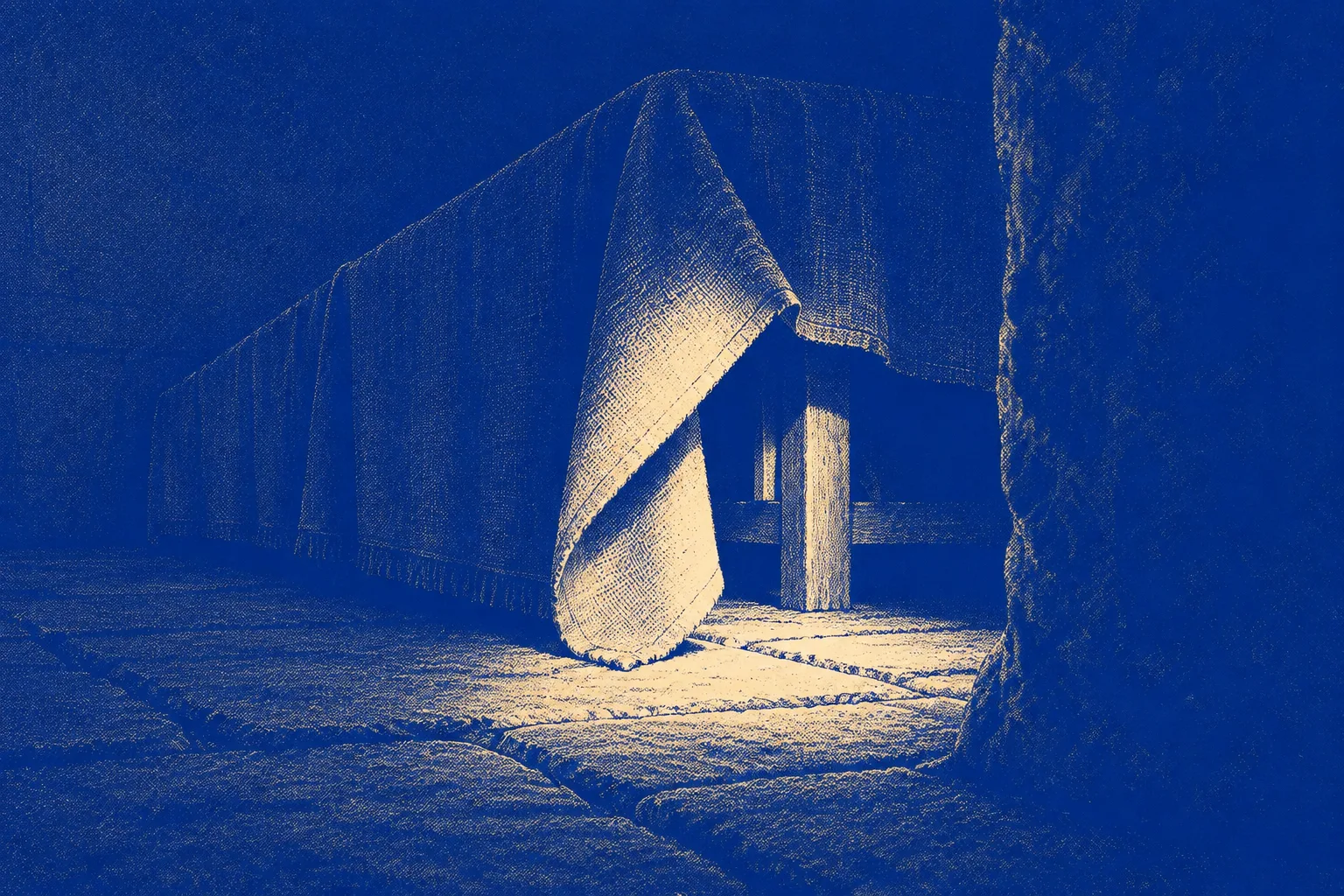
So Mephibosheth lived in Jerusalem, because he always ate at the king’s table, and he was lame in both feet.
2 Samuel 9:13 (BSB)
The verse the whole week has been walking toward. Both halves, unreconciled, in one sentence.
EU•AN•GE•LION (YOO-AN-GEL-EE-ON) · εὐαγγέλιον — Good News
EUANGELION is a product of WokeGod LLC. Copyright © 2026 WokeGod LLC. All rights reserved.v0.8.38TermsPrivacyCookie PolicyCommunity GuidelinesContent Disclaimer
EU•AN•GE•LION (YOO-AN-GEL-EE-ON) · εὐαγγέλιον — Good News
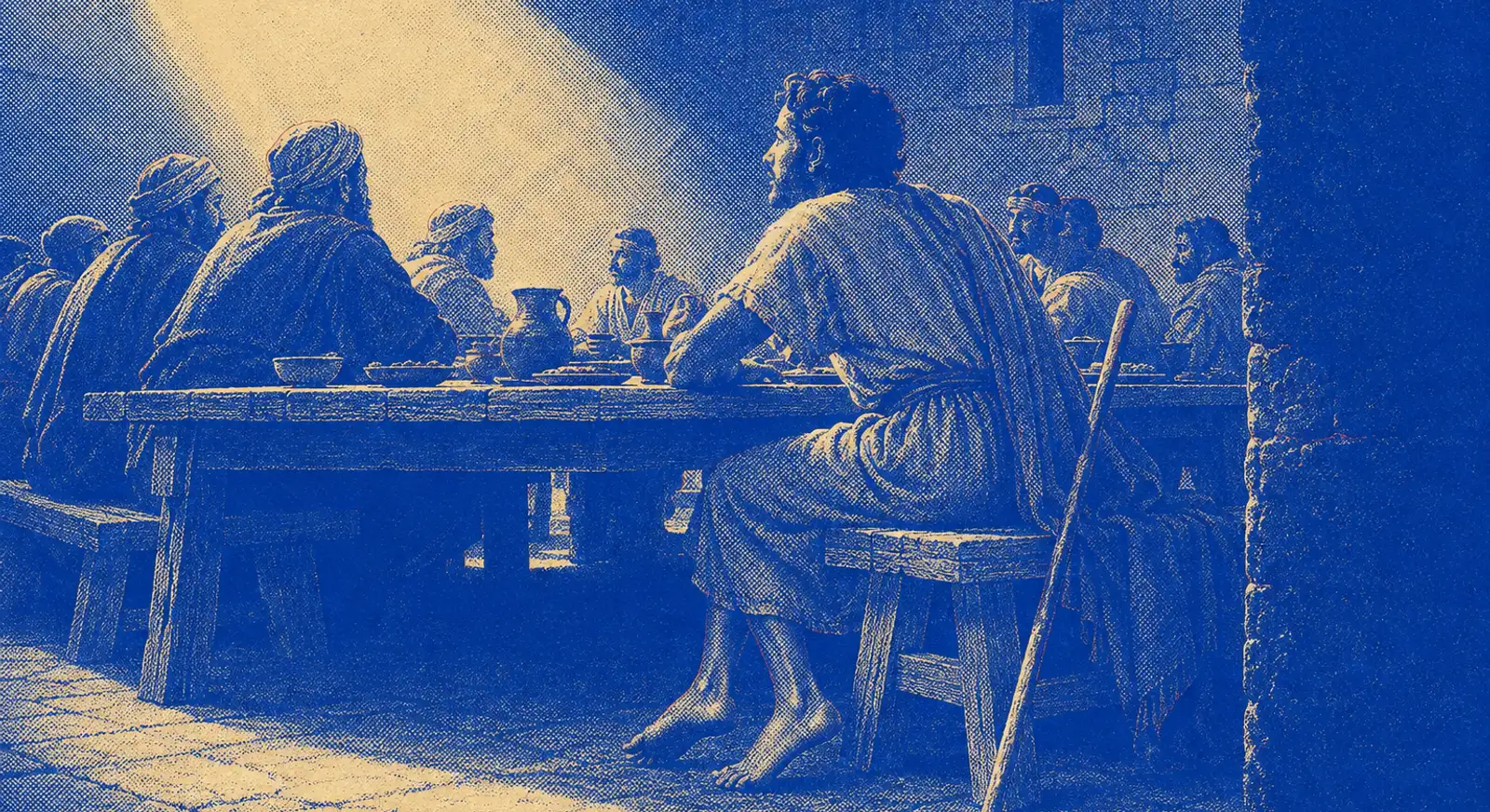
He always ate at the king’s table, and he was lame in both feet. Both halves, in one sentence, reconciled by nobody.
2 Samuel 9:13
Opening
So Mephibosheth lived in Jerusalem, because he always ate at the king’s table, and he was lame in both feet.
2 Samuel 9:13 (BSB)
The verse the whole week has been walking toward. Both halves, unreconciled, in one sentence.
Everything this week has been holding is in the last verse of 2 Samuel 9.
He always ate at the king's table. And he was lame in both feet.
That is the shape of the whole thing. A place that was given, and a condition that remained, sitting in the same sentence without either one cancelling the other.
If you only take one thing out of this week, take that verse and the way it refuses to tidy itself up.
REFLECT
Which of the five days did you most want to argue with?
A Two-Minute Prayer
God, thank You for a week that did not pretend. You sought, You paid, You came down, You began the repair, and You seated me. Let none of that become theory by Friday.
IN YOUR OWN WORDS
The Week
Sunday — Is There Anyone Left. A king who had won asked whether anyone survived the house that had hunted him. He was keeping a promise made years earlier to a friend who was already dead. Jonathan had asked him for exactly this, naming the moment it would be hardest: do not cut off your kindness from my household, not even when every enemy of yours has been removed.
The answer came back with a condition attached before a name — there is still a son of Jonathan, and he is lame in both feet.
The word for that condition, nekeh, occurs three times in the Hebrew Bible. Twice of him. Once in Isaiah 66:2, where God names the person He will look at.
Monday — What The Breach Costs. Reconciliation is not God changing His mind about us. Greek writers used Paul's verb of God being reconciled — an offended deity talked round. Paul turns it over: God reconciled us to Himself. Across the New Testament, God is never once said to be reconciled to us.
Chrysostom asked the question that settles it. Who was the aggrieved one? Himself.
And there is an accounting word in the middle of it. Not counting men's trespasses against them. The debts are real. They are simply not being charged, because they went somewhere else.
Tuesday — The God Who Comes Down Looking. Ezekiel 34 lists five things the shepherds of Israel failed to do, then repeats the same five as first-person promises. God does not appoint better shepherds. He goes Himself, into the clouds and darkness, into every place the flock was scattered.
That is the direction of every rescue in Scripture. Downward. A strong man stooping lower and lower to get underneath the load, in Lewis's image, almost disappearing under it before he straightens up.
Wednesday — Robe, Ring, Sandals. Rescue and rehabilitation are not the same thing. The father calls for three items and none of them is a comfort: the household's finest garment, a signet ring that confers authority, and shoes that distinguish a son from a barefoot servant. Standing, not consolation.
And the repair is slower than the rescue. Athanasius said the spoiled panel is not thrown away — the sitter returns so the likeness can be redone on the same wood. Howe, teaching Laura Bridgman, recorded the honest version in one clause: many weeks of apparently unprofitable labour.
Thursday — At The Table, Still Lame. God made alive, raised, and seated — three verbs, identical grammar, all completed, all with God as the subject. You cannot take the resurrection as settled and hold the seating in reserve.
And Augustine on the crown: God crowns His own gifts, not thy deservings.
Then the chapter's last clause, which we did not soften. There is no healing verb anywhere in 2 Samuel 9. What changed was not his feet. What changed is that his feet stopped being the first thing anyone said about him.
What We Deliberately Did Not Say
Four things are missing from this week on purpose, and it is worth naming them.
We did not say the tablecloth covered his feet. It is the most-quoted line about Mephibosheth in circulation and it has no source — not Scripture, not Spurgeon, not anyone. It also solves the wrong problem, by hiding the thing the text puts in its final four words.
We did not say Lo-debar means a barren wasteland. The etymology requires changing the vowels of the Hebrew, and the standard lexicon declines to translate the name at all. More decisively, Scripture tells us what was in Lo-debar: Machir, the man sheltering him, later provisions David's entire army with beds, grain, honey and cheese. Mephibosheth was not starving in a desert. He was hidden in a rich man's house, which is its own kind of lost.
We did not say he was a beggar. There is no word for beggar in biblical Hebrew. What the chapter gives him is land, servants to farm it, a household, and a table — patronage, not destitution.
We did not promise that the limp goes. Not in this life, and not on our authority. There is a promise about it, and it is in Isaiah 35:6, using the same word the end of 2 Samuel 9 uses. Then the lame will leap like a deer.
Then. Not yet. But then.
Further Your Learning
The passage trail. Read these in this order and the week rebuilds itself.
A guided read. Take 2 Samuel 9 alone, with a pen, and read it thinking about one question: who is the subject of each verb? Mark every action and note who performs it. David asks, David sends, David summons, David restores, David says. Mephibosheth falls on his face, and calls himself a dead dog, and eats. Then read the chapter again and notice how little the found man contributes to being found.
Free primary texts, all of them public domain.
The verified study set. Every video below was checked live this week — the title confirmed against YouTube's own record, and embedding confirmed. Several are retitled from what you may remember.
Carry This Into The Week
I will let one true thing about me stop being the first thing I say about myself.
LEAVING AT THE CROSS
RECEIVING FROM THE CROSS
Sources For The Week
RELATED SCRIPTURES
FOR DEEPER STUDY
Hebrew and Greek this week were checked against Strong’s and the BibleHub interlinear: nekeh H5223 (three occurrences — 2 Samuel 4:4, 9:3, Isaiah 66:2); chesed H2617, construct at 2 Samuel 9:3 and governed by asah H6213; pisseach H6455, thirteen occurrences including 2 Samuel 9:13 and Isaiah 35:6; rapha H7495, distinct from raphah H7503; atar H5849, intensive form at Psalm 103:4, with the noun atarah H5850 absent from that verse; katallagē G2643 and katallassō G2644, both Pauline only; huiothesia G5206, five occurrences, all Pauline, and absent from the Septuagint; synekathisen G4776, aorist active indicative, matching the two verbs beside it in Ephesians 2:5-6. Three widely-repeated claims were checked and rejected: that a tablecloth covered Mephibosheth’s feet (no source of any kind); that Lo-debar means no pasture (requires repointing; Brown-Driver-Briggs gives the name no meaning); and that Roman adoption cancelled the adoptee’s debts (refuted by the praetor’s edict at Digest 4.5.2.1 and by Gaius 3.84 and 4.38).
Finished reading? Mark this day read.
BEFORE YOU GO
Anything you want to keep from today?
EUANGELION is a product of WokeGod LLC. Copyright © 2026 WokeGod LLC. All rights reserved.v0.8.38TermsPrivacyCookie PolicyCommunity GuidelinesContent Disclaimer