We love because He first loved us.
1 John 4:19 (BSB)
Five words that set the order of everything else. Not a reward for loving. The reason we can.
EU•AN•GE•LION (YOO-AN-GEL-EE-ON) · εὐαγγέλιον — Good News
EUANGELION is a product of WokeGod LLC. Copyright © 2026 WokeGod LLC. All rights reserved.v0.8.37TermsPrivacyCookie PolicyCommunity GuidelinesContent Disclaimer
EU•AN•GE•LION (YOO-AN-GEL-EE-ON) · εὐαγγέλιον — Good News

The first word of the Bible has six letters. The outer four spell covenant. The two in the middle spell fire. A medieval rabbi counted them and wrote it down. Look what sits in this word.
Genesis 1:1
Opening
We love because He first loved us.
1 John 4:19 (BSB)
Five words that set the order of everything else. Not a reward for loving. The reason we can.
John does not write that God loves us back. He writes that God went first.
Sit with how much that removes. If God loved first, your love is not the cause of anything. It is an answer. You are responding to a voice that was already speaking before you knew there was anyone in the room.
Most of us learned it backwards. Reach hard enough and heaven leans in. Pray well enough and something opens. That arrangement is exhausting, and it has one hidden comfort: it keeps us in charge. If my effort starts the fire, my effort controls it.
John takes that away, and what he leaves in its place is far better. The fire was lit by somebody else. You did not strike it. You will not restart it by striking harder.
Which matters most on the mornings you feel nothing. If your love began this, a cold week is evidence against you. If His love began it, a cold week is a cold week. The ground has not moved.
We are standing at the very beginning of the story this week. Creation. Before the fall, before the promise, before the exile. Before anyone had done anything at all, God was already the one who moved first.
REFLECT
Think of one thing you have been trying to feel your way back into with God. Now ask it differently: what if that thing was never yours to start?
A Two-Minute Prayer
Father, You loved first. Before I knew, before I answered, before I could have earned a single thing. Let that be the ground I stand on today, and not my own warmth. Amen.
IN YOUR OWN WORDS
In the beginning God created the heaven and the earth.
Genesis 1:1 (KJV)
בְּרֵאשִׁית בָּרָא אֱלֹהִים
Seven words in Hebrew. The whole library rests on them. And the very first word is the one we are going to look at.
Hebrew is written in consonants. Vowel marks came later, added by scribes who wanted to preserve how the words had always been spoken. So a Hebrew word arrives as a run of letters, and a run of letters can hold a shape.
Here is the first word of the Bible.
בְּרֵאשִׁית
Six letters. Bet, resh, aleph, shin, yod, tav.
Take the outer four — the first two and the last two. Bet, resh, yod, tav.
בְּרִית. B'rit. Covenant.
What is left standing in the middle is aleph and shin.
אֵשׁ. Esh. Fire.
Covenant, wrapped around a flame. Sitting in the first word of the first sentence, before God has made anything at all.
Somebody counted these letters a long time before us. A medieval Jewish commentary, recovered from a manuscript in Aleppo, sets out the same six letters and the same split — and reads the covenant as circumcision and Sabbath, and the fire as Torah. That is their reading, and it is about why the world was made at all. What we are about to do with it is ours.
So look at it a moment longer.
Fire is the thing in Scripture that God keeps appearing as. A bush that burns and is not spent. A pillar that goes ahead of a nation at night. A torch moving through the dark between the pieces of a covenant, which is where we are going tomorrow. Fire on a mountain, fire on an altar that is never allowed to go out, fire that finally comes down and rests on ordinary heads.
And covenant is the thing God keeps binding Himself with. A promise. An oath. A word He will not take back.
Both of them, folded into six letters, at the head of everything.
Read the next sentence of Genesis and see what this word is sitting on top of.
The earth is formless. It is empty. Darkness lies over the face of the deep.
And over that surface, the Spirit of God hovers.
Not the language of conquest. The language of brooding — something settled close over what has not hatched yet.
So the opening scene of the Bible is God at close range over a dark and empty place, waiting, before a single word is spoken.
That is the sentence the first word sits at the head of. Covenant with fire inside it, and then immediately: darkness, depth, and God already near enough to hover.
Nothing in that scene has earned anything. Nothing in it has asked. There is no one there to be impressed. And He is already there, already close, already about to speak.
The fire is not something the covenant produces. It is something the covenant is wrapped around.
Now turn to the opening of John's Gospel.
In the beginning was the Word.
A first-century reader would not have heard a pleasant opening line. They would have heard a quotation. Those are the words Genesis starts with, and John has picked them up deliberately and set them down at the head of his own book.
Genesis: in the beginning, God made. John: in the beginning, the Word was.
And then John turns the whole library over. The Word was with God. The Word was God. And a few lines further on, the Word became flesh and lived among us.
So the Word is not a text. The Word is a Person, and He has a face.
Which collapses two things you have probably been carrying as separate chores. There is getting your relationship with God warm again. And there is getting back into Scripture. Most of us feel those as two obligations, and both feel heavy.
John will not let them stay apart. The book you have been avoiding is not a manual describing Him. It is Him. Opening it is not homework you complete so that a relationship can begin later. It is the relationship, happening.
There is a harder edge to that, and it is worth saying. If you have been reading and reading and feeling nothing, you may not have failed at a technique. You may have been treating a Person like a manual.
He has been in the room the whole time.
And when that Word finally speaks in Genesis, the first thing He calls for is light — before there is a sun to carry it, before there is anyone to see by it.
Light arrives three days before the thing that produces it.
Sit with that for a second. Whatever the light of the first day was, it did not come from the machinery we now depend on. It came before it, and independent of it.
Which is the pattern this whole week runs on. The light does not originate in the equipment. Not then, and not in you.
Then and Now
ANCIENT TRUTH
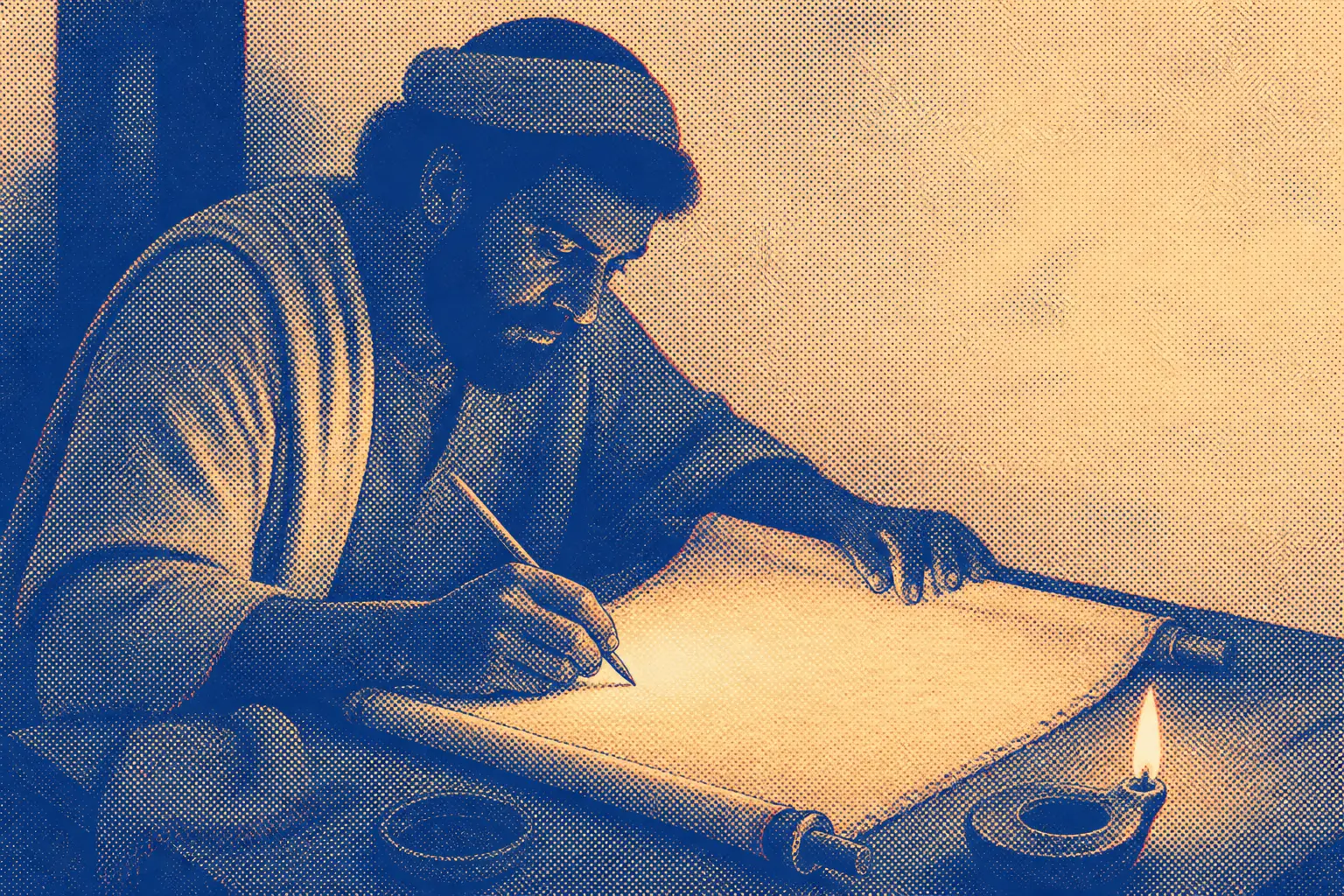
A scribe copying Genesis worked in consonants only, with no vowel marks and no spaces the way we use them. He looked at every letter individually because he had to. Getting one wrong meant starting the sheet again.
The pattern in bereshit is not hidden. It is simply too small to survive the speed we normally read at.
MODERN APPLICATION
We read fast, in translation, on a screen, usually while something else is loading. It is just a different relationship to the page — and it makes a word like this one invisible.
NEW TESTAMENT ECHO
Which may be why Jesus so often answers a question with “Have you not read?” — asked of people who had, in fact, read it.
There is a reason the week starts here.
If you are reading this at all, something has gone quiet. Perhaps prayer has thinned into a habit you perform. Perhaps a season changed underneath you — a job, a house, the shape of a family — and the faith that fit the old season does not seem to fit this one. Perhaps you opened a study, could not finish it, and the not-finishing has become a small private shame.
The instinct in that condition is to generate heat. Read more. Feel more. Be more disciplined.
Genesis will not let us begin there. Before anything is asked of anyone, God is already moving over a dark and formless place. Nothing had earned that. Nothing had asked for it. There was no one there to be impressed. The first thing Scripture tells you about God is that He moves first, into a situation with nothing to offer Him.
And John says: that same One walked into a room and had a face.
So the fire this week is not a fire you are being told to produce. It was burning before you arrived to see it. The covenant it sits inside was made without your signature. The love that began it went first, and it went first precisely so that none of it would depend on how you feel this morning.
That is either the most freeing sentence in the book or the most insulting one, depending on how badly you want to be the one who made it happen.
Most of us want that more than we admit. Being loved first is lovely in the abstract. In practice it means walking into a house you did not build, sitting at a table you did not set, and being handed a chair.
There is a word for that, and the word is grace, and almost nobody likes it at first.
When the shape of a life shifts, the practices that carried your faith usually go with it. The commute where you prayed is gone. The friends you talked to are elsewhere. The quiet hour belongs to something new. And because the practices went quiet, it is easy to conclude the thing underneath them went quiet too.
It usually did not. What went is the scaffolding, not the building. Those are very different losses, and mistaking one for the other has ended more faith than doubt ever has.
Genesis is unbothered by formlessness. It is the opening condition, not the emergency.
There is one more thing in that opening scene, and it is easy to walk past because it is so quiet.
God speaks light into existence, looks at it, and calls it good. Then He separates it from the darkness. He does not abolish the dark. He gives it a border and a name and lets it stay.
Evening and morning. Both of them, every day, from the first one.
Which means the nights in your life are not a failure of the design. They were written into it on the opening page, before anything had gone wrong, while everything was still being called good.
You are not in the dark because something broke. You may simply be in the half of the day that has always been there — and the light that ends it was never yours to switch on.
A Woman Teaching Her Children Under the Sky
In Ulster County, New York, near the end of the eighteenth century, a woman known as Mau-mau Bett was enslaved on the Ardinburgh farm. She had ten or twelve children. Most had been sold before her youngest daughter could remember them.
When the owner died, the girl — Isabella, who would take the name Sojourner Truth much later — began finding her mother crying. She asked why. Her mother said she was thinking of the children who had been sold away.
Then, under the night sky, Mau-mau Bett gathered the children she still had and taught them. She spoke in Low Dutch, the only language she had.
“My children, there is a God, who hears and sees you.” The children asked where he lived. “He lives in the sky,” she said, “and when you are beaten, or cruelly treated, or fall into any trouble, you must ask help of him, and he will always hear and help you.” She taught them to kneel and say the Lord’s Prayer.
Isabella was sold at nine years old for one hundred dollars, in a lot with sheep.
Decades later she was still praying that prayer in Low Dutch, as taught her by her mother. She did not light that. It was handed to her, in the dark, by a woman with almost nothing left to hand anyone.
A fire lit by someone else, in conditions that should have made it impossible, still burning long after the one who lit it was gone.
What Gets Handed Down
Isabella could not read. Everything she knew of God arrived by voice, at night, in a language she would later lose daily use of, from a woman who had already lost most of her children. That is how most faith travels. Not through argument. Through somebody who has almost nothing left deciding to hand you the one thing they still have. She was still praying that prayer decades later, in Low Dutch, as taught her by her mother. The woman who taught it never saw a single day of it.
HISTORICAL CONTEXT
Olive Gilbert, Narrative of Sojourner Truth: A Northern Slave, Boston, 1850.
Here is the shape of the next six days.
Tomorrow we watch God make a promise to a man who is asleep for it — a torch moving alone down an aisle in the dark while the other party lies unconscious in the grass. On the third day we find the word this week is named for, and it turns out Paul used it exactly once, writing to somebody young and frightened whose faith had reached him through his grandmother. Then a day about coming to the fire as a lamb rather than as its keeper. Then a day about lamps going out, which is the honest one. Then we gather it, and then we rest.
None of those days will ask you to work up a feeling.
What they ask is smaller and harder. To stop treating your own warmth as the measurement. To notice that the thing you are trying to restart has been burning in the dark the whole time, kept by Someone who does not need you awake to keep it.
One practical word before you go. You do not need to finish this week to receive something from it. of how this particular fire behaves — it does not require an unbroken streak, and the day you miss is not a reset.
Say that out loud now, at the start, because on about day four most people miss one and quietly stop.
In the beginning was the Word, and the Word was with God, and the Word was God.
John 1:1 (KJV)
Chosen in the King James here for one reason: it opens with exactly the same three words as its Genesis translation, so the echo John built is visible on the page instead of buried in a paraphrase.
REFLECT
Somebody handed you whatever faith you have — a parent, a friend, a stranger, a book. Who was it, and have you ever actually thanked them?
A Breath to Carry Today
This one is short on purpose. Say the first line as you breathe in, the second as you breathe out. Do it four or five times, slowly, and then stop.
One word. Six letters. Covenant on the outside, fire in the middle.
It will not win an argument. It is closer to something you notice on a wall you have walked past a thousand times, and once you have seen it you cannot stop seeing it.
And it is a fair picture of the week. The fire is real. It is small. It is surrounded on every side by an agreement you did not negotiate, made by Someone who went first, and it has been burning since the first word of the first sentence.
You do not have to feel it today. Nothing here is asking you to.
Tomorrow the sun goes down, a deep sleep falls on a man named Abram, and God walks through the dark alone.
Closing Prayer
God of the beginning,
Before there was anything to love, You were already moving over the dark. Before I knew Your name, You knew mine. I did not start this and I cannot end it.
I have spent a long time trying to be warm enough to deserve You. I am tired of it. Teach me the other order — Yours first, mine after.
And where the fire in me has gone quiet, let me stop striking at it long enough to notice it never actually went out.
In the name of the Word who came and stood in a body. Amen.
BREATH PRAYER
You loved first / I am answering
IN YOUR OWN WORDS
Carry This
I will stop measuring my standing with God by how much I feel today.
LEAVING AT THE CROSS
RECEIVING FROM THE CROSS
Check Yourself
Why does John open his Gospel with the words “In the beginning”?
The Readers Who Saw It First
Medieval; recovered from a manuscript in Aleppo and printed in Vienna, 1894
We do not know who assembled this collection. What survives is a manuscript that surfaced in Aleppo and was edited and published in the nineteenth century. Its comment on Genesis 1:1 sets out the same six letters, the same split, the same two words.
Bet, resh — the head of the word. Yod, tav — the end of the word. And that is covenant.
LESSON FOR US
Somebody sat with the first word of the Bible long enough to count its letters, and then wrote down what they found so it would not be lost. That is the whole practice, and it is still available to anyone willing to slow down.
Go Deeper
RELATED SCRIPTURES
FOR DEEPER STUDY
Sources for today — Midrash Aggadah (ed. Buber, Vienna 1894), Genesis 1:1:6, for the letter pattern. Olive Gilbert, Narrative of Sojourner Truth: A Northern Slave, Boston, 1850, for the account of Mau-mau Bett’s teaching, dictated by Truth and written in the third person by Gilbert. Hebrew glosses checked against Strong’s H7225 (reshit), H784 (esh) and H1285 (b’rit).
Finished reading? Mark this day read.
BEFORE YOU GO
Anything you want to keep from today?
EUANGELION is a product of WokeGod LLC. Copyright © 2026 WokeGod LLC. All rights reserved.v0.8.37TermsPrivacyCookie PolicyCommunity GuidelinesContent Disclaimer